


Dietary Diversity and Undernutrition in Children Aged 6-23 Months in Sub-Saharan Africa
- PMID: 34684435
- PMCID: PMC8537414
- DOI: 10.3390/nu13103431
Dietary Diversity and Undernutrition in Children Aged 6-23 Months in Sub-Saharan Africa
Abstract
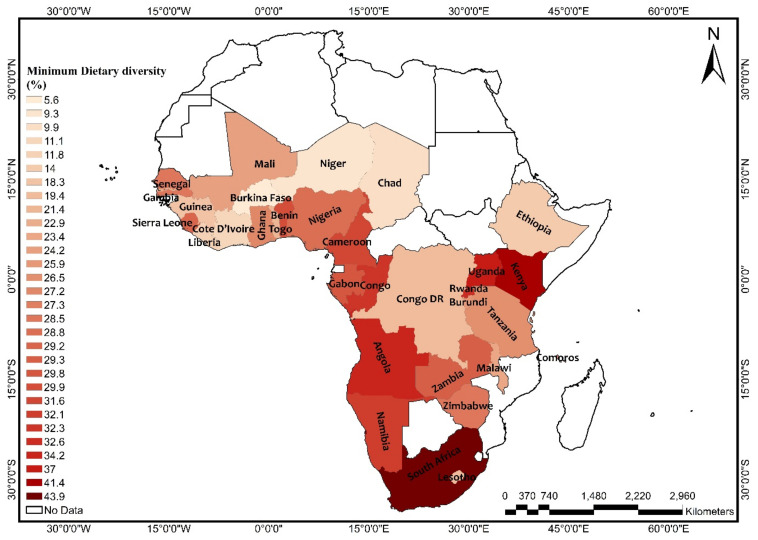
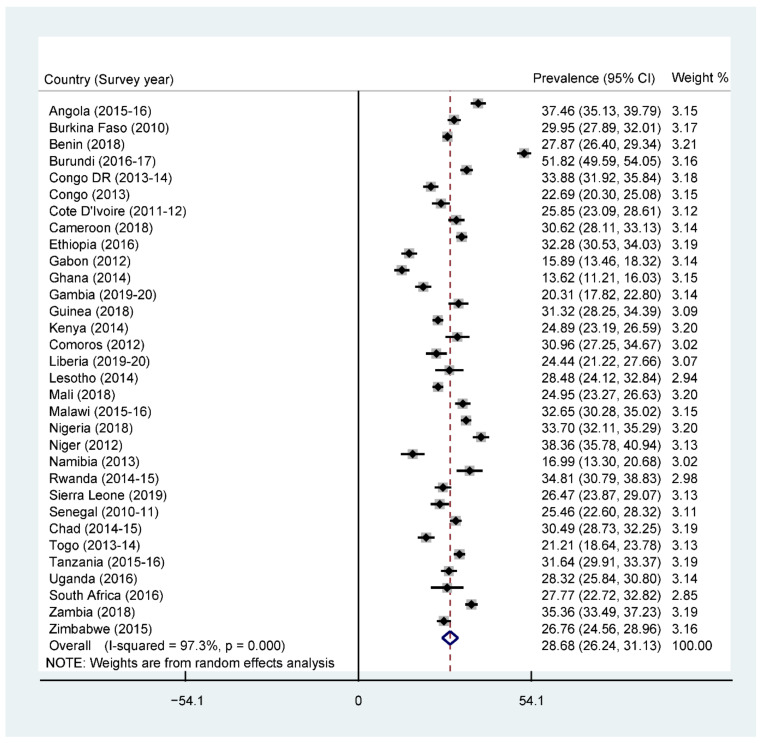
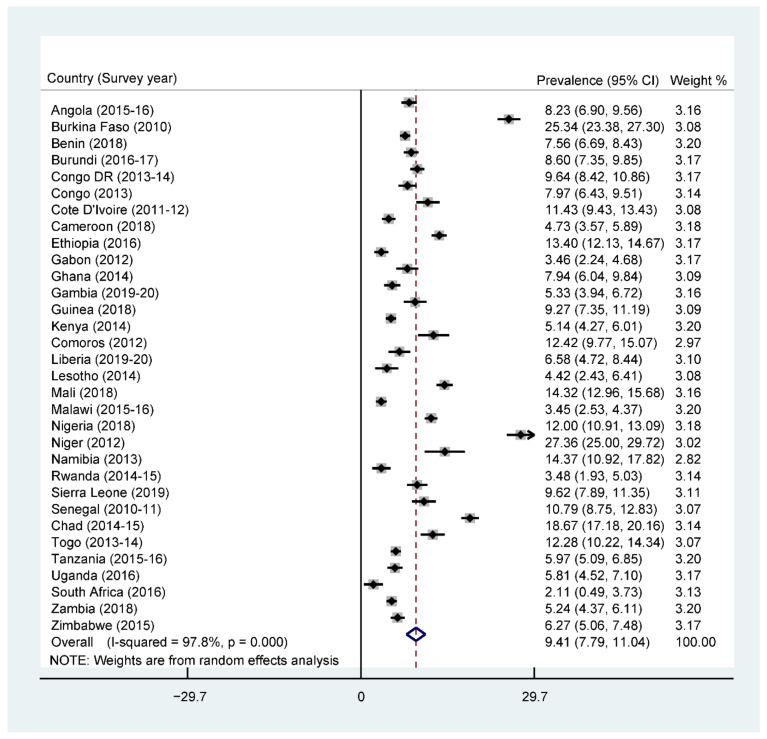
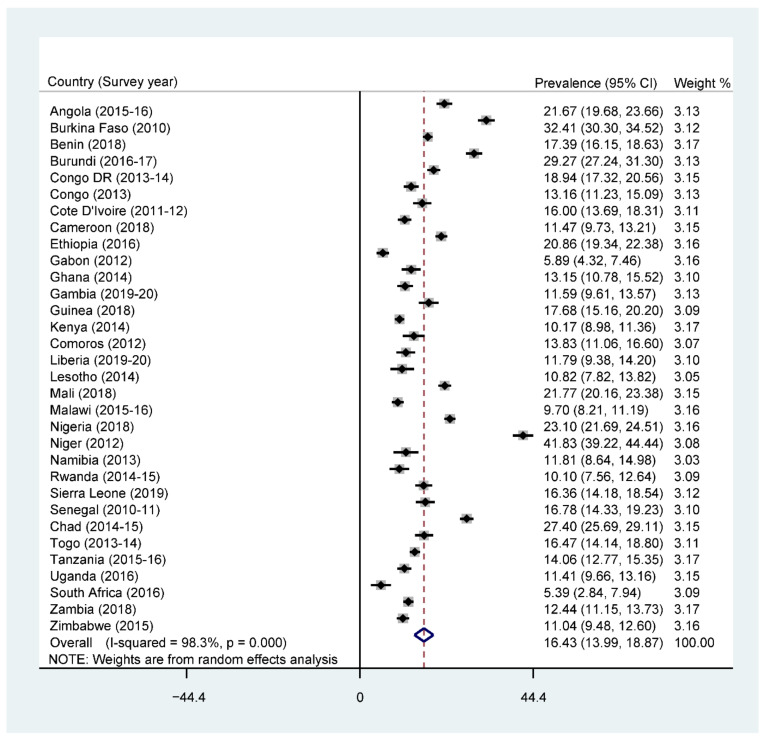
Dietary diversity plays a major role in the health status of children. However, evidence on its crucial role on children's health status remains inconclusive in sub-Saharan Africa (SSA). In this study, we examined the association between dietary diversity and undernutrition among children aged 6-23 months in SSA. We pooled data from the most recent Demographic and Health Surveys of 32 countries in SSA from 2010 to 2020. A sample of 48,968 mother-child pairs of children within the ages of 6-23 months and mothers aged 15-49 years were included in this study. Multilevel logistic regression analysis was carried out to examine the association between dietary diversity and stunting, wasting, and underweight. The results were presented as crude odds ratios (cOR) and adjusted odds ratios (aOR) with their 95% confidence intervals. Statistical significance was set at p < 0.05. The overall prevalence of minimum dietary diversity was 25.1%, with South Africa recording the highest prevalence (43.9%) and Burkina Faso recording the lowest prevalence (5.6%). The highest prevalence of stunting was recorded by Burundi (51.8%) while the lowest prevalence was found in Ghana (13.6%), with an overall regional prevalence of 28.6%. For wasting, prevalence from all countries was found to be 9.4%. South Africa recorded the lowest prevalence of wasting (2.1%) while Niger recorded the highest prevalence (27.3%). Lastly, the prevalence of underweight ranged from 5.3% in South Africa to 41.8% in Niger, with an all-country prevalence of 16.4%. Children who had adequate minimum dietary diversity had 12% less likelihood of being stunted (aOR = 0.88, 95% CI = 0.83, 0.94), compared to those who had inadequate minimum dietary diversity. Having an adequate minimum dietary diversity significantly lowered the risk of underweight among children by 17% (aOR = 0.83, 95% CI = 0.77, 0.91). Having an adequate minimum dietary diversity was associated with 13% reduced odds of wasting among children (aOR = 0.87, 95% CI = 0.78, 0.97), compared to those who had inadequate minimum dietary diversity. This study highlights the significant association between minimum dietary diversity and stunting, wasting, and underweight among 6-23 month-old children in SSA. There is an urgent need for additional nutrition-specific interventions and strengthening of existing interventions aimed at improving infant and young child feeding practices, including complementary feeding practices among children aged 6-23 months in the 32 countries in SSA. Such interventions should focus more on countries where the prevalence of adequate minimum dietary diversity was low and undernutrition was high.
Keywords: dietary diversity; stunting; sub-Saharan Africa; undernutrition; underweight; wasting.
Conflict of interest statement
The authors declare no competing interests.
Figures
References
-
- United Nations . Sustainable Development Goals. United Nations; New York, NY, USA: 2015.
-
- Gatica-Domínguez G., Neves P.A.R., Barros A.J.D., Victora C.G. Complementary Feeding Practices in 80 Low- and Middle-Income Countries: Prevalence of and Socioeconomic Inequalities in Dietary Diversity, Meal Frequency, and Dietary Adequacy. J. Nutr. 2021;151:1956–1964. doi: 10.1093/jn/nxab088. - DOI - PMC - PubMed
MeSH terms
LinkOut - more resources
Full Text Sources
Medical
Research Materials
