


Trajectories of Energy Intake Distribution and Risk of Dyslipidemia: Findings from the China Health and Nutrition Survey (1991-2018)
- PMID: 34684489
- PMCID: PMC8538511
- DOI: 10.3390/nu13103488
Trajectories of Energy Intake Distribution and Risk of Dyslipidemia: Findings from the China Health and Nutrition Survey (1991-2018)
Abstract
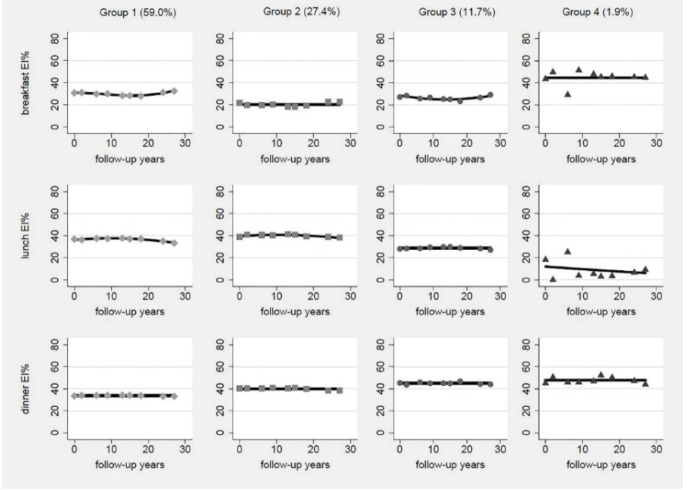
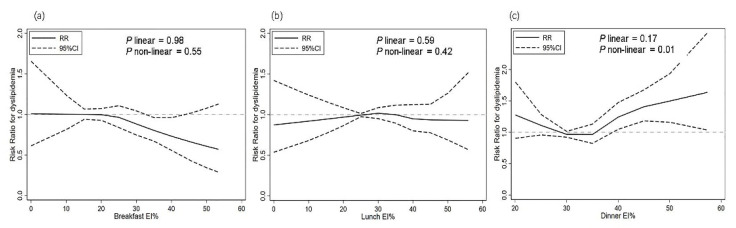
Few studies have examined the secular trend of energy intake distribution. This study aims to describe trajectories of energy intake distribution and determine their association with dyslipidemia risk. Data of 2843 adult participants from the China Health and Nutrition Survey (CHNS) were analyzed. Trajectory groups of energy intake distribution were identified by multi-trajectory model over 27 years. Multilevel mixed-effects modified Poisson regression with robust estimation of variance was used to calculate risk ratio for incident dyslipidemia in a 9-year follow-up. Four trajectory groups were identified: "Energy evenly distributed group" (Group 1), "Lunch and dinner energy dominant group" (Group 2), "Dinner energy dominant group" (Group 3), "breakfast and dinner energy dominant group" (Group 4). Compared with Group 1, Group 3 was associated with higher risk of dyslipidemia (RR = 1.48, 95% CI = 1.26, 1.75), hypercholesterolemia (RR = 1.96, 95% CI = 1.37, 2.81) and high low-density lipoproteins cholesterols (LDL-C) (RR = 2.41, 95% CI = 1.82, 3.20). A U-shape was observed between cumulative average proportion of dinner energy and dyslipidemia risk (p for non-linear = 0.01), with stronger relationship at 40% and above. Energy intake distribution characterized by higher proportion of dinner energy, especially over 40% was associated with higher dyslipidemia risk in Chinese adults.
Keywords: cohort; dyslipidemia; energy intake; multi-trajectory model.
Conflict of interest statement
The authors declare no conflict of interest.
Figures
References
-
- Ference B.A., Ginsberg H.N., Graham I., Ray K.K., Packard C.J., Bruckert E., Hegele R.A., Krauss R.M., Raal F.J., Schunkert H., et al. Low-density lipoproteins cause atherosclerotic cardiovascular disease. 1. Evidence from genetic, epidemiologic, and clinical studies. A consensus statement from the European Atherosclerosis Society Consensus Panel. Eur. Heart J. 2017;38:2459–2472. doi: 10.1093/eurheartj/ehx144. - DOI - PMC - PubMed
-
- Nagasawa S.Y., Okamura T., Iso H., Tamakoshi A., Yamada M., Watanabe M., Murakami Y., Miura K., Ueshima H. Evidence for Cardiovascular Prevention from Observational Cohorts in Japan Research, G. Relation between serum total cholesterol level and cardiovascular disease stratified by sex and age group: A pooled analysis of 65 594 individuals from 10 cohort studies in Japan. J. Am. Heart Assoc. 2012;1:e001974. doi: 10.1161/JAHA.112.001974. - DOI - PMC - PubMed
MeSH terms
Grants and funding
- 2019YFC1605100/National Key R&D Program of China
- R01-HD30880, DK056350, R24 HD050924, and R01-HD38700/National Institutes of Health, USA (NIH)
- D43TW007709 and D43TW009077/Fogarty International Center, USA (NIH)
- P2CHD050924, T32HD007168/The Carolina Population Center, University of North Carolina at Chapel Hill
- 13103110700015005/The Ministry of Finance of the Republic of China
LinkOut - more resources
Full Text Sources
