


Metabolic Syndrome and Sarcopenia
- PMID: 34684520
- PMCID: PMC8541622
- DOI: 10.3390/nu13103519
Metabolic Syndrome and Sarcopenia
Abstract
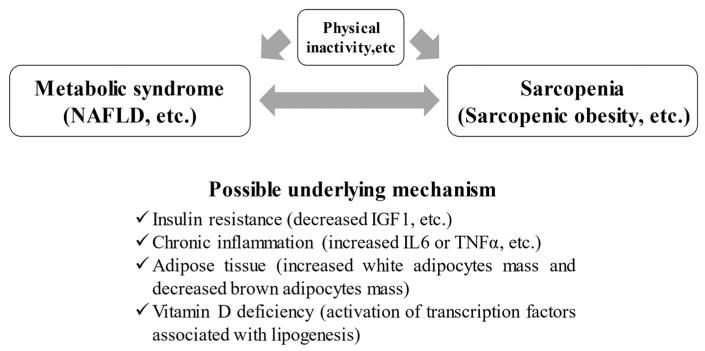
Skeletal muscle is a major organ of insulin-induced glucose metabolism. In addition, loss of muscle mass is closely linked to insulin resistance (IR) and metabolic syndrome (Met-S). Skeletal muscle loss and accumulation of intramuscular fat are associated with a variety of pathologies through a combination of factors, including oxidative stress, inflammatory cytokines, mitochondrial dysfunction, IR, and inactivity. Sarcopenia, defined by a loss of muscle mass and a decline in muscle quality and muscle function, is common in the elderly and is also often seen in patients with acute or chronic muscle-wasting diseases. The relationship between Met-S and sarcopenia has been attracting a great deal of attention these days. Persistent inflammation, fat deposition, and IR are thought to play a complex role in the association between Met-S and sarcopenia. Met-S and sarcopenia adversely affect QOL and contribute to increased frailty, weakness, dependence, and morbidity and mortality. Patients with Met-S and sarcopenia at the same time have a higher risk of several adverse health events than those with either Met-S or sarcopenia. Met-S can also be associated with sarcopenic obesity. In this review, the relationship between Met-S and sarcopenia will be outlined from the viewpoints of molecular mechanism and clinical impact.
Keywords: insulin resistance; mechanism; metabolic syndrome; outcome; sarcopenia; sarcopenic obesity.
Conflict of interest statement
The authors declare no conflict of interest.
Figures
References
-
- [(accessed on 5 July 2021)]. Available online: https://www.mhlw.go.jp/toukei/list/81-1a.html.
-
- [(accessed on 5 July 2021)]. Available online: http://www.e-healthnet.mhlw.go.jp/information/food/e-02-001.html.
-
- Chen L.-K., Woo J., Assantachai P., Auyeung T.-W., Chou M.-Y., Iijima K., Jang H.C., Kang L., Kim M., Kim S., et al. Asian working group for sarcopenia: 2019 consensus update on sarcopenia diagnosis and treatment. J. Am. Med. Dir. Assoc. 2020;21:300–307.e2. doi: 10.1016/j.jamda.2019.12.012. - DOI - PubMed
-
- Nishikawa H., Shiraki M., Hiramatsu A., Moriya K., Hino K., Nishiguchi S. Japan society of hepatology guidelines for sarcopenia in liver disease (1st edition): Recommendation from the working group for creation of sarcopenia assessment criteria. Hepatol. Res. 2016;46:951–963. doi: 10.1111/hepr.12774. - DOI - PubMed
Publication types
MeSH terms
LinkOut - more resources
Full Text Sources
Medical
Miscellaneous
