. 2021 Oct 13;13(10):3577.
doi: 10.3390/nu13103577.

Melatonin Prevents T Lymphocyte Infiltration to the Kidneys of Hypertensive Rats, Induced by a High-Salt Diet, by Preventing the Expression of CXCR3 Ligand Chemokines

Affiliations

Melatonin Prevents T Lymphocyte Infiltration to the Kidneys of Hypertensive Rats, Induced by a High-Salt Diet, by Preventing the Expression of CXCR3 Ligand Chemokines

Ariel Bier et al. Nutrients. .

Abstract

In a previous study, we demonstrated that melatonin prevents kidney damage in a salt-induced hypertension model by decreasing oxidative stress. We hypothesized that this effect involves melatonin's immunomodulatory properties. In vivo Study-Dahl salt-sensitive (DSS) rats were fed normal chow, a high-salt diet (HSD), or a HSD and melatonin (30 mg/kg/day) in their water for eight weeks. Kidneys were harvested for immediate lymphocyte isolation and characterization by Flow cytometry (CD3+CD4+ and CD3+CD8+) and for lymphocyte chemoattractant (mainly CXCL chemokines) gene expression studies. In vitro study-rat mesangial cells (RMC) were cultured in a high-salt medium without and with melatonin. A HSD was associated with significant renal infiltration of CD4+ and CD8+ T lymphocytes compared to control. Melatonin significantly reduced renal lymphocyte infiltration. A HSD significantly increased mRNA expression of CXCL chemokines. Adding melatonin to the HSD abolished this effect. Treating RMC cells with salt increased the expression of CXCL10 and CXCL11 but not CXCL9. Adding melatonin to the culture media prevented this increase. Treating HSD-fed rats with melatonin decreased renal lymphocyte chemoattractant mRNA expression and is associated with significantly reducing renal T lymphocyte infiltration. Salt may have a direct effect on chemokine-producing renal cells, which is blunted by melatonin treatment.

Keywords: CXCL 10; CXCL 11; CXCL 9; T-lymphocytes; hypertension; kidney; melatonin; salt.


Conflict of interest statement

The authors declare no conflict of interest.

Figures
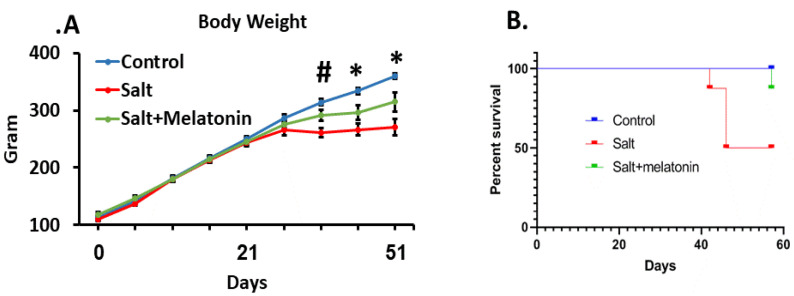
Figure 1
Figure 1
Melatonin ameliorated blood pressure and survival in HSD. DSS Rats were treated for 9 weeks with HSD with and without melatonin. High-salt diet reduced body weight from day 36 and melatonin moderated this effect (A). HSD increased mortality rate from day 40. Treating HSD-fed rats with melatonin improve their survival. (B). (n = 8) *-p ≤ 0.05 salt and salt+melatonin versus control. #-p ≤ 0.05 salt versus control and salt+melatonin. HSD—high-salt diet.
Figure 2
Figure 2
Melatonin prevent T cells infiltration to the kidney. T cells were isolated from rats’ kidneys and were gated for CD3. The CD3-positive cells were gated for CD4 and CD8. Melatonin (C) reduced both CD3+CD4+ and CD3+CD8+ as compart to HSD without melatonin (B) with no different from the control group (A). An analysis for all rats is shown in (D) (n = 7–8). HSD—high-salt diet. *-p ≤ 0.05 versus control. #-p ≤ 0.05 versus salt+melatonin.
Figure 3
Figure 3
Upregulation of kidney’s chemokines in HSD with and without melatonin. The expression of chemokine (C-X-C motif) ligand (CXCL) family (A), chemokine (C-C motif) ligand family and CX3CL1 (B) were determined in the rats. (n = 7–8) *-p ≤ 0.05 versus control. #-p ≤ 0.05 versus salt+melatonin. HSD—high-salt diet.
Figure 4
Figure 4
Salt upregulated CXCL10 and CXCL11 expression in mesangial cell line where melatonin treatment downregulated its expression. RMC (rats’ mesangial cell line) were treated with salt 80 mM with and without 0.5 mM melatonin. CXCL10 (A) and CXCL11 (B) were upregulated by salt treatment and the addition of melatonin reduce this upregulation. The graphs present 6 independent trials. *-p ≤ 0.001 versus control #-p ≤ 0.005 versus salt 80 mM and melatonin 0.5 mM. $-p ≤ 0.05 versus salt 80 mM and melatonin 0.5 mM.

References

    1. Olsen M.H., Angell S.Y., Asma S., Boutouyrie P., Burger D., Chirinos J.A., Damasceno A., Delles C., Gimenez-Roqueplo A.P., Hering D., et al. A call to action and a lifecourse strategy to address the global burden of raised blood pressure on current and future generations: The Lancet Commission on hypertension. Lancet. 2016;388:2665–2712. doi: 10.1016/S0140-6736(16)31134-5. - DOI - PubMed
    1. O’Brien E. The Lancet Commission on hypertension: Addressing the global burden of raised blood pressure on current and future generations. J. Clin. Hypertens. 2017;19:564–568. doi: 10.1111/jch.12998. - DOI - PMC - PubMed
    1. O’Donnell M., Mente A., Yusuf S. Sodium intake and cardiovascular health. Circ. Res. 2015;116:1046–1057. doi: 10.1161/CIRCRESAHA.116.303771. - DOI - PubMed
    1. Schiffrin E.L. Mechanisms of remodelling of small arteries, antihypertensive therapy and the immune system in hypertension. Clin. Investig. Med. 2015;38:E394–E402. doi: 10.25011/cim.v38i6.26202. - DOI - PubMed
    1. Guzik T.J., Hoch N.E., Brown K.A., McCann L.A., Rahman A., Dikalov S., Goronzy J., Weyand C., Harrison D.G. Role of the T cell in the genesis of angiotensin II induced hypertension and vascular dysfunction. J. Exp. Med. 2007;204:2449–2460. doi: 10.1084/jem.20070657. - DOI - PMC - PubMed
