


Enhancement of Phytosterol and Triterpenoid Production in Plant Hairy Root Cultures-Simultaneous Stimulation or Competition?
- PMID: 34685836
- PMCID: PMC8541584
- DOI: 10.3390/plants10102028
Enhancement of Phytosterol and Triterpenoid Production in Plant Hairy Root Cultures-Simultaneous Stimulation or Competition?
Abstract
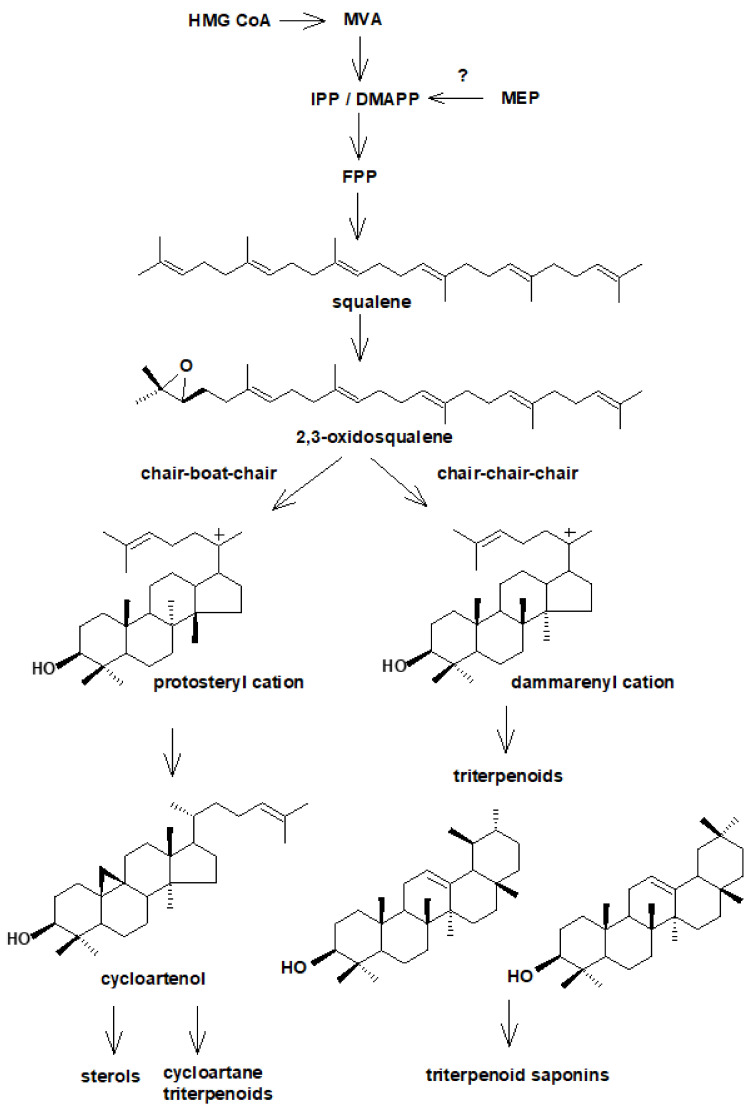
Plant in vitro cultures, including hairy roots, can be applied for controlled production of valuable natural products, such as triterpenoids and sterols. These compounds originate from the common precursor squalene. Sterols and triterpenoids distinctly differ in their functions, and the 2,3-oxidosqualene cyclization step is often regarded as a branch point between primary and secondary (more aptly: general and specialized) metabolism. Considering the crucial role of phytosterols as membrane constituents, it has been postulated that unconstrained biosynthesis of triterpenoids can occur when sterol formation is already satisfied, and these compounds are no longer needed for cell growth and division. This hypothesis seems to follow directly the growth-defense trade-off plant dilemma. In this review, we present some examples illustrating the specific interplay between the two divergent pathways for sterol and triterpenoid biosynthesis appearing in root cultures. These studies were significant for revealing the steps of the biosynthetic pathway, understanding the role of particular enzymes, and discovering the possibility of gene regulation. Currently, hairy roots of many plant species can be considered not only as an efficient tool for production of phytochemicals, but also as suitable experimental models for investigations on regulatory mechanisms of plant metabolism.
Keywords: hairy roots; plant in vitro cultures; saponins; squalene cyclization; sterols; triterpenoids.
Conflict of interest statement
The authors declare no conflict of interest.
Figures
References
-
- Bensaddek L., Villarreal M.L., Fliniaux M.A. Induction and growth of hairy roots for the production of medical compounds. Electron. J. Integr. Biosci. 2008;3:2–9.
-
- Chandra S., Chandra R. Engineering secondary metabolite production in hairy roots. Phytochem. Rev. 2011;10:371–375. doi: 10.1007/s11101-011-9210-8. - DOI
-
- Li P., Lou J., Mou Y., Sun W., Shan T., Zhou L. Effects of oligosaccharide elicitors from endophyitc Fusarium oxysporum Dzf17 on diosgenin accumulation in Dioscorea zingiberensis seedling cultures. J. Med. Plants Res. 2012;6:5128–5134.
-
- Sivanandhan G., Selvaraj N., Ganapathi A., Manickavasagam M. Enhanced biosynthesis of withanolides by elicitation and precursor feeding in cell suspension culture of Withania somnifera (L.) Dunal in shake-flask culture and bioreactor. PLoS ONE. 2014;9:e104005. doi: 10.1371/journal.pone.0104005. - DOI - PMC - PubMed
Publication types
LinkOut - more resources
Full Text Sources
