. 2021 Oct 22;11(1):20915.
doi: 10.1038/s41598-021-00440-1.

Metagenomic detection and characterisation of multiple viruses in apparently healthy Australian Neophema birds

Affiliations

Metagenomic detection and characterisation of multiple viruses in apparently healthy Australian Neophema birds

Subir Sarker. Sci Rep. .

Abstract

Emerging viral pathogens are a significant concern, with potential consequences for human, animal and environmental health. Over the past several decades, many novel viruses have been found in animals, including birds, and often pose a significant threat to vulnerable species. However, despite enormous interest in virus research, little is known about virus communities (viromes) in Australian Neophema birds. Therefore, this study was designed to characterise the viromes of Neophema birds and track the evolutionary relationships of recently emerging psittacine siadenovirus F (PsSiAdV-F) circulating in the critically endangered, orange-bellied parrot (OBP, Neophema chrysogaster), using a viral metagenomic approach. This study identified 16 viruses belonging to the families Adenoviridae, Circoviridae, Endornaviridae, Picobirnaviridae and Picornaviridae. In addition, this study demonstrated a potential evolutionary relationship of a PsSiAdV-F sequenced previously from the critically endangered OBP. Strikingly, five adenoviral contigs identified in this study show the highest identities with human adenovirus 2 and human mastadenovirus C. This highlights an important and unexpected aspects of the avian virome and warrants further studies dedicated to this subject. Finally, the findings of this study emphasise the importance of testing birds used for trade or in experimental settings for potential pathogens to prevent the spread of infections.


Conflict of interest statement

The author declares no competing interests.

Figures

Figure 1
Figure 1
The phylogenetic tree shows the possible evolutionary relationship of PsSiAdV-F strain S10/AU with other selected AdVs. The maximum likelihood (ML) tree was constructed by using concatenated amino acid sequences of the complete DNA-dependent DNA polymerase, pTP, penton and hexon genes. Concatenated protein sequences were aligned with MAFTT (version 7.450) in Geneious (version 10.2.2, Biomatters, Ltd., Auckland, New Zealand), under the BLOSUM62 scoring matrix and gap open penalty = 1.53. The gap > 20 residues deleted from the alignments. The ML tree was constructed under the WAG substitution model, and 1000 bootstrap re-samplings using tools available in CLC Genomics Workbench (version 9.5.4). The numbers on the left show bootstrap values as percentages, and the labels at branch tips refer to original AdVs host species followed by AdVs name and GenBank accession numbers in parentheses. The clade correspondence to the genus Siadenovirus is highlighted in pink, and the PsSiAdV-F sequenced in this study is shown in the blue box.
Figure 2
Figure 2
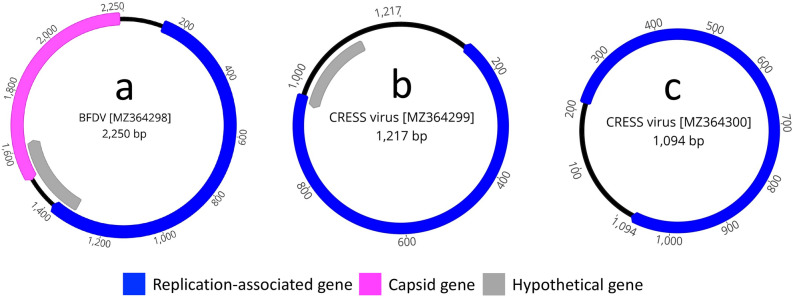
The whole genome sequence structure of circular viruses isolated from Neophema bird species. The arrows symbolise genes and open reading frames (ORFs), with orientation indicating their direction of transcription. Each gene or ORF is colour-coded, as indicated by the key in the legend.
Figure 3
Figure 3
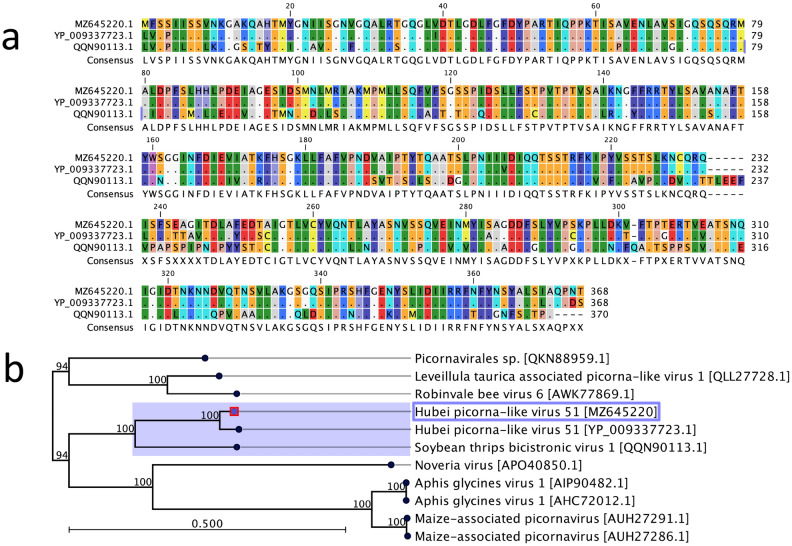
Comparison of picorna-like virus detected in this study (GenBank accession no. MZ645220) with other selected picorna-like viruses of the family Picornaviridae. (a) Multiple alignments of the selected amino acid sequences were performed using tools available in CLC Genomics Workbench (version 9.5.4), where dots represent those amino acids identical to the picorna-like virus detected in this study. (b) A maximum likelihood (ML) tree was constructed by using selected amino acid sequences of the partial hypothetical protein 1 gene of Hubei picorna-like virus. The ML tree was constructed under the WAG substitution model, and 1000 bootstrap replicates using tools available in CLC Genomics Workbench (version 9.5.4). The numbers on the left show bootstrap values as percentages, and the labels at branch tips refer to original picorna virus names, followed by GenBank accession numbers in parentheses. The clade correspondence to the picorna-like virus sequence from this study is highlighted in purple, and the picorna-like virus sequenced in this study is shown in the purple box.

References

    1. Lupiani B, Reddy SM. The history of avian influenza. Comp. Immunol. Microbiol. Infect. Dis. 2009;32:311–323. doi: 10.1016/j.cimid.2008.01.004. - DOI - PubMed
    1. Alexander DJ. Newcastle disease and other avian paramyxoviruses. OIE Rev. Sci. Tech. 2000;19:443–462. doi: 10.20506/rst.19.2.1231. - DOI - PubMed
    1. Fabricant J. The early history of infectious bronchitis. Avian Dis. 1998;42:648–650. doi: 10.2307/1592697. - DOI - PubMed
    1. Allison AB, et al. Cyclic avian mass mortality in the northeastern United States is associated with a novel orthomyxovirus. J. Virol. 2015;89:1389–1403. doi: 10.1128/jvi.02019-14. - DOI - PMC - PubMed
    1. Raidal SR, Sarker S, Peters A. Review of psittacine beak and feather disease and its effect on Australian endangered species. Aust. Vet. J. 2015;93:466–470. doi: 10.1111/avj.12388. - DOI - PubMed

Publication types