


The kinocardiograph for assessment of changes in haemodynamic load in patients with chronic heart failure with reduced ejection fraction
- PMID: 34687162
- PMCID: PMC8712789
- DOI: 10.1002/ehf2.13522
The kinocardiograph for assessment of changes in haemodynamic load in patients with chronic heart failure with reduced ejection fraction
Abstract
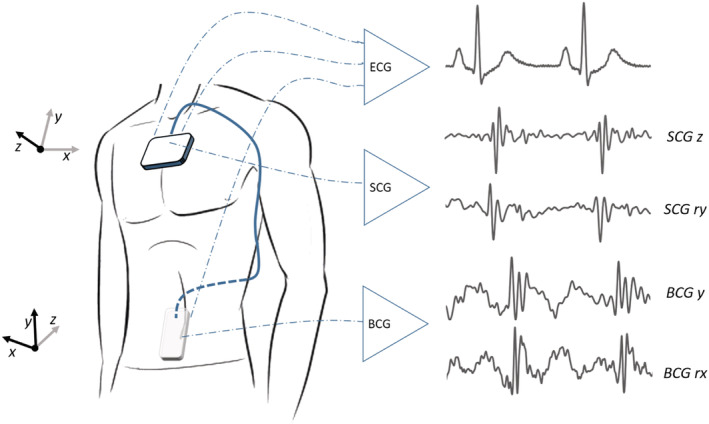
Aims: The kinocardiograph (KCG) is an unobtrusive device, consisting of a chest sensor, which records local thoracic vibrations produced in result of cardiac contraction and ejection of blood into the great vessels [seismocardiography (SCG)], and a lower back sensor, which records micromovements of the body in reaction to blood flowing through the vasculature [ballistocardiography (BCG)]. SCG and BCG signals are translated to the integral of cardiac kinetic energy (iK) and cardiac maximum power (Pmax), which might be promising metrics for future telemonitoring purposes in heart failure (HF). As a first step of validation, this study aimed to determine whether iK and Pmax are responsive to exercise-induced changes in the haemodynamic load of the heart in HF patients.
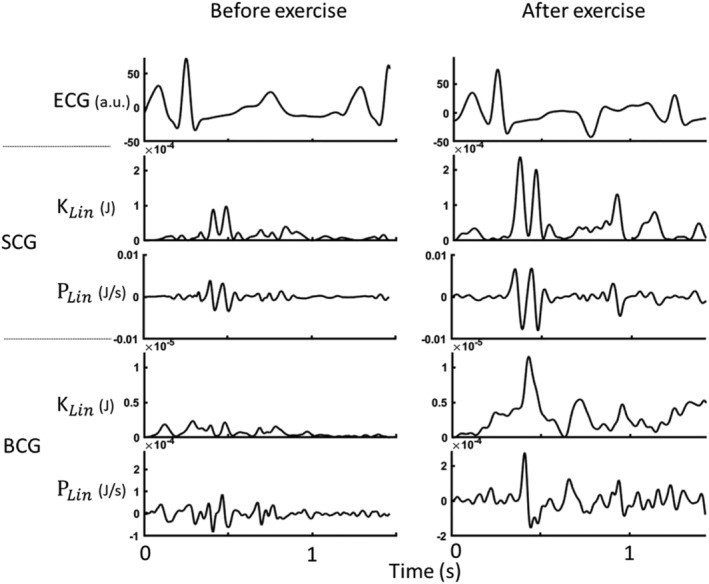
Methods and results: Fifteen patients with stable HF with reduced ejection fraction performed a submaximal exercise protocol. KCG and cardiac ultrasound measurements were obtained both at rest and at submaximal exercise. BCG iK over the cardiac cycle (CC) increased significantly (0.0026 ± 0.0017 to 0.0052 ± 0.0061 mJ.s.; P = 0.01) during exercise, in contrast to a non-significant increase in SCG iK CC. BCG Pmax CC increased significantly (0.92 ± 0.89 to 2.03 ± 1.95 mJ/s; P = 0.02), in contrast to a non-significant increase in SCG Pmax CC. When analysing the systolic phase of the CC, similar patterns were found. Cardiac output (CO) ratio (i.e. CO exercise/CO rest) showed a moderate, significant correlation with BCG Pmax CC ratio (r = +0.65; P = 0.008) and with SCG Pmax CC ratio (r = +0.54; P = 0.04).
Conclusions: iK and Pmax measured with the KCG, preferentially using BCG, are responsive to changes in the haemodynamic load of the heart in HF patients. The combination of the BCG and SCG sensor might be of added value to fully understand changes in haemodynamics and to discriminate between an HF patient and a healthy individual.
Keywords: Ballistocardiography; Chronic heart failure; Hemodynamic load; Kinetic energy; Seismocardiography.
© 2021 The Authors. ESC Heart Failure published by John Wiley & Sons Ltd on behalf of European Society of Cardiology.
Conflict of interest statement
P.‐F.M. and A.H. are minority shareholders at HeartKinetics. The other authors declare no conflicts of interest.
Figures
Similar articles
-
Assessment of left ventricular twist by 3D ballistocardiography and seismocardiography compared with 2D STI echocardiography in a context of enhanced inotropism in healthy subjects.Sci Rep. 2021 Jan 12;11(1):683. doi: 10.1038/s41598-020-79933-4. Sci Rep. 2021. PMID: 33436841 Free PMC article.
-
Influence of sympathetic activation on myocardial contractility measured with ballistocardiography and seismocardiography during sustained end-expiratory apnea.Am J Physiol Regul Integr Comp Physiol. 2020 Oct 1;319(4):R497-R506. doi: 10.1152/ajpregu.00142.2020. Epub 2020 Sep 2. Am J Physiol Regul Integr Comp Physiol. 2020. PMID: 32877240
-
Kinocardiography Derived from Ballistocardiography and Seismocardiography Shows High Repeatability in Healthy Subjects.Sensors (Basel). 2021 Jan 26;21(3):815. doi: 10.3390/s21030815. Sensors (Basel). 2021. PMID: 33530417 Free PMC article.
-
Investigating Cardiorespiratory Interaction Using Ballistocardiography and Seismocardiography-A Narrative Review.Sensors (Basel). 2022 Dec 6;22(23):9565. doi: 10.3390/s22239565. Sensors (Basel). 2022. PMID: 36502267 Free PMC article. Review.
-
Omecamtiv Mecarbil in Chronic Heart Failure With Reduced Ejection Fraction: Rationale and Design of GALACTIC-HF.JACC Heart Fail. 2020 Apr;8(4):329-340. doi: 10.1016/j.jchf.2019.12.001. Epub 2020 Feb 6. JACC Heart Fail. 2020. PMID: 32035892 Review.
Cited by
-
Continuous Estimation of Blood Pressure by Utilizing Seismocardiogram Signal Features in Relation to Electrocardiogram.Biosensors (Basel). 2024 Dec 17;14(12):621. doi: 10.3390/bios14120621. Biosensors (Basel). 2024. PMID: 39727886 Free PMC article.
-
Non-invasive cardiac kinetic energy distribution: a new marker of heart failure with impaired ejection fraction (KINO-HF).Front Cardiovasc Med. 2023 May 2;10:1096859. doi: 10.3389/fcvm.2023.1096859. eCollection 2023. Front Cardiovasc Med. 2023. PMID: 37200972 Free PMC article.
-
Smartphone-Derived Seismocardiography: Robust Approach for Accurate Cardiac Energy Assessment in Patients with Various Cardiovascular Conditions.Sensors (Basel). 2024 Mar 27;24(7):2139. doi: 10.3390/s24072139. Sensors (Basel). 2024. PMID: 38610349 Free PMC article.
-
Evaluating Seismocardiography as a Non-Exercise Method for Estimating Maximal Oxygen Uptake.Healthcare (Basel). 2024 Oct 30;12(21):2162. doi: 10.3390/healthcare12212162. Healthcare (Basel). 2024. PMID: 39517374 Free PMC article.
-
The kinocardiograph for assessment of fluid status in patients with acute decompensated heart failure.ESC Heart Fail. 2023 Dec;10(6):3446-3453. doi: 10.1002/ehf2.14477. Epub 2023 Sep 14. ESC Heart Fail. 2023. PMID: 37710415 Free PMC article.
References
-
- Koehler F, Koehler K, Deckwart O, Prescher S, Wegscheider K, Kirwan B‐A, Winkler S, Vettorazzi E, Bruch L, Oeff M, Zugck C, Doerr G, Naegele H, Störk S, Butter C, Sechtem U, Angermann C, Gola G, Prondzinsky R, Edelmann F, Spethmann S, Schellong SM, Schulze PC, Bauersachs J, Wellge B, Schoebel C, Tajsic M, Dreger H, Anker SD, Stangl K. Efficacy of telemedical interventional management in patients with heart failure (TIM‐HF 2): a randomised controlled parallel‐group, unmasked trial. Lancet 2018; 392: 1047–1057. - PubMed
MeSH terms
LinkOut - more resources
Full Text Sources
Medical
Research Materials
Miscellaneous
