


Safety and efficacy of losartan for the reduction of brain atrophy in clinically diagnosed Alzheimer's disease (the RADAR trial): a double-blind, randomised, placebo-controlled, phase 2 trial
- PMID: 34687634
- PMCID: PMC8528717
- DOI: 10.1016/S1474-4422(21)00263-5
Safety and efficacy of losartan for the reduction of brain atrophy in clinically diagnosed Alzheimer's disease (the RADAR trial): a double-blind, randomised, placebo-controlled, phase 2 trial
Abstract
Background: Drugs modifying angiotensin II signalling could reduce Alzheimer's disease pathology, thus decreasing the rate of disease progression. We investigated whether the angiotensin II receptor antagonist losartan, compared with placebo, could reduce brain volume loss, as a measure of disease progression, in clinically diagnosed mild-to-moderate Alzheimer's disease.
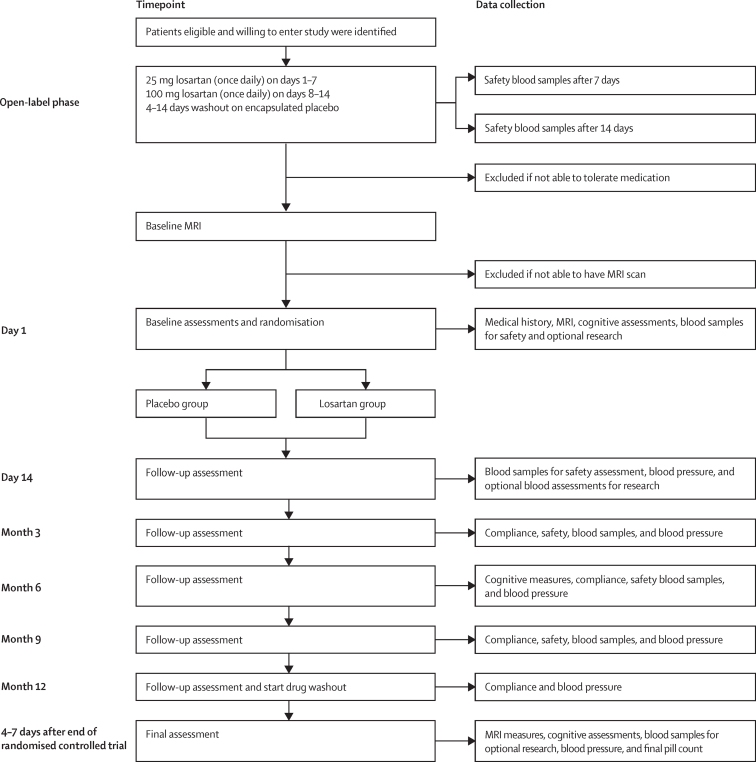
Methods: In this double-blind, multicentre, randomised controlled trial, eligible patients aged 55 years or older, previously untreated with angiotensin II drugs and diagnosed (National Institute of Neurological and Communicative Disorders and Stroke and the Alzheimer's Disease and Related Disorders Association criteria) with mild-to-moderate Alzheimer's disease, and who had capacity to consent, were recruited from 23 UK National Health Service hospital trusts. After undergoing a 4-week, open-label phase of active treatment then washout, participants were randomly assigned (1:1) oral over-encapsulated preparations of either 100 mg losartan (after an initial two-dose titration stage) or matched placebo daily for 12 months. Randomisation, minimised by age and baseline medial temporal lobe atrophy score, was undertaken online or via pin-access service by telephone. Participants, their study companions, and study personnel were masked to group assignment. The primary outcome, analysed by the intention-to-treat principle (ie, participants analysed in the group to which they were randomised, without imputation for missing data), was change in whole brain volume between baseline and 12 months, measured using volumetric MRI and determined by boundary shift interval (BSI) analysis. The trial is registered with the International Standard Randomised Controlled Trial Register (ISRCTN93682878) and the European Union Drug Regulating Authorities Clinical Trials Database (EudraCT 2012-003641-15), and is completed.
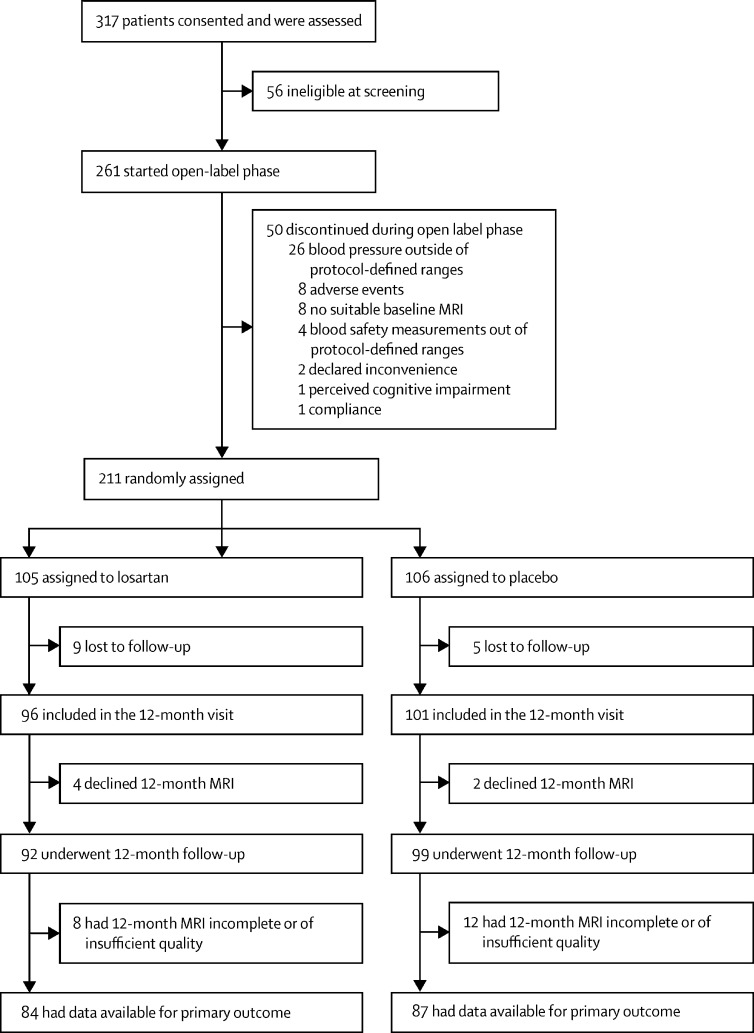
Findings: Between July 22, 2014, and May 17, 2018, 261 participants entered the open-label phase. 211 were randomly assigned losartan (n=105) or placebo (n=106). Of 197 (93%) participants who completed the study, 171 (81%) had complete primary outcome data. The mean brain volume (BSI) reduction was 19·1 mL (SD 10·3) in the losartan group and 20·0 mL (10·8) in the placebo group. The difference in total volume reduction between groups was -2·29 mL (95% CI -6·46 to 0·89; p=0·14). The number of adverse events was low (22 in the losartan group and 20 in the placebo group) with no differences between treatment groups. There was one treatment-related death per treatment group.
Interpretation: 12 months of treatment with losartan was well tolerated but was not effective in reducing the rate of brain atrophy in individuals with clinically diagnosed mild-to-moderate Alzheimer's disease. Further research is needed to assess the potential therapeutic benefit from earlier treatment in patients with milder cognitive impairment or from longer treatment periods.
Funding: Efficacy and Mechanism Evaluation Programme (UK Medical Research Council and National Institute for Health Research).
Copyright © 2021 The Author(s). Published by Elsevier Ltd. This is an Open Access article under the CC BY 4.0 license. Published by Elsevier Ltd.. All rights reserved.
Conflict of interest statement
Declaration of interests PGK reports grants from the National Institute of Health Research (NIHR), during the conduct of the study; being a non-funded co-investigator of the ongoing Alzheimer's Association-funded HEART phase 1b study of telmisartan and its use as an intervention against the renin–angiotensin system in African American people at risk of developing dementia by parental history; and having previously undertaken advisory work for Novartis in their development and intended trialling of dual acting inhibitors of Angiotensin Receptor Blockers and neprilysin (LCZ696) for the treatment of heart failure. NT, BH, LJ, SLB, IBM, CN, NJT, PSB, JAL, PP, JT, DLT, IW, and YBS report grants from the NIHR, during the conduct of the study. JB reports grants from Alzheimer's Research UK, outside the submitted work. CHS reports grants for the Alzheimer's Society, during the conduct of the study. EC reports grants from the NIHR, during the conduct of the study; and received payment from Biogen, Novartis, and Union Chimique Belge for providing educational resources or consultancy around Alzheimer's Disease trials. NCF reports other funding from Roche, personal fees from Biogen, and non-financial support from Lilly and Ionis, outside the submitted work. AW and H-JM declare no competing interests.
Figures
Comment in
-
The link between blood pressure and Alzheimer's disease.Lancet Neurol. 2021 Nov;20(11):878-879. doi: 10.1016/S1474-4422(21)00340-9. Lancet Neurol. 2021. PMID: 34687619 No abstract available.
References
Publication types
MeSH terms
Substances
Grants and funding
LinkOut - more resources
Full Text Sources
Medical
