Review
. 2022 Feb 1;1868(2):166294.
doi: 10.1016/j.bbadis.2021.166294. Epub 2021 Oct 20.

Repositioning Ivermectin for Covid-19 treatment: Molecular mechanisms of action against SARS-CoV-2 replication

Affiliations
Review

Repositioning Ivermectin for Covid-19 treatment: Molecular mechanisms of action against SARS-CoV-2 replication

Zheng Yao Low et al. Biochim Biophys Acta Mol Basis Dis. .

Abstract

Ivermectin (IVM) is an FDA approved macrocyclic lactone compound traditionally used to treat parasitic infestations and has shown to have antiviral potential from previous in-vitro studies. Currently, IVM is commercially available as a veterinary drug but have also been applied in humans to treat onchocerciasis (river blindness - a parasitic worm infection) and strongyloidiasis (a roundworm/nematode infection). In light of the recent pandemic, the repurposing of IVM to combat SARS-CoV-2 has acquired significant attention. Recently, IVM has been proven effective in numerous in-silico and molecular biology experiments against the infection in mammalian cells and human cohort studies. One promising study had reported a marked reduction of 93% of released virion and 99.98% unreleased virion levels upon administration of IVM to Vero-hSLAM cells. IVM's mode of action centres around the inhibition of the cytoplasmic-nuclear shuttling of viral proteins by disrupting the Importin heterodimer complex (IMPα/β1) and downregulating STAT3, thereby effectively reducing the cytokine storm. Furthermore, the ability of IVM to block the active sites of viral 3CLpro and S protein, disrupts important machinery such as viral replication and attachment. This review compiles all the molecular evidence to date, in review of the antiviral characteristics exhibited by IVM. Thereafter, we discuss IVM's mechanism and highlight the clinical advantages that could potentially contribute towards disabling the viral replication of SARS-CoV-2. In summary, the collective review of recent efforts suggests that IVM has a prophylactic effect and would be a strong candidate for clinical trials to treat SARS-CoV-2.

Keywords: Antiviral; Cytokine storm; Drug repurposing; Importin heterodimer complex; Inhibition; STAT3; Streptomyces avermitilis; Treatment; Viral 3CLpro.


Conflict of interest statement

The authors declare that they have no known competing financial interests or personal relationships that could have appeared to influence the work reported in this paper.

Figures
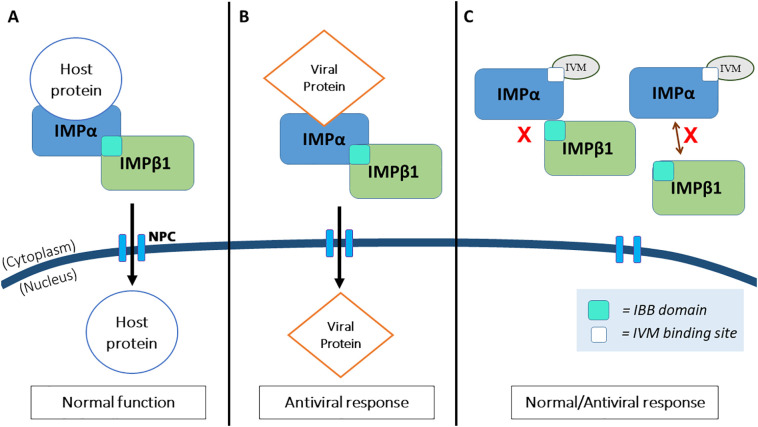
Fig. 1
Fig. 1
A brief layout illustrating the roles of IMPα/β1 in nuclear transport during normal function and upon SARS-CoV-2 infection with respect to the inhibitory activity by IVM. A) Transporting host proteins (e.g.: STAT) requires interaction with the Importin heterodimer complex (IMPα/β1) via binding at the IMPα, which subsequently brings the whole complex (IMPα/β1) to the nucleus via the nuclear pore complex (NPC), thus establishing normal transcriptional activities. B) However, this process is postulated to be hijacked by the viral protein NS12. C) IVM targets the binding site at the IMPα or binding domain at IMPβ1, leading to dissociation of the complex from the latter, halting the hijacking mechanism mentioned in B.
Fig. 2
Fig. 2
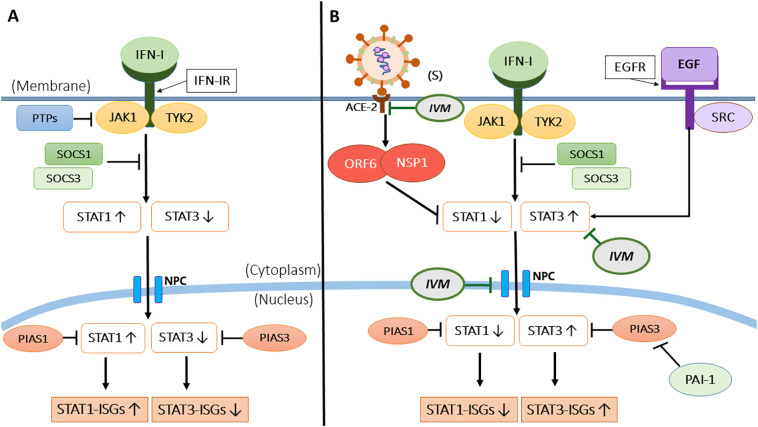
A schematic layout on STAT dependent IFN-1 signalling, a key contributor to the cytokine storm in SARS-CoV-2 infected individuals and the action of IVM. A) The IFN-I signalling pathway showing JAK1 and TYK2 being activated upon binding of Interferon-1 (IFN-I) at the IFN-1 receptor (IFN-IR). In a normal scenario, STAT1 is predominantly activated to induce interferon-stimulated genes (ISGs)-(STAT1-ISGs) via (STAT1/STAT2/IRF9) complex, known as ISGF3 (not shown here). STAT3 activation is also present here albeit small. B) Upon SARS-CoV-2 infection the activity of STAT1 is inhibited by SARS-CoV-2 proteins (NSP1 and ORF6), leading to the upregulation of STAT3 activity that subsequently induces STAT3-ISGs. Following this, the PIAS1 and PIAS3 regulate the binding activity of STAT1 and STAT3 to the DNA respectively, via negative feedback. However, upon infection, the hyperactivation of STAT3 represses the miR-34a, an inhibitor for plasminogen activator inhibitor-1 (PAI-1), inadvertently enhancing the level of PAI-1, which in turn inhibits the activity of PIAS3. To further stress, the epidermal growth factor receptor (EGFR) produced from the reduced STAT1 activity also activates STAT3, leading to enhanced production of cytokine and chemokines. Here, IVM inhibits STAT3 activity, subsequently reducing inflammatory IL-6 cytokine production, preventing cytokine storm and ADRS. IVM also binds to the viral S protein, thereby prohibiting the attachment of S protein to the host ACE2 receptors for viral entry and reducing the viral load.

References

    1. Worldometers Coronavirus Update (Live) COVID-19 Virus Pandemic. https://www.worldometers.info/coronavirus/
    1. Andersen K., Rambaut A., Lipkin W., Holmes E., Garry R. The proximal origin of SARS-CoV-2. Nat. Med. 2020;26:450–452. - PMC - PubMed
    1. Wehbe Z., Hammoud S., Soudani N., Zaraket H., El-Yazbi A., Eid A. Molecular insights into SARS COV-2 interaction with cardiovascular disease: role of RAAS and MAPK signaling. Front. Pharmacol. 2020;11 - PMC - PubMed
    1. Low Z., Farouk I., Lal S. Drug repositioning: new approaches and future prospects for life-debilitating diseases and the COVID-19 pandemic outbreak. Viruses. 2020;12:1058. - PMC - PubMed
    1. Sharma A., Ahmad Farouk I., Lal S. COVID-19: a review on the novel coronavirus disease evolution, transmission, detectionControl and Prevention. 2021;13:202. - PMC - PubMed

MeSH terms

LinkOut - more resources