


Acceptance and Commitment Training for Veterans with Polytrauma: A randomized controlled trial protocol
- PMID: 34687944
- PMCID: PMC8792908
- DOI: 10.1016/j.cct.2021.106601
Acceptance and Commitment Training for Veterans with Polytrauma: A randomized controlled trial protocol
Abstract
Background: Mild traumatic brain injury (mTBI) is a signature wound of Veterans of operations in Iraq and Afghanistan (i.e., OIF/OEF/OND). Most Veterans with mTBI also experience stress-based psychopathology (e.g., depression, posttraumatic stress disorder) and chronic pain. This combination - referred to as polytrauma - results in detrimental long-term effects on social, occupational, and community reintegration. This study will compare the efficacy of a one-day Acceptance and Commitment Training plus Education, Resources, and Support (ACT+ERS) workshop to a one-day active control group (ERS) on symptoms of distress and social, occupational, and community reintegration. We will also examine mediators and moderators of treatment response.
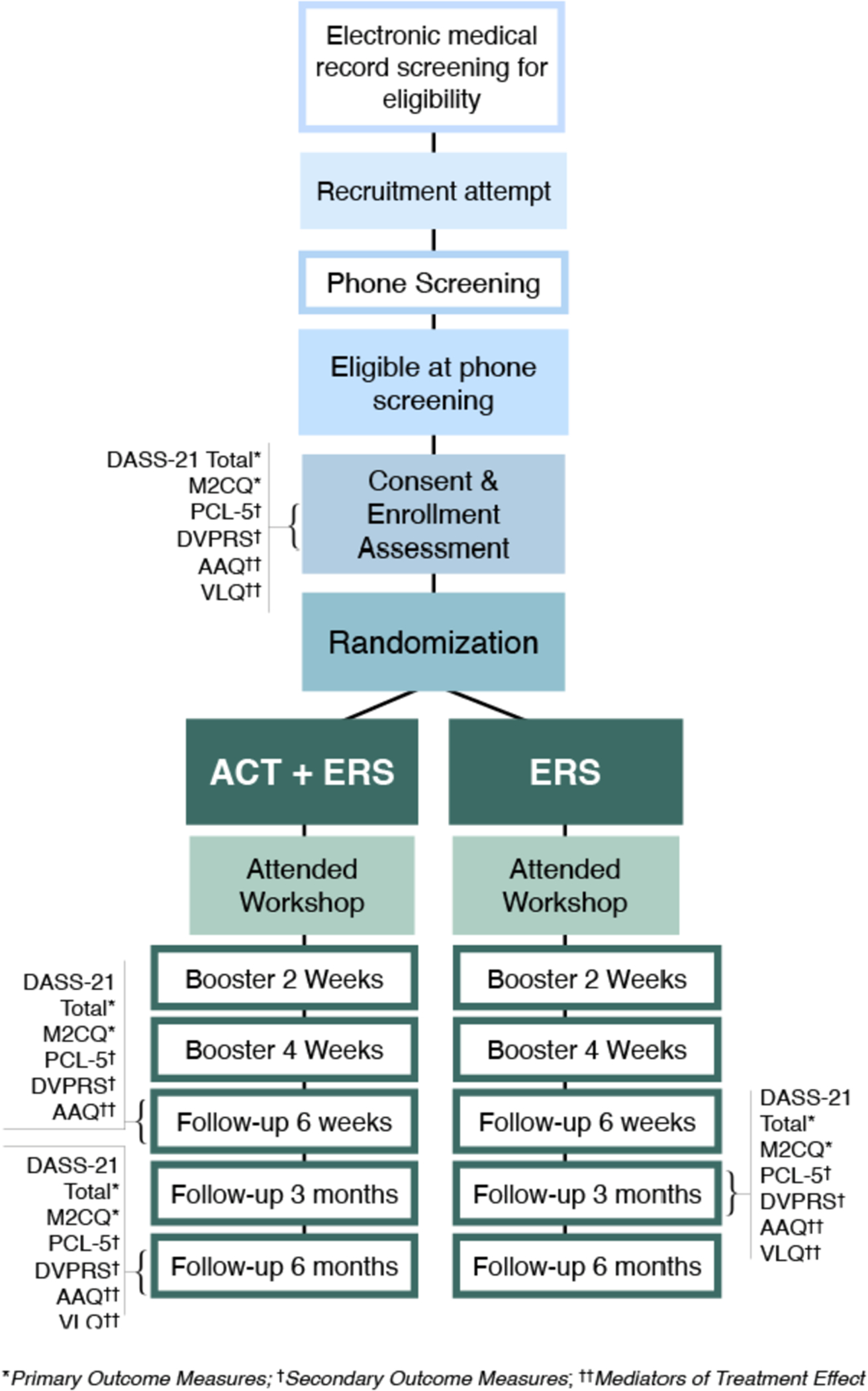
Methods: This is an ongoing randomized clinical trial. 212 OIF/OEF/OND Veterans with polytrauma are being recruited. Veterans are randomly assigned to a one-day ACT+ERS or a one-day ERS workshop with two individualized booster sessions approximately two- and four-weeks post-workshop. Veterans complete assessments prior to the workshop and again at six weeks, three months, and six months post-workshop. Of note, workshops were converted to a virtual format due to the COVID-19 pandemic.
Results: The primary outcomes are symptoms of distress and reintegration; secondary outcomes are post-traumatic stress disorder symptoms and pain interference. Secondary analyses will assess whether changes in avoidance at three months mediate changes in distress and reintegration at six months.
Conclusion: Facilitating the psychological adjustment and reintegration of Veterans with polytrauma is critical. The results of this study will provide important information about the impact of a brief intervention for Veterans with these concerns.
Keywords: Acceptance commitment therapy; Brief intervention; Mild traumatic brain injury; Polytrauma; Randomized controlled trial; Veterans.
Copyright © 2021 Elsevier Inc. All rights reserved.
Conflict of interest statement
Declaration of Competing Interest
The authors declare that they have no known competing financial interests or personal relationships that could have appeared to influence the work reported in this paper.
Figures
References
-
- Department of Veterans Affairs, Analysis of VA Health Care Utilization among Operation Enduring Freedom (OEF), Operation Iraqi Freedom (OIF), and Operation New Dawn (OND) Veterans, from 1st Quarter FY 2002 through 1st Quarter FY 2012, Accessed November 24, 2020, https://www.publichealth.va.gov/docs/epidemiology/healthcare-utilization..., 2012.
-
- US Department of Defense, VA/DoD Clinical Practice Guideline for Management of Post-Traumatic Stress, 2010, pp. 1–48. https://www.healthquality.va.gov/guidelines/MH/ptsd/cpg_PTSD-full-201011.... (Accessed 24 November 2020).
-
- Tanielian TL, Tanielian T, Jaycox L, Invisible wounds of war: psychological and cognitive injuries, their consequences, and services to assist recovery, in: Invisible Wounds of War: Psychological and Cognitive Injuries, Their Consequences, and Services to Assist Recovery, Rand Corporation, 2008, pp. 87–115.
Publication types
MeSH terms
Grants and funding
LinkOut - more resources
Full Text Sources
Medical
