


Specialized Mechanosensory Epithelial Cells in Mouse Gut Intrinsic Tactile Sensitivity
- PMID: 34688712
- PMCID: PMC8792331
- DOI: 10.1053/j.gastro.2021.10.026
Specialized Mechanosensory Epithelial Cells in Mouse Gut Intrinsic Tactile Sensitivity
Abstract
Background and aims: The gastrointestinal (GI) tract extracts nutrients from ingested meals while protecting the organism from infectious agents frequently present in meals. Consequently, most animals conduct the entire digestive process within the GI tract while keeping the luminal contents entirely outside the body, separated by the tightly sealed GI epithelium. Therefore, like the skin and oral cavity, the GI tract must sense the chemical and physical properties of the its external interface to optimize its function. Specialized sensory enteroendocrine cells (EECs) in GI epithelium interact intimately with luminal contents. A subpopulation of EECs express the mechanically gated ion channel Piezo2 and are developmentally and functionally like the skin's touch sensor- the Merkel cell. We hypothesized that Piezo2+ EECs endow the gut with intrinsic tactile sensitivity.
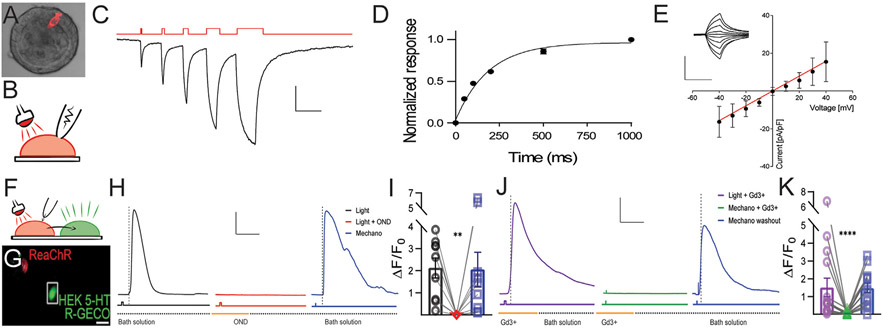
Methods: We generated transgenic mouse models with optogenetic activators in EECs and Piezo2 conditional knockouts. We used a range of reference standard and novel techniques from single cells to living animals, including single-cell RNA sequencing and opto-electrophysiology, opto-organ baths with luminal shear forces, and in vivo studies that assayed GI transit while manipulating the physical properties of luminal contents.
Results: Piezo2+ EECs have transcriptomic features of synaptically connected, mechanosensory epithelial cells. EEC activation by optogenetics and forces led to Piezo2-dependent alterations in colonic propagating contractions driven by intrinsic circuitry, with Piezo2+ EECs detecting the small luminal forces and physical properties of the luminal contents to regulate transit times in the small and large bowel.
Conclusions: The GI tract has intrinsic tactile sensitivity that depends on Piezo2+ EECs and allows it to detect luminal forces and physical properties of luminal contents to modulate physiology.
Keywords: Enteroendocrine Cell; GI Physiology; Ion Channels; Mechanosensitivity; Neuroepithelial Connection.
Copyright © 2022 AGA Institute. Published by Elsevier Inc. All rights reserved.
Conflict of interest statement
Conflicts of interest
The authors disclose no conflicts.
Figures




Comment in
-
Diminished Piezo2-Dependent Tactile Sensitivity Occurs in Aging Human Gut and Slows Gastrointestinal Transit in Mice.Gastroenterology. 2022 May;162(6):1755-1757.e2. doi: 10.1053/j.gastro.2022.01.043. Epub 2022 Feb 3. Gastroenterology. 2022. PMID: 35122761 No abstract available.
References
-
- Hebden JM, Blackshaw E, D’Amato M, et al. Abnormalities of GI transit in bloated irritable bowel syndrome: effect of bran on transit and symptoms. Am J Gastroenterol 2002;97:2315–2320. - PubMed
-
- Karamanolis G, Tack J. Nutrition and motility disorders. Best Pract Res Clin Gastroenterol 2006;20:485–505. - PubMed
Publication types
MeSH terms
Substances
Grants and funding
LinkOut - more resources
Full Text Sources
Molecular Biology Databases
