Review
. 2021 Oct 24;18(1):210.
doi: 10.1186/s12985-021-01677-y.

Small but mighty: old and new parvoviruses of veterinary significance

Affiliations
Review

Small but mighty: old and new parvoviruses of veterinary significance

Mason C Jager et al. Virol J. .

Abstract

In line with the Latin expression "sed parva forti" meaning "small but mighty," the family Parvoviridae contains many of the smallest known viruses, some of which result in fatal or debilitating infections. In recent years, advances in metagenomic viral discovery techniques have dramatically increased the identification of novel parvoviruses in both diseased and healthy individuals. While some of these discoveries have solved etiologic mysteries of well-described diseases in animals, many of the newly discovered parvoviruses appear to cause mild or no disease, or disease associations remain to be established. With the increased use of animal parvoviruses as vectors for gene therapy and oncolytic treatments in humans, it becomes all the more important to understand the diversity, pathogenic potential, and evolution of this diverse family of viruses. In this review, we discuss parvoviruses infecting vertebrate animals, with a special focus on pathogens of veterinary significance and viruses discovered within the last four years.

Keywords: Amdoparvovirus; Animal parvoviruses; Chaphamaparvovirus; Copiparvovirus; Pathogenicity; Viral metagenomics; Viral therapeutics.


Conflict of interest statement

The authors declare that they have no competing interests.

Figures
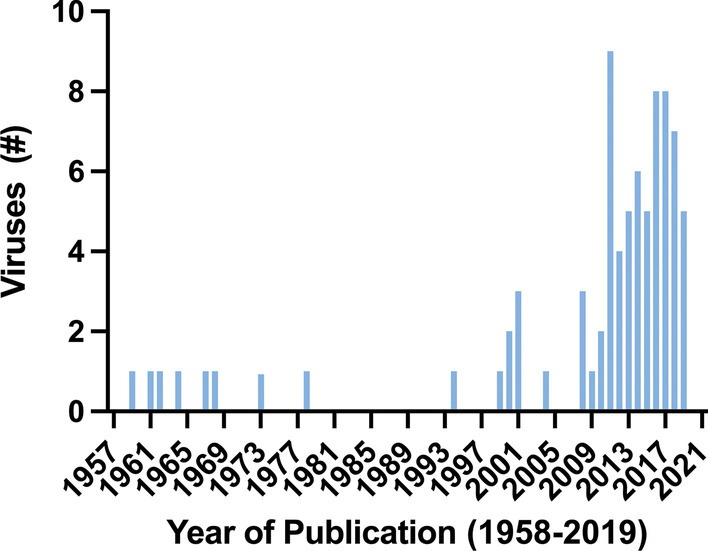
Fig. 1
Fig. 1
Number of animal parvoviruses discovery by year. Graph showing the number of new ICTV-recognized non-human, vertebrate animal parvoviruses [20] discovered between 1958 and 2019. Viruses discovered since 2019 have not been consistently added to the ICTV taxonomy and are, thus, excluded. Note the marked increase in viral discovery in the last 20 years due to the use of metagenomics and high-throughput sequencing
Fig. 2
Fig. 2
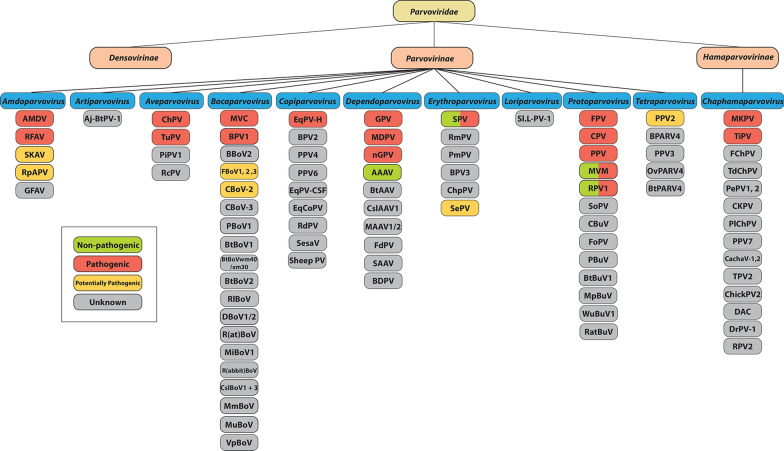
Vertebrate animal Parvovirus Classification and Pathogenicity. A graphical representation of known pathogenicity of select vertebrate animal parvoviruses including all ten genera of the subfamily Parvovirinae and one genus of Hamaparvovirinae. Viruses marked as both non-pathogenic and pathogenic may have certain conditions, i.e. immunosuppressed host, where the virus is pathogenic. Potentially pathogenic viruses include those where viral nucleic acid has been demonstrated in tissues of a diseased animal or experimental infection has produced disease, but modern Koch’s postulates have not been fully satisfied
Fig. 3
Fig. 3
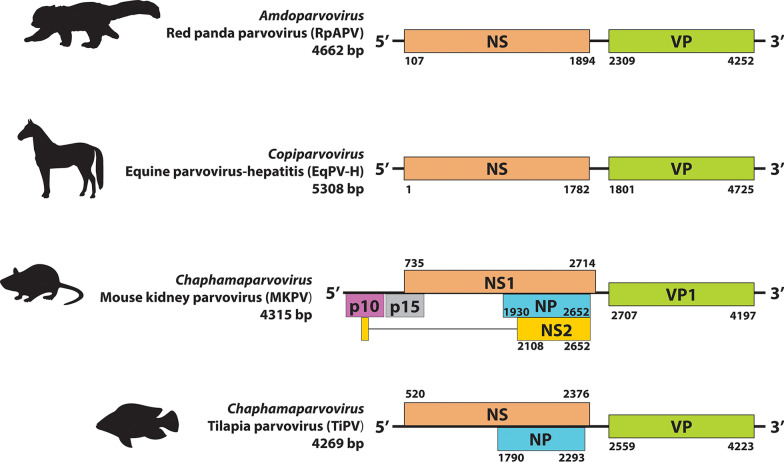
Genome structures of partial or complete coding sequences of recently identified vertebrate parvoviruses. Included are red panda parvovirus (RpAPV) (NC_031751), equine parvovirus-hepatitis (EqPV-H) (MG136722), mouse kidney parvovirus (MKPV) (MH670587), and tilapia parvovirus (TiPV) (MT393593). The genome length known to date, with partial or complete inverted terminal repeats (ITRs), are below the virus name. The colored boxes represent the open reading frames (ORFs) of the non-structural (NS), viral protein (VP), or accessory viral proteins encoded in the genome
Fig. 4
Fig. 4
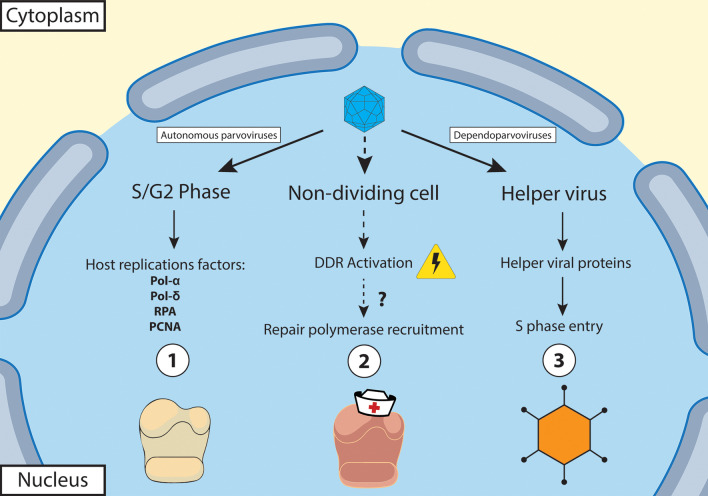
Summary of parvovirus replication requirements. (1) Most autonomous parvoviruses require mitotically active cells (S/G2 phase) to provide host replication factors to replicate their viral genome. (2) Recently, human bocavirus 1 (HBoV1) was demonstrated to replicate in non-dividing airway epithelial cells through hijacking of DNA repair machinery [33, 34]. (3) Dependoparvoviruses depend on co-infection with a helper virus to undergo productive replication in a host cell

References

    1. Vibin J, Chamings A, Klaassen M, Bhatta TR, Alexandersen S. Metagenomic characterisation of avian parvoviruses and picornaviruses from Australian wild ducks. Sci Rep. 2020;10(1):12800. - PMC - PubMed
    1. Du J, Wang W, Chan JF-W, Wang G, Huang Y, Yi Y, et al. Identification of a Novel Ichthyic Parvovirus in Marine Species in Hainan Island, China. Front Microbiol. 2019;10:2815. - PMC - PubMed
    1. Divers TJ, Tennant BC, Kumar A, McDonough S, Cullen J, Bhuva N, et al. New parvovirus associated with serum hepatitis in horses after inoculation of common biological product. Emerg Infect Dis. 2018;24(2):303–310. - PMC - PubMed
    1. Tomlinson JE, Jager M, Struzyna A, Laverack M, Fortier LA, Dubovi E, et al. Tropism, pathology, and transmission of equine parvovirus-hepatitis. Emerging Microbes & Infections. 2020;9(1):651–663. - PMC - PubMed
    1. Vengust M, Jager MC, Zalig V, Cociancich V, Laverack M, Renshaw RW, et al. First report of equine parvovirus-hepatitis-associated Theiler’s disease in Europe. Equine Veterinary Journal [Internet]. [cited 2020 Sep 28];n/a(n/a). Available from: http://beva.onlinelibrary.wiley.com/doi/abs/10.1111/evj.13254 - PMC - PubMed

Publication types

LinkOut - more resources