


Acute Care Visits for Eating Disorders Among Children and Adolescents After the Onset of the COVID-19 Pandemic
- PMID: 34690054
- PMCID: PMC8530790
- DOI: 10.1016/j.jadohealth.2021.09.025
Acute Care Visits for Eating Disorders Among Children and Adolescents After the Onset of the COVID-19 Pandemic
Abstract
Purpose: Anecdotal reports suggest a significant increase in acute presentations of eating disorders among children and adolescents. Our objective was to compare the rates of emergency department visits and hospitalizations for pediatric eating disorders before and during the first 10 months of the COVID-19 pandemic.
Methods: Using linked health administrative databases, we conducted a population-based repeated cross-sectional study of emergency department visits and hospitalizations for eating disorders among all children and adolescents aged 3-17 years, residing in Ontario, Canada. We defined the pre-COVID period from January 1, 2017, to February 29, 2020, and the post-COVID period from March 1, 2020, to December 26, 2020. Poisson generalized estimating equations were used to model 3-year pre-COVID trends to predict expected post-COVID trends and estimate the relative change from expected rates.
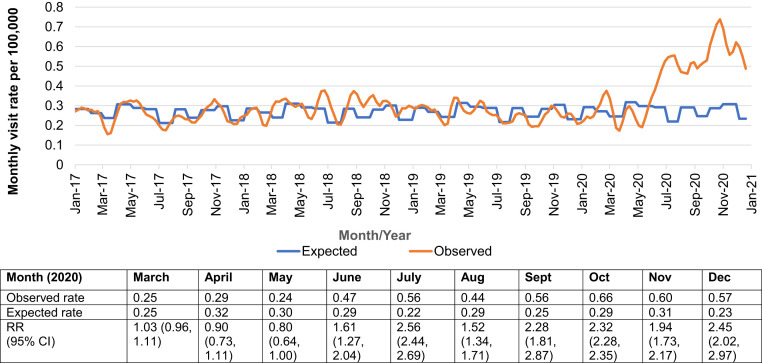
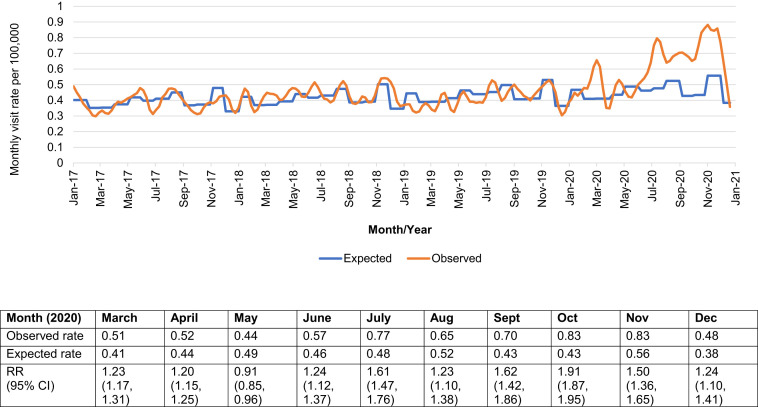
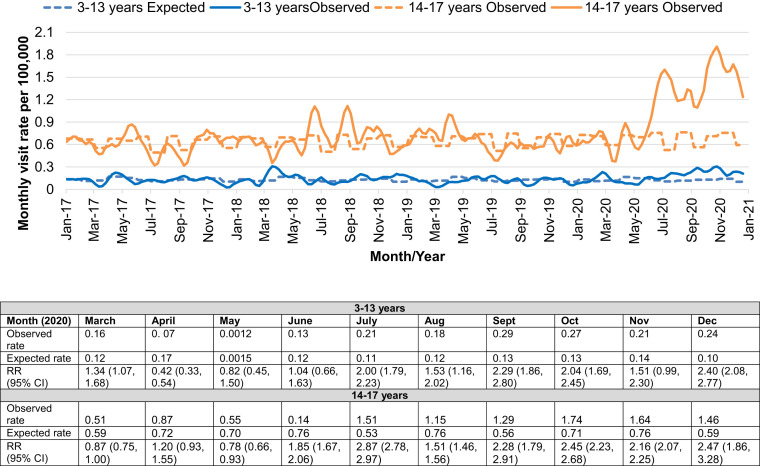
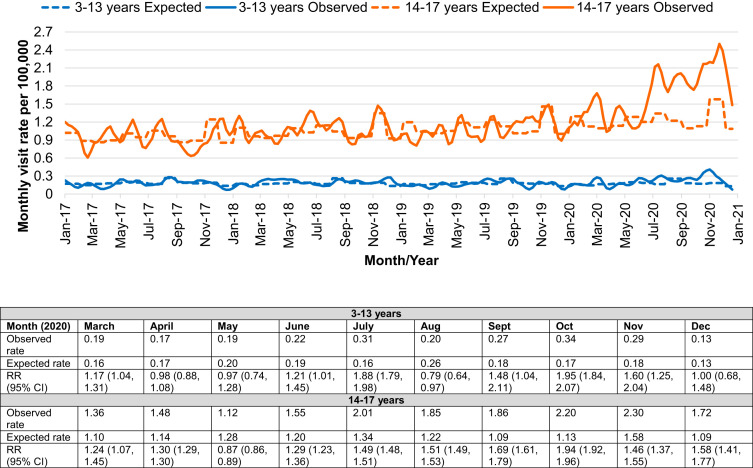
Results: In our population of almost 2.5 million children and adolescents, acute care visits for eating disorders increased immediately after the onset of the pandemic, reaching a 4-week peak annualized rate of 34.6 (emergency department visits) and 43.2 per 100,000 population (hospitalizations) in October 2020. Overall, we observed a 66% (adjusted relative rate: 1.66, 95% confidence interval: 1.41-1.96) and 37% (adjusted relative rate: 1.37, 95% confidence interval: 1.25-1.50) increase in risk for emergency department visit and hospitalization, respectively.
Conclusions: Acute care visits for pediatric eating disorders increased significantly in Ontario after the onset of COVID-19 pandemic and remained well above expected levels during the first 10 months of the pandemic. Further research is needed to understand the social and neurobiological mechanisms underlying the observed changes in health system utilization.
Keywords: Acute care; Eating disorders; Epidemiology.
Copyright © 2021 Society for Adolescent Health and Medicine. Published by Elsevier Inc. All rights reserved.
Figures
References
-
- Haripersad Y.V., Kannegiesser-Bailey M., Morton K., et al. Outbreak of anorexia nervosa admissions during the COVID-19 pandemic. Arch Dis Child. 2021;106:e15. - PubMed
-
- Martinson J. In the shadow of a pandemic, demand soars for eating disorder treatment 2020. https://www.cbc.ca/news/canada/british-columbia/anorexia-shadow-pandemic... Available at:
-
- Dalle Grave R. Coronavirus disease 2019 and eating disorders psychology Today2020 updated March 21. https://www.psychologytoday.com/ca/blog/eating-disorders-the-facts/20200...
Publication types
MeSH terms
LinkOut - more resources
Full Text Sources
Medical
