Review
. 2021 Dec;35(4):101717.
doi: 10.1016/j.berh.2021.101717. Epub 2021 Oct 21.

Urate transport in health and disease

Affiliations
Review

Urate transport in health and disease

Victoria L Halperin Kuhns et al. Best Pract Res Clin Rheumatol. 2021 Dec.

Abstract

Circulation of urate levels is determined by the balance between urate production and excretion, homeostasis regulated by the function of urate transporters in key epithelial tissues and cell types. Our understanding of these physiological processes and identification of the genes encoding the urate transporters has advanced significantly, leading to a greater ability to predict risk for urate-associated diseases and identify new therapeutics that directly target urate transport. Here, we review the identified urate transporters and their organization and function in the renal tubule, the intestinal enterocytes, and other important cell types to provide a fuller understanding of the complicated process of urate homeostasis and its role in human diseases. Furthermore, we review the genetic tools that provide an unbiased catalyst for transporter identification as well as discuss the role of transporters in determining the observed significant gender differences in urate-associated disease risk.

Keywords: ABCG2; Gout; Hyperuricemia; SLC22A12; SLC2A9; URAT1; Urate.


Conflict of interest statement

Declaration of competing interest In the past three years, O.M.W has received research funding from AstraZeneca.

Figures
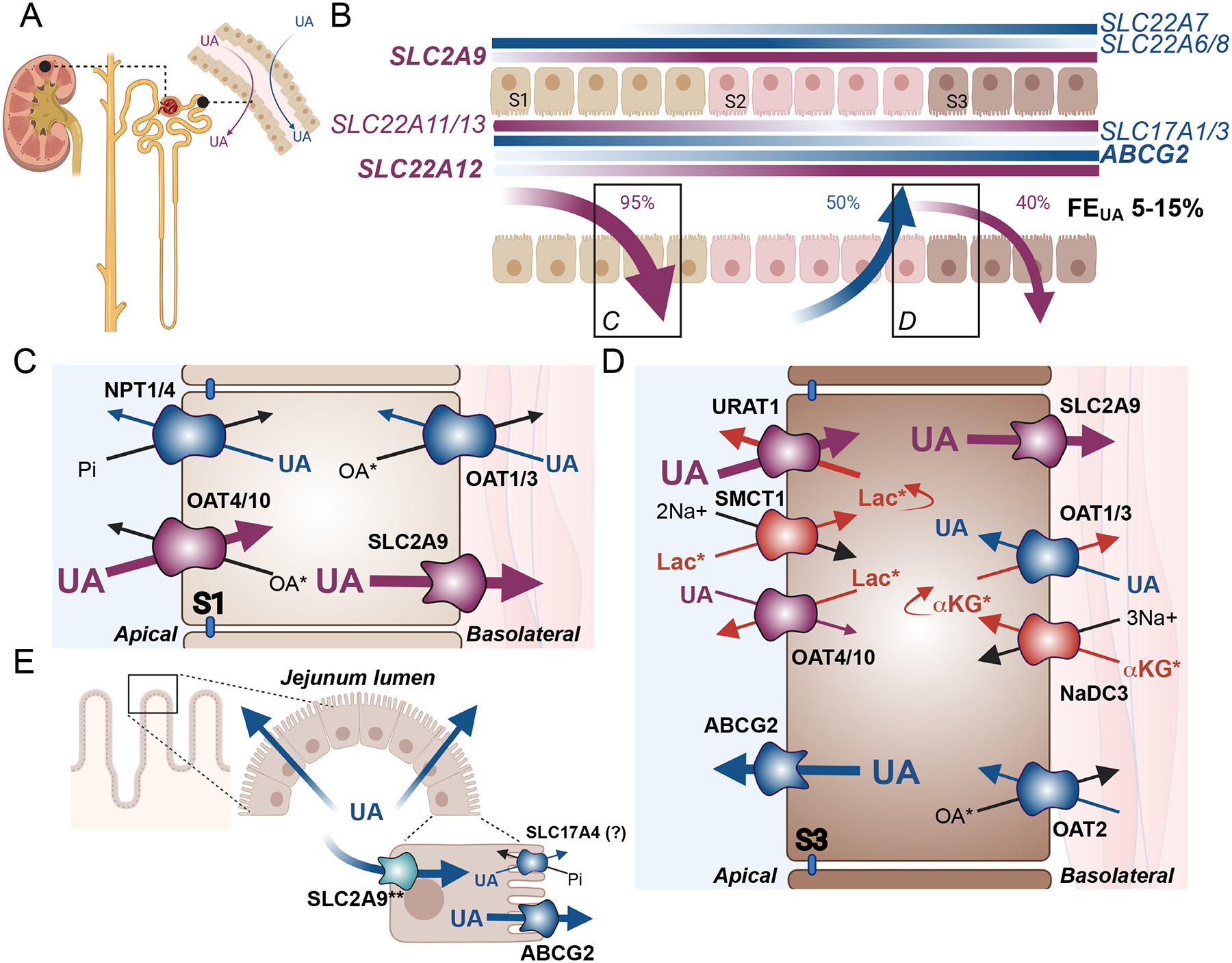
Fig. 1.
Fig. 1.. Renal and Intestinal Urate Physiology
(A) The proximal tubule of the renal nephron is the principal site of urate (UA) handling through both secretion (blue arrow) and reabsorption (purple arrow). (B) Expression patterns of human urate transporter genes. Secretory transporter genes are shown in blue, while reabsorptive transporter genes are shown in purple. Gradients are displayed on the membranes of expression, with SLC22A6/7/8 and SLC2A9 coding for basolateral proteins, and ABCG2, SLC17A1/3, and SLC22A11/12/13 encoding apical transporters. The darker the color, the higher the expression, based on data from the Kidney Interactive Transcriptomics database[62]. Percentages delineate the amount of the original urate filtered load is either reabsorbed (purple arrows) or secreted (blue arrow) leading to a final fraction excretion of urate (FEUA) shown in black. Transporter protein localization and transport patterns are shown for the S1 (C) and S3 (D) segments. (C) Transporters most abundantly expressed in the S1 segments include transporters of the secretory pathway: NPT1 (SLC17A1), NPT4 (SLC17A3), OAT1 (SLC22A6) and OAT3 (SLC22A8), shown in blue, and transporters of the reabsorptive pathway: OAT4 (SLC22A11), OAT10 (SLC22A13), and SLC2A9/GLUT9 (SLC2A9), shown in purple. (D) Transporters most abundantly expressed in the S3 segment include secretory pathway transporters ABCG2/BCRP (ABCG2), OAT1, OAT2 (SLC22A7) and OAT3 shown in blue, and reabsorptive pathway transporters URAT1 (SLC22A12), SLC2A9, OAT4, and OAT10, shown in purple. Additional transporters that are functionally coupled to urate transport include the sodium cotransporters SMCT1 (SLC5A8) and NaDC3 (SLC13A3) shown in red. Blue and purple arrows indicate the direction of urate transport, while black and red arrows indicate transport of counter ions. (E) Urate is also excreted through the jejunum segment of the small intestine, where urate may enter through basolateral SLC2A9 (**well established in mice, requires further confirmation in humans), and is then secreted into the lumen primarily through ABCG2 with some potential contribution from SLC17A4 (SLC14A4).. *Some transporters have many known endogenous substrates, with only the most relevant shown. Lac: lactate; αKG: alpha-ketoglutarate; OA: organic anion; Pi: inorganic phosphate. Endogenous OAs for the OATs may include the following: OAT1: medium chain fatty acids, citrulline, prostaglandin E2 prostaglandin F2, cyclic nucleotides (cAMP, cGMP), folate[47, 50, 53]; OAT2: cAMP, GMP, GDP, GTP, cGMP, glutamate, glutarate, α-ketoglutarate, L-ascorbate, orotic acid, trigonelline, hypoxanthine, prostaglandin E2, prostaglandin F2, estrone-3-sulfate, dehydroepiandrosterone sulphate[50, 67]; OAT3: cAMP, cortisol, glutarate, prostaglandin E2, prostaglandin F2α, dehydroepiandrosterone sulphate, estrone sulphate, estradiol-17β-glucuronide, taurocholate, cholate, indoxyl sulphate [47, 50, 54, 130]; OAT4 estrone-3-sulfate, prostaglandin E2, prostaglandin F2, dehydroepiandrosterone sulphate[50, 67]; OAT10: lactate, nicotinate, glutathione, succinate[50, 92]. An additional endogenous OA for NPT1 and NP4 is inorganic phosphate co-transported in cis with Na+[57, 58]. SMCT1 mediates sodium dependent transport of monocarboxylates including short chain fatty acids, pyruvate and nicotinate[131], while NaDC3 mediates sodium coupled transport of di- and tri-carboxylates including, α-ketoglutarate, glutarate and its derivatives, citrate, succinate, and amino acid N-acetyl-L-aspartate[75].

References

    1. Shimizu T, Nishikawa M, Matsushige H. 139 THE SOLUBILITY OF URIC ACID AND MONOSODIUM URATE IN URINE. Pediatric Research. 1988;24(1):134–. - PubMed
    1. Wilcox WR, Khalaf A, Weinberger A, et al. Solubility of uric acid and monosodium urate. Med Biol Eng. 1972;10(4):522–31. - PubMed
    1. Friedman TB, Polanco GE, Appold JC, et al. On the loss of uricolytic activity during primate evolution--I. Silencing of urate oxidase in a hominoid ancestor. Comp Biochem Physiol B. 1985;81(3):653–9. - PubMed
    1. Oda M, Satta Y, Takenaka O, et al. Loss of urate oxidase activity in hominoids and its evolutionary implications. Mol Biol Evol. 2002;19(5):640–53. - PubMed
    1. So A, Thorens B. Uric acid transport and disease. J Clin Invest. 2010;120(6):1791–9. - PMC - PubMed

Publication types

Substances
