


Baseline Depression-Like Behaviors in Wild-Type Adolescent Mice Are Strain and Age but Not Sex Dependent
- PMID: 34690714
- PMCID: PMC8529326
- DOI: 10.3389/fnbeh.2021.759574
Baseline Depression-Like Behaviors in Wild-Type Adolescent Mice Are Strain and Age but Not Sex Dependent
Abstract
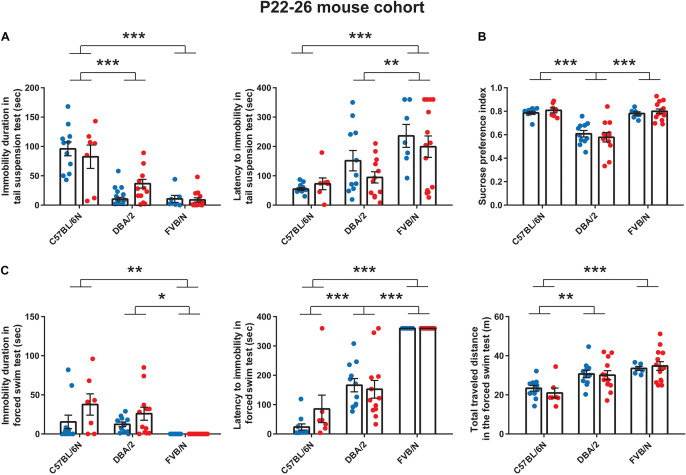
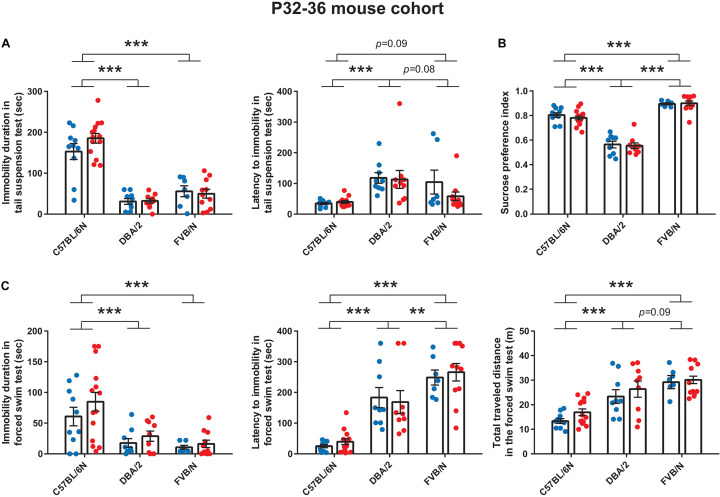
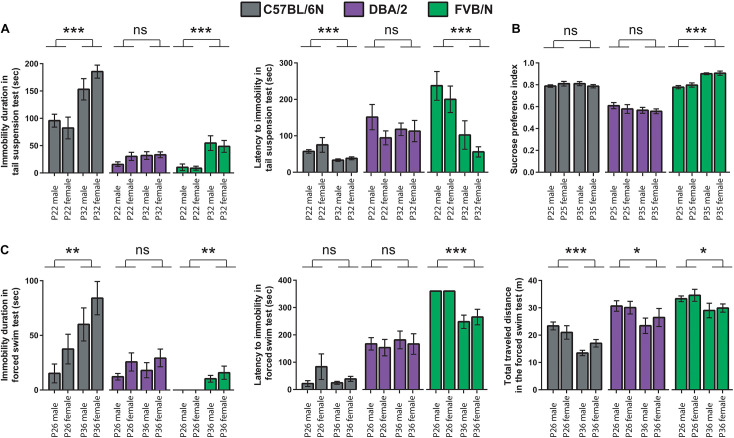
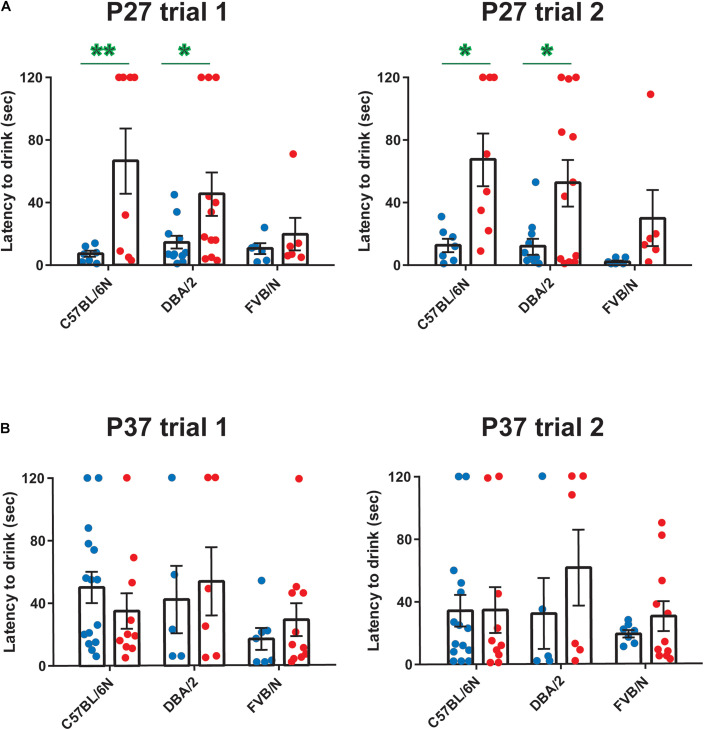
Depression is a major neuropsychiatric disorder, decreasing the ability of hundreds of millions of individuals worldwide to function in social, academic, and employment settings. Beyond the alarming public health problem, depression leads to morbidity across the entire age including adolescence and adulthood. Modeling depression in rodents has been used to understand the pathophysiological mechanisms behind this disorder and create new therapeutics. Although women are two times more likely to be diagnosed with depression compared to men, behavioral experiments on rodent models of depression are mainly performed in males based on the assumption that the estrous cycles in females may affect the behavioral outcome and cause an increase in the intrinsic variability compared to males. Still, the inclusion of female rodents in the behavioral analysis is mandatory to establish the origin of sex bias in depression. Here, we investigated the baseline depression-like behaviors in male and female mice of three adolescent wild-type inbred strains, C57BL/6N, DBA/2, and FVB/N, that are typically used as background strains for mouse models of neuropsychiatric disorders. Our experiments, performed at two different developmental stages during adolescence (P22-P26 and P32-P36), revealed strain but no sex differences in a set of depression-related tests, including tail suspension, sucrose preference and forced swim tests. Additionally, the 10-day interval during this sensitive period uncovered a strong impact on the behavioral outcome of C57BL/6N and FVB/N mice, highlighting a significant effect of maturation on behavioral patterns. Since anxiety-related behavioral tests are often performed together with depression tests in mouse models of neuropsychiatric disorders, we extended our study and included hyponeophagia as an anxiety test. Consistent with a previous study revealing sex differences in other anxiety tests in adolescent mice, male and females mice behaved differently in the hyponeophagia test at P27. Our study gives insight into the behavioral experiments assessing depression and stresses the importance of considering strain, age and sex when evaluating neuropsychiatric-like traits in rodent models.
Keywords: depression; forced swim test; hyponeophagia test; sex differences; sucrose preference test; tail suspension test.
Copyright © 2021 Eltokhi, Kurpiers and Pitzer.
Conflict of interest statement
The authors declare that the research was conducted in the absence of any commercial or financial relationships that could be construed as a potential conflict of interest.
Figures
References
-
- American-Psychiatric-Association [APA] (2013). Diagnostic and Statistical Manual of Mental Disorders, Fifth Edition (DSM-5TM). Arlington, VA: American Psychiatric Association.
-
- Andrade L., Caraveo-Anduaga J. J., Berglund P., Bijl R. V., De Graaf R., Vollebergh W. (2003). The epidemiology of major depressive episodes: results from the International Consortium of Psychiatric Epidemiology (ICPE) Surveys. Int. J. Methods Psychiatr. Res. 12 3–21. 10.1002/mpr.138 - DOI - PMC - PubMed
LinkOut - more resources
Full Text Sources
Molecular Biology Databases
Research Materials
