


Efficacy of radiofrequency ablation versus laparoscopic liver resection for hepatocellular carcinoma in China: a comprehensive meta-analysis
- PMID: 34691297
- PMCID: PMC8512513
- DOI: 10.5114/wiitm.2021.105377
Efficacy of radiofrequency ablation versus laparoscopic liver resection for hepatocellular carcinoma in China: a comprehensive meta-analysis
Abstract
Introduction: Hepatocellular carcinoma (HCC) has been the second leading cause of cancer-related death in China. Radiofrequency ablation is a relatively novel treatment that may improve the treatment of HCC.
Aim: To evaluate and compare the efficacy and safety of radiofrequency ablation (RFA) versus laparoscopic liver resection (LLR) in the treatment of HCC.
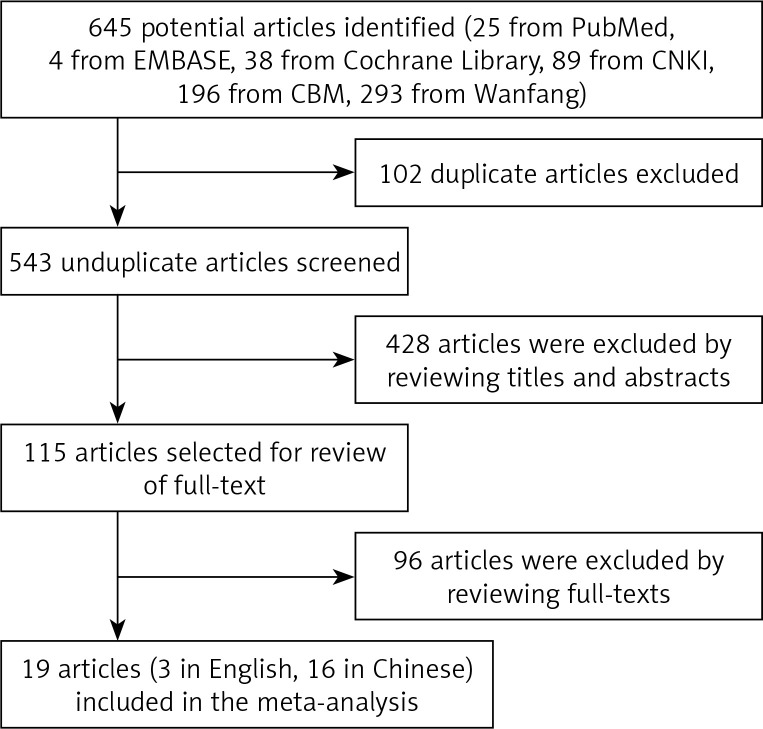
Material and methods: We searched for relevant published studies in English (PubMed, Cochrane Library, EMBASE) and in Chinese (CBM, CNKI and Wanfang) from their inception until September 23, 2019. The quality of included studies was evaluated by the Newcastle-Ottawa Scale.
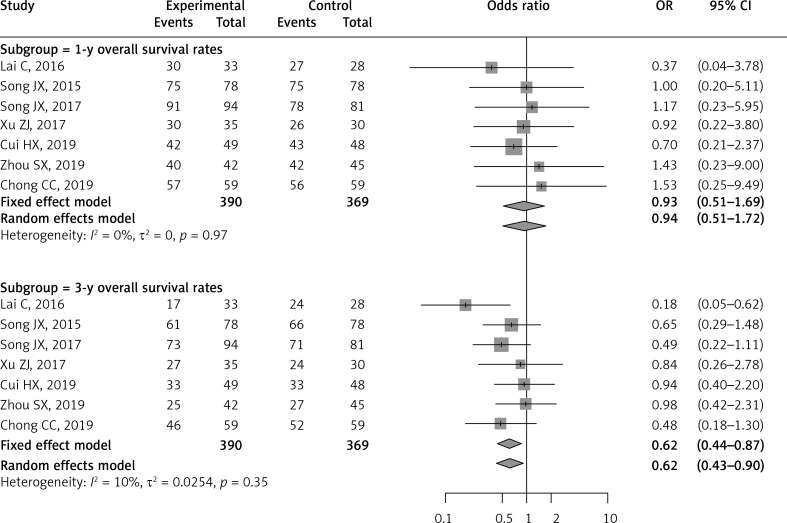
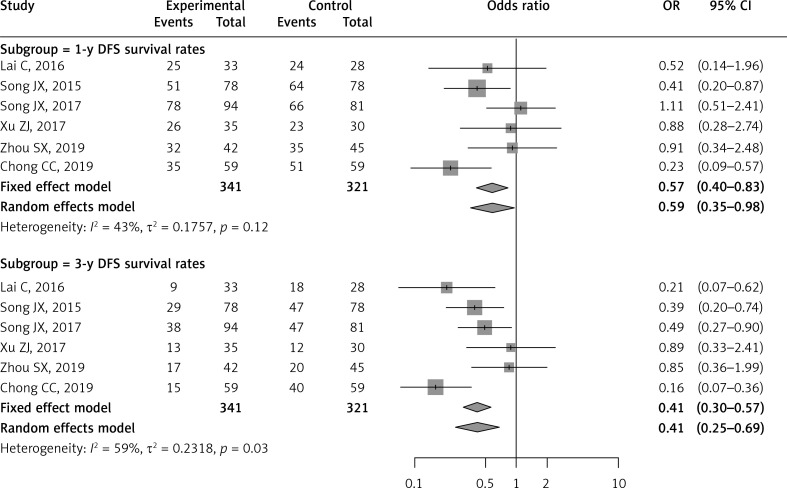
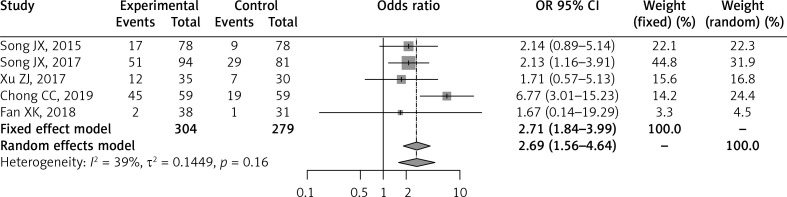
Results: A total of 19 retrospective studies including 2038 patients were eligible for the meta-analysis. The results of the meta-analysis demonstrated that LLR was superior to RFA in terms of 3-year overall survival rate (OR = 0.62), 1 to 3-year disease-free survival rates (OR = 0.57; OR = 0.41, respectively) and local recurrence rates (OR = 2.71).
Conclusions: The meta-analysis demonstrates that laparoscopic liver resection should be preferred in tumors of size 3-5 cm, while for < 3 cm the long term results are equal.
Keywords: laparoscopic liver resection; radiofrequency ablation; small hepatocellular carcinoma; survival.
Copyright: © 2021 Fundacja Videochirurgii.
Conflict of interest statement
The authors declare no conflict of interest.
Figures
References
-
- Zhu ZX, Huang JW, Liao MH, et al. Treatment strategy for hepatocellular carcinoma in China: radiofrequency ablation versus liver resection. Jpn J Clin Oncol. 2016;46:1075–80. - PubMed
-
- Crocetti L. Radiofrequency ablation versus resection for small hepatocellular carcinoma: are randomized controlled trials still needed? Radiology. 2018;287:473–5. - PubMed
-
- Zhu GQ, Sun M, Liao WT, et al. Comparative efficacy and safety between ablative therapies or surgery for small hepatocellular carcinoma: a network meta-analysis. Expert Rev Gastroenterol Hepatol. 2018;12:935–45. - PubMed
-
- Li L, Zhang J, Liu X, et al. Clinical outcomes of radiofrequency ablation and surgical resection for small hepatocellular carcinoma: a meta-analysis. J Gastroen Hepatol. 2012;27:51–8. - PubMed
-
- Jiang B, Yan XF, Zhang JH. Meta-analysis of laparoscopic versus open liver resection for hepatocellular carcinoma. Hepatol Res. 2018;48:635–63. - PubMed
LinkOut - more resources
Full Text Sources
