Review
. 2021 Sep;13(9):439-459.
doi: 10.14740/jocmr4575. Epub 2021 Sep 30.

Microbial Therapeutics in Neurocognitive and Psychiatric Disorders

Affiliations
Review

Microbial Therapeutics in Neurocognitive and Psychiatric Disorders

Kannayiram Alagiakrishnan et al. J Clin Med Res. 2021 Sep.

Abstract

Microbial therapeutics, which include gut biotics and fecal transplantation, are interventions designed to improve the gut microbiome. Gut biotics can be considered as the administration of direct microbial populations. The delivery of this can be done through live microbial flora, certain food like fiber, microbial products (metabolites and elements) obtained through the fermentation of food products, or as genetically engineered substances, that may have therapeutic benefit on different health disorders. Dietary intervention and pharmacological supplements with gut biotics aim at correcting disruption of the gut microbiota by repopulating with beneficial microorganism leading to decrease in gut permeability, inflammation, and alteration in metabolic activities, through a variety of mechanisms of action. Our understanding of the pharmacokinetics of microbial therapeutics has improved with in vitro models, sampling techniques in the gut, and tools for the reliable identification of gut biotics. Evidence from human studies points out that prebiotics, probiotics and synbiotics have the potential for treating and preventing mental health disorders, whereas with paraprobiotics, proteobiotics and postbiotics, the research is limited at this point. Some animal studies point out that gut biotics can be used with conventional treatments for a synergistic effect on mental health disorders. If future research shows that there is a possibility of synergistic effect of psychotropic medications with gut biotics, then a gut biotic or nutritional prescription can be given along with psychotropics. Even though the overall safety of gut biotics seems to be good, caution is needed to watch for any known and unknown side effects as well as the need for risk benefit analysis with certain vulnerable populations. Future research is needed before wide spread use of natural and genetically engineered gut biotics. Regulatory framework for gut biotics needs to be optimized. Holistic understanding of gut dysbiosis, along with life style factors, by health care providers is necessary for the better management of these conditions. In conclusion, microbial therapeutics are a new psychotherapeutic approach which offer some hope in certain conditions like dementia and depression. Future of microbial therapeutics will be driven by well-done randomized controlled trials and longitudinal research, as well as by replication studies in human subjects.

Keywords: Gut biotics; Life style factors; Neurocognitive disorders; Paraprobiotics proteobiotics; Postbiotics; Prebiotics; Probiotics; Psychiatric diseases; Synbiotics.


Conflict of interest statement

The authors declare no potential conflict of interest.

Figures
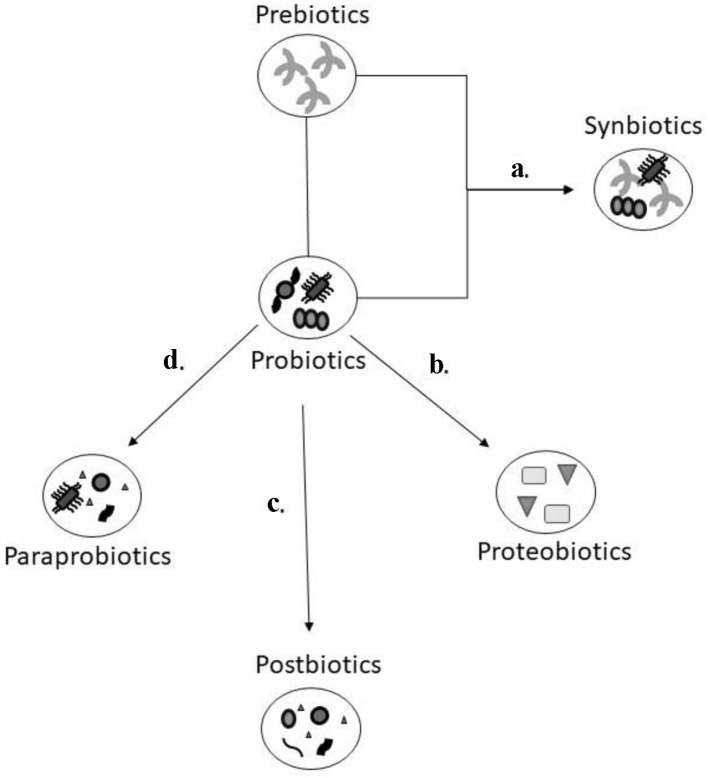
Figure 1
Figure 1
Schematic model of the various gut biotics. Prebiotics are dietary fibre that help with the growth of probiotics which are microorganisms that can provide a health benefit. The combination of prebiotics and probiotics (a) is referred as synbiotics as it is felt there is a synergistic effect due to this combination. Postbiotics, paraprobiotics, and proteobiotics are considered non-viable bacterial products or metabolic by products from probiotic microbes. The natural metabolites through the process of fermentation (b) are isolated from the culture media of probiotics which are identified as proteobiotics. When probiotics are treated through sonication, chemical, or enzymatic processes (c), they are broken down to functional bioactive compounds, referred to as postbiotics. Using radiation, heating, pasteurization and other inactivation methods (d), probiotics are converted to non-viable microbial cells known as paraprobiotics.
Figure 2
Figure 2
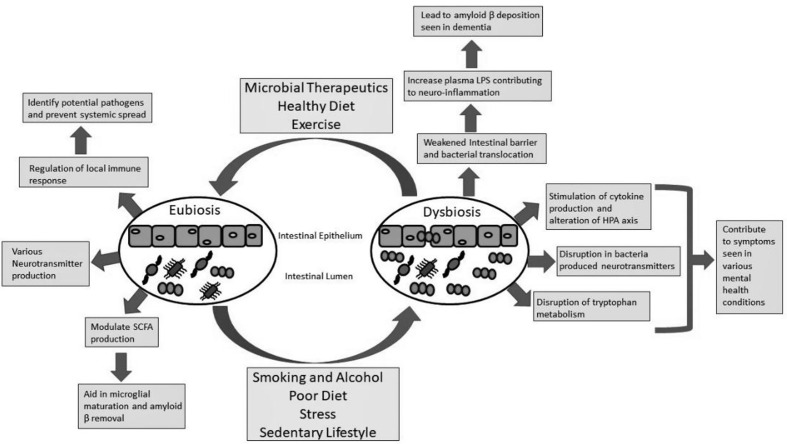
The role of the gut microbiome in neurocognitive and metal health conditions. In a state of eubiosis, the gut bacteria are controlled by the host immune system to prevent systemic spread. Since many of the gut bacteria have a polysaccharide coating the immune system can recognize potential pathogens from the commensal organism. This can prevent systemic spread and inflammation that has been shown to play a role in various mental health conditions. Different species of bacteria in the gut microbiome can produce different neurotransmitters, such as serotonin through tryptophan metabolism. Short-chain fatty acids (SCFAs) are also produced by different gut bacteria and have been found to play a role in microglial maturation which can help remove amyloid β peptide (the major component in Alzheimer’s disease (AD)). Various factors, such as lifestyle and diet, can lead to microbial dysbiosis. A weakened intestinal barrier can result in bacterial translocation causing increased lipopolysaccharide (LPS) serum levels. The result is systemic and neuroinflammation that can contribute to amyloid β deposition leading to AD. The systemic inflammation can become chronic and lead to an alteration of the hypothalamic pituitary adrenal axis (HPA) and has been linked to various mental health conditions. The disrupted microbiome can affect neurotransmitter production and tryptophan metabolism, again impacting the host’s mental health.

References

    1. Baquero F, Nombela C. The microbiome as a human organ. Clin Microbiol Infect. 2012;18(Suppl 4):2–4. doi: 10.1111/j.1469-0691.2012.03916.x. - DOI - PubMed
    1. Marchesi JR, Ravel J. The vocabulary of microbiome research: a proposal. Microbiome. 2015;3:31. doi: 10.1186/s40168-015-0094-5. - DOI - PMC - PubMed
    1. Claesson MJ, Cusack S, O'Sullivan O, Greene-Diniz R, de Weerd H, Flannery E, Marchesi JR. et al. Composition, variability, and temporal stability of the intestinal microbiota of the elderly. Proc Natl Acad Sci U S A. 2011;108(Suppl 1):4586–4591. doi: 10.1073/pnas.1000097107. - DOI - PMC - PubMed
    1. Carding S, Verbeke K, Vipond DT, Corfe BM, Owen LJ. Dysbiosis of the gut microbiota in disease. Microb Ecol Health Dis. 2015;26:26191. doi: 10.3402/mehd.v26.26191. - DOI - PMC - PubMed
    1. Bik EM, Ugalde JA, Cousins J, Goddard AD, Richman J, Apte ZS. Microbial biotransformations in the human distal gut. Br J Pharmacol. 2018;175(24):4404–4414. doi: 10.1111/bph.14085. - DOI - PMC - PubMed

LinkOut - more resources