Cardiac abnormalities in athletes after SARS-CoV-2 infection: a systematic review
- PMID: 34691762
- PMCID: PMC8520588
- DOI: 10.1136/bmjsem-2021-001164
Cardiac abnormalities in athletes after SARS-CoV-2 infection: a systematic review
Abstract
Objectives: Quantification of pericardial/myocardial involvement and risks of sudden cardiac arrest/sudden cardiac death (SCA/SCD) after SARS-CoV-2 infection in athletes who return to sports.
Design: Systematic review on post-SARS-CoV-2 infection pericardial/myocardial manifestations in athletes.
Data sources: Combinations of key terms in Medline, Embase and Scopus (through 2 June 2021).
Eligibility criteria for selecting studies: Inclusion: athletes, with cardiovascular magnetic resonance (CMR) or echocardiography after recovery from SARS-CoV-2 infection, including arrhythmia outcomes. Exclusion: study population ≥1 individual comorbidity and mean age <18 or >64 years. Quality assessment was performed using Joanna Briggs Institute Critical Appraisal tools checklists.
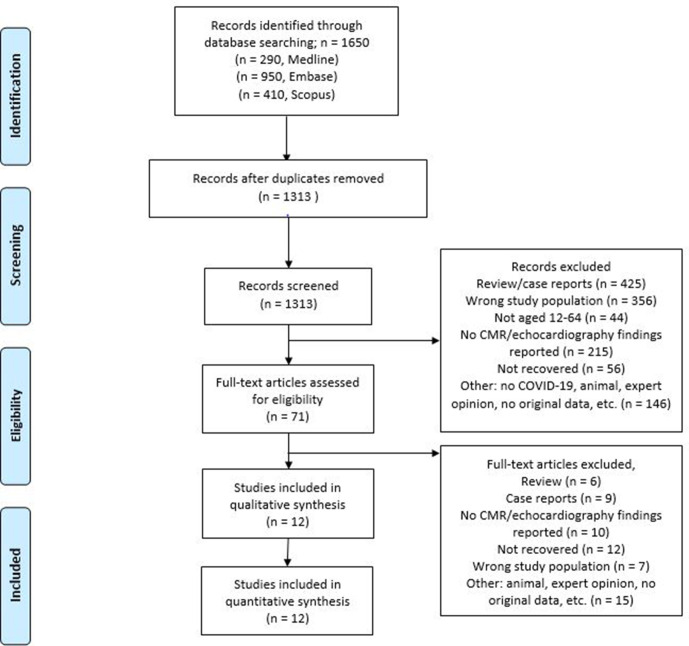
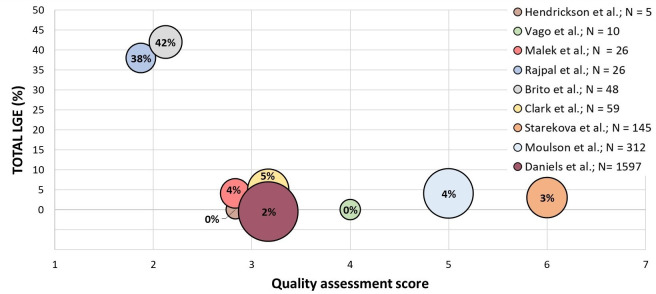
Results: In total, 12 manuscripts (1650 papers reviewed) comprising 3131 athletes (2198 college/student athletes, 879 professional athletes and 54 elite athletes) were included. The prevalence of myocarditis on echocardiography and/or CMR was 0%-15%, pericardial effusion 0%-58% and late gadolinium enhancement (LGE) 0%-46%. Weighted means of diagnosed myocarditis were 2.1% in college/student athletes and 0% in elite athletes. The prevalence of LGE was markedly lower in studies with high-quality assessment scores (3%-4%) versus low scores (38%-42%). A single study reported reversibility of myocardial involvement in 40.7%. No important arrhythmias were reported. Ten studies (n=4171) reporting postrecovery troponin T/I found no clear relationship with cardiac abnormalities.
Summary/conclusion: Athletes have an overall low risk of SARS-CoV-2 pericardial/myocardial involvement, arrhythmias and SCA/SCD. Rates of pericardial/myocardial abnormalities in athletes are highly variable and dependent on study quality. Troponin screenings seem unreliable to identify athletes at risk for myocardial involvement. Prospective athlete studies, with pre-SARS-CoV-2 imaging (CMR), including structured follow-up and arrhythmia monitoring, are urgently needed.
Keywords: COVID-19; athlete; cardiovascular.
© Author(s) (or their employer(s)) 2021. Re-use permitted under CC BY-NC. No commercial re-use. See rights and permissions. Published by BMJ.
Conflict of interest statement
Competing interests: None declared.
Figures

References
-
- World Health Organization . WHO Director-General’s opening remarks at the media briefing on COVID-19 - 11 March 2020. Available: https://www.who.int/director-general/speeches/detail/who-director-genera...
-
- Phillips M, Robinowitz M, Higgins JR, et al. . Sudden cardiac death in air force recruits. A 20-year review. JAMA 1986;256:2696–9. - PubMed
Publication types
LinkOut - more resources
Full Text Sources
Miscellaneous