. 2019 May;6(3):421-437.
doi: 10.1093/nsr/nwz005. Epub 2019 Jan 17.

Gene editing in plants: progress and challenges

Affiliations

Gene editing in plants: progress and challenges

Yanfei Mao et al. Natl Sci Rev. 2019 May.

Abstract

The clustered regularly interspaced short palindromic repeat (CRISPR)-associated protein 9 (Cas9) genome editing system is a powerful tool for targeted gene modifications in a wide range of species, including plants. Over the last few years, this system has revolutionized the way scientists perform genetic studies and crop breeding, due to its simplicity, flexibility, consistency and high efficiency. Considerable progress has been made in optimizing CRISPR/Cas9 systems in plants, particularly for targeted gene mutagenesis. However, there are still a number of important challenges ahead, including methods for the efficient delivery of CRISPR and other editing tools to most plants, and more effective strategies for sequence knock-ins and replacements. We provide our viewpoint on the goals, potential concerns and future challenges for the development and application of plant genome editing tools.

Keywords: CRISPR; Cas9; base editing; crop breeding; gene targeting; genome editing.


Figures

Figure 1.
Figure 1.
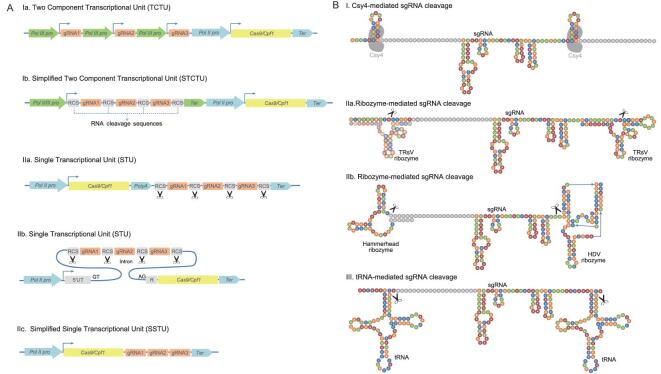
Multiplex gene editing systems in plants. (A) Vector systems developed for multiplex gene editing in plants. Pol II/III pro: RNA Pol II- or III-dependent gene promoters; gRNA: guide RNA; Cas9/Cas12a: Cas9 or Cas12a coding sequences; Ter: terminator; RCS: RNA cleavage sequences; Poly A: polyadenylation sequences; 5′UT-R: 5′ untranslated region. (B) Strategies used for co-expressing multiple guide RNAs within a single RNA transcript. Csy4: CRISPR/Cas Subtype Ypest protein 4; TRsV ribozyme: a ribozyme derived from the tobacco ringspot virus; HDV ribozyme: a ribozyme derived from Hepatitis delta virus; tRNA: transfer RNA.
Figure 2.
Figure 2.
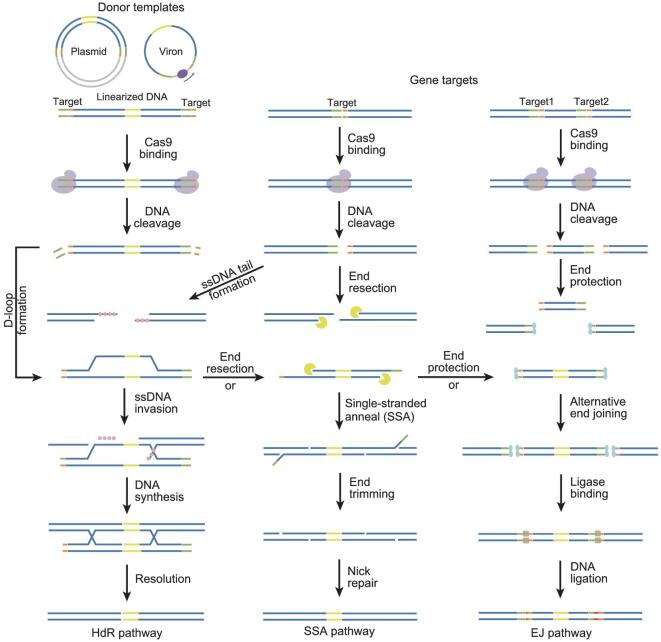
Precise gene editing using CRISPR systems. In the presence of a donor DNA template, precise gene editing can be accomplished via three different DSB repair pathways. The donor templates are supplied mainly in three forms: linearized double-stranded DNA, circular plasmids and single-stranded DNA (ssDNA) replicons. To facilitate the release of donor templates from the backbone, an sgRNA target is usually fused to each end of the DNA template. When the CRISPR-mediated cleavage of the gene target and donor template are synchronized, targeted gene replacement can happen via three different repair pathways. For HdR and Single-stranded Anneal (SSA) pathways, the integration of donor templates into gene targets can be seamless owing to the base pairing between their homologous sequences. With the end-joining (EJ) pathway, indels are usually induced at the junctions of swapped sequences. The sgRNA binding sites within the gene targets and donor templates are indicated in green. The PAM motifs are shown in orange. The anticipated gene mutations within the donor templates are highlighted in yellow. The indels induced by end-joining repair are shown in red.
Figure 3.
Figure 3.
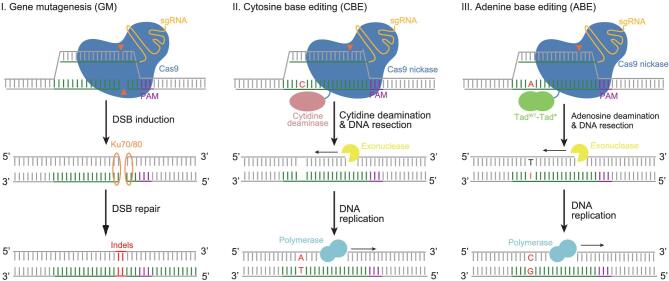
A model of CRISPR/Cas-mediated gene mutagenesis and base editing. Mechanisms of target binding, DNA cleavage and repair during gene mutagenesis (left), cytosine base editing (middle) and adenine base editing (right). Red triangles indicate the single-stranded break within the guide RNA recognition sites.

References

    1. Hartwell L. Genetics: From Genes to Genomes, 6th ed. New York: McGraw-Hill Education, 2017.
    1. Gaj T, Gersbach CA, Barbas CF III. ZFN, TALEN, and CRISPR/Cas-based methods for genome engineering. Trends Biotechnol 2013; 31: 397–405. - PMC - PubMed
    1. Shrivastav M, De Haro LP, Nickoloff JA. Regulation of DNA double-strand break repair pathway choice. Cell Res 2008; 18: 134–47. - PubMed
    1. Ceccaldi R, Rondinelli B, D’Andrea AD. Repair pathway choices and consequences at the double-strand break. Trends Cell Biol 2016; 26: 52–64. - PMC - PubMed
    1. Jiang W, Marraffini LA.. CRISPR-Cas: new tools for genetic manipulations from bacterial immunity systems. Annu Rev Microbiol 2015; 69: 209–28. - PubMed