


Rapid non-destructive volumetric tumor yield assessment in fresh lung core needle biopsies using polarization sensitive optical coherence tomography
- PMID: 34692203
- PMCID: PMC8515979
- DOI: 10.1364/BOE.433346
Rapid non-destructive volumetric tumor yield assessment in fresh lung core needle biopsies using polarization sensitive optical coherence tomography
Abstract
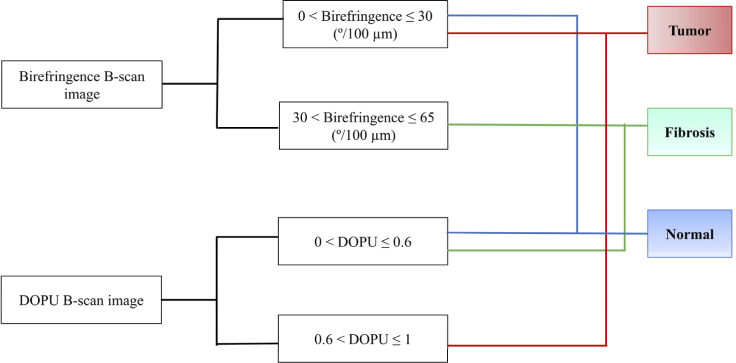
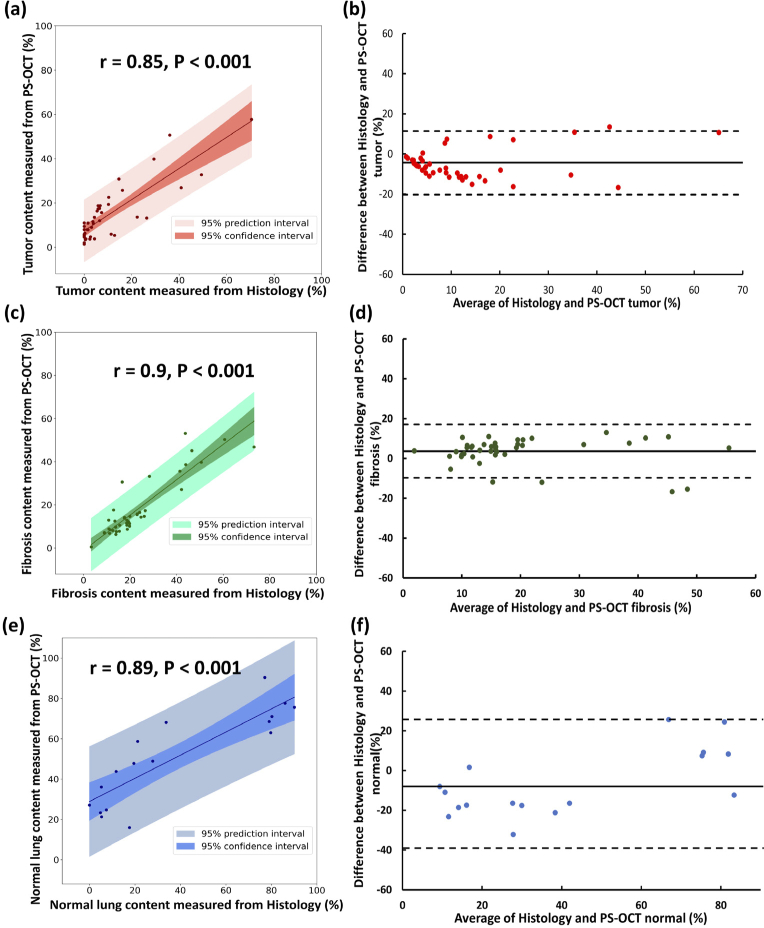
Adequate tumor yield in core-needle biopsy (CNB) specimens is essential in lung cancer for accurate histological diagnosis, molecular testing for therapeutic decision-making, and tumor biobanking for research. Insufficient tumor sampling in CNB is common, primarily due to inadvertent sampling of tumor-associated fibrosis or atelectatic lung, leading to repeat procedures and delayed diagnosis. Currently, there is no method for rapid, non-destructive intraprocedural assessment of CNBs. Polarization-sensitive optical coherence tomography (PS-OCT) is a high-resolution, volumetric imaging technique that has the potential to meet this clinical need. PS-OCT detects endogenous tissue properties, including birefringence from collagen, and degree of polarization uniformity (DOPU) indicative of tissue depolarization. Here, PS-OCT birefringence and DOPU measurements were used to quantify the amount of tumor, fibrosis, and normal lung parenchyma in 42 fresh, intact lung CNB specimens. PS-OCT results were compared to and validated against matched histology in a blinded assessment. Linear regression analysis showed strong correlations between PS-OCT and matched histology for quantification of tumors, fibrosis, and normal lung parenchyma in CNBs. PS-OCT distinguished CNBs with low tumor content from those with higher tumor content with high sensitivity and specificity. This study demonstrates the potential of PS-OCT as a method for rapid, non-destructive, label-free intra-procedural tumor yield assessment.
© 2021 Optical Society of America under the terms of the OSA Open Access Publishing Agreement.
Conflict of interest statement
LPH: Boehringer Ingelheim, Pliant Therapeutics, LX Medical, and Biogen Idec. MJS: NinePoint Medical, LX Medical.
Figures


References
-
- National Lung Screening Trial Research Team , Aberle D. R., Adams A. M., Berg C. D., Black W. C., Clapp J. D., Fagerstrom R. M., Gareen I. F., Gatsonis C., Marcus P. M., Sicks J. D., “Reduced lung-cancer mortality with low-dose computed tomographic screening,” N. Engl. J. Med. 365(5):395–409 (2011).10.1056/NEJMoa1102873 - DOI - PMC - PubMed
-
- Bach P. B., Mirkin J. N., Oliver T. K., Azzoli C. G., Berry D. A., Brawley O. W., Byers T., Colditz G. A., Gould M. K., Jett J. R., Sabichi A. L.., Smith-Bindman R.., Wood D. E, Qaseem A., Detterbeck F. C., “Benefits and harms of CT screening for lung cancer: a systematic review,” JAMA 307(22), 2418–2429 (2012).10.1001/jama.2012.5521 - DOI - PMC - PubMed
Grants and funding
LinkOut - more resources
Full Text Sources