Discourse Performance in Adults With Mild Traumatic Brain Injury, Orthopedic Injuries, and Moderate to Severe Traumatic Brain Injury, and Healthy Controls
- PMID: 34694868
- PMCID: PMC9135020
- DOI: 10.1044/2021_AJSLP-20-00299
Discourse Performance in Adults With Mild Traumatic Brain Injury, Orthopedic Injuries, and Moderate to Severe Traumatic Brain Injury, and Healthy Controls
Abstract
Introduction: Adults with mild traumatic brain injury (mTBI) are at risk for communication disorders, yet studies exploring cognitive-communication performance are currently lacking.
Aims: This aim of this study was to characterize discourse-level performance by adults with mTBI on a standardized elicitation task and compare it to (a) healthy adults, (b) adults with orthopedic injuries (OIs), and (c) adults with moderate to severe TBI.
Method: This study used a cross-sectional design. The participants included mTBI and OI groups recruited prospectively from an emergency medicine department. Moderate to severe TBI and healthy data were acquired from TalkBank. One-way analyses of variance were used to compare mean linguistic scores.
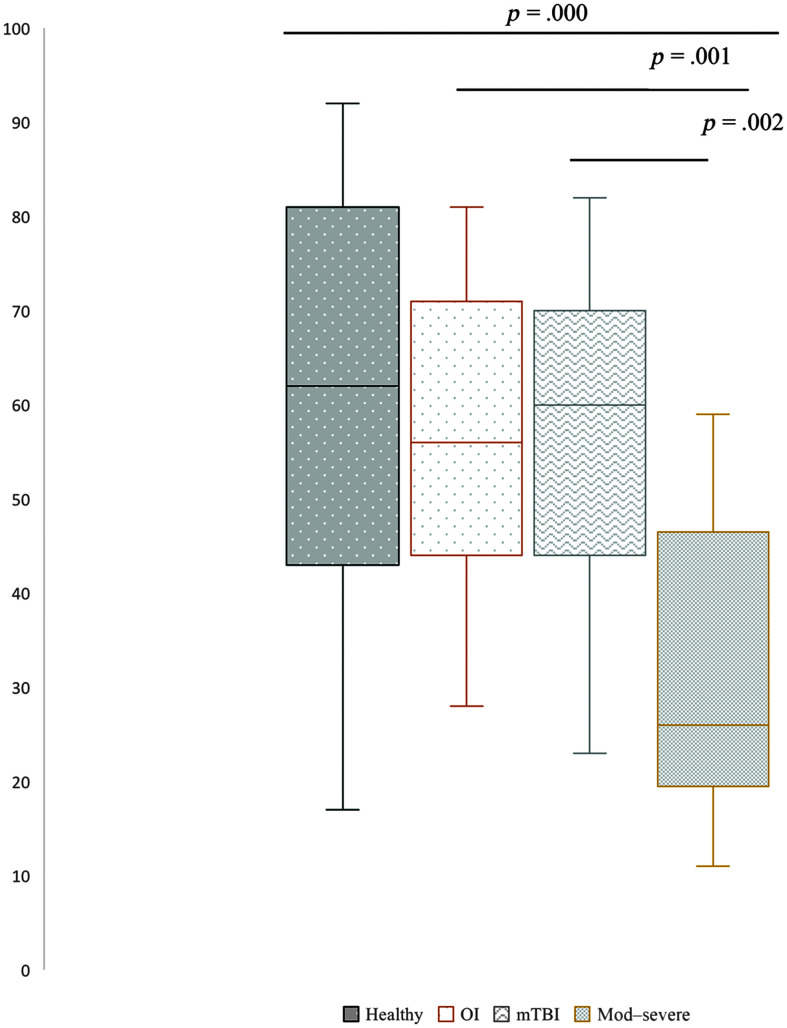
Results: Seventy participants across all groups were recruited. Groups did not differ on demographic variables. The study found significant differences in both content and productivity measures among the groups. Variables did not appear sensitive to differentiate between mTBI and OI groups.
Discussion: Cognitive and language performance of adults with mTBI is a pressing clinical issue. Studies exploring language with carefully selected control groups can influence the development of sensitive measures to identify individuals with cognitive-communication deficits.
Figures

References
-
- American Speech-Language-Hearing Association. (1993). Definitions of communication disorders and variations [Relevant paper]. https://www.asha.org/policy/rp1993-00208/ - PubMed
-
- American Speech-Language-Hearing Association. (2004). Knowledge and skills needed by speech-language pathologists providing services to individuals with cognitive-communication disorders. Retrieved May 1, from https://www.asha.org/policy/ks2004-00080/
-
- Barrow, I. M. , Hough, M. , Rastatter, M. P. , Walker, M. , Holbert, D. , & Rotondo, M. F. (2003). Can within-category naming identify subtle cognitive deficits in the mild traumatic brain-injured patient? Journal of Trauma and Acute Care Surgery, 54(5), 888–897. https://doi.org/10.1097/01.TA.0000057150.60668.7C0 - PubMed
-
- Barrow, I. M. , Hough, M. , Rastatter, M. P. , Walker, M. , Holbert, D. , & Rotondo, M. F. (2006). The effects of mild traumatic brain injury on confrontation naming in adults. Brain Injury, 20(8), 845–855. https://doi.org/10.1080/02699050600832445 - PubMed
-
- Bernstein, D. M. (2002). Information processing difficulty long after self-reported concussion. Journal of the International Neuropsychological Society, 8(5), 673–682. https://doi.org/10.1017/S1355617702801400 - PubMed
Publication types
MeSH terms
Grants and funding
LinkOut - more resources
Full Text Sources
Medical