


Validation of Soft Multipin Dry EEG Electrodes
- PMID: 34696039
- PMCID: PMC8541549
- DOI: 10.3390/s21206827
Validation of Soft Multipin Dry EEG Electrodes
Abstract
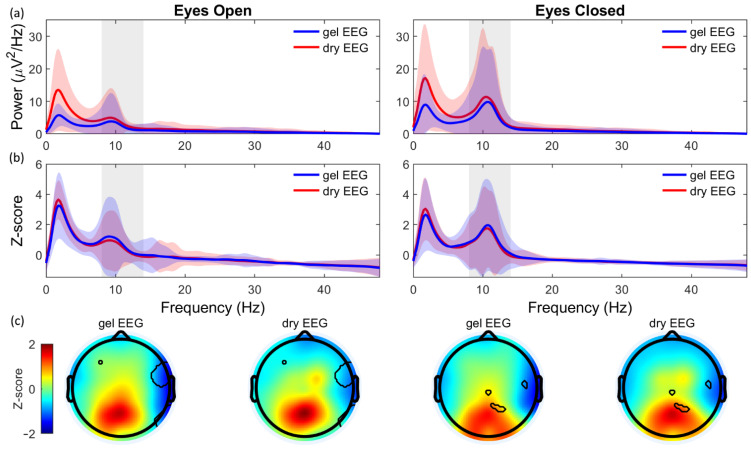
Current developments towards multipin, dry electrodes in electroencephalography (EEG) are promising for applications in non-laboratory environments. Dry electrodes do not require the application of conductive gel, which mostly confines the use of gel EEG systems to the laboratory environment. The aim of this study is to validate soft, multipin, dry EEG electrodes by comparing their performance to conventional gel EEG electrodes. Fifteen healthy volunteers performed three tasks, with a 32-channel gel EEG system and a 32-channel dry EEG system: the 40 Hz Auditory Steady-State Response (ASSR), the checkerboard paradigm, and an eyes open/closed task. Within-subject analyses were performed to compare the signal quality in the time, frequency, and spatial domains. The results showed strong similarities between the two systems in the time and frequency domains, with strong correlations of the visual (ρ = 0.89) and auditory evoked potential (ρ = 0.81), and moderate to strong correlations for the alpha band during eye closure (ρ = 0.81-0.86) and the 40 Hz-ASSR power (ρ = 0.66-0.72), respectively. However, delta and theta band power was significantly increased, and the signal-to-noise ratio was significantly decreased for the dry EEG system. Topographical distributions were comparable for both systems. Moreover, the application time of the dry EEG system was significantly shorter (8 min). It can be concluded that the soft, multipin dry EEG system can be used in brain activity research with similar accuracy as conventional gel electrodes.
Keywords: brain imaging; dry electrodes; electroencephalography (EEG); gel electrodes; validation study.
Conflict of interest statement
The funders had no role in the design of the study; in the collection, analyses, or interpretation of data; in the writing of the manuscript, or in the decision to publish the results. P.F. was employed at ANT Neuro b.v. (Hengelo, The Netherlands) during the design of the study, and not during the period of data analysis and the writing of the manuscript. Moreover, P.F. was not involved in the data collection and data analysis.
Figures



References
-
- Lazarou I., Nikolopoulos S., Petrantonakis P.C., Kompatsiaris I., Tsolaki M. EEG-Based Brain-Computer Interfaces for Communication and Rehabilitation of People with Motor Impairment: A Novel Approach of the 21 (st) Century. Front. Hum. Neurosci. 2018;12:14. doi: 10.3389/fnhum.2018.00014. - DOI - PMC - PubMed
MeSH terms
Grants and funding
LinkOut - more resources
Full Text Sources
