


Reinfections in COVID-19 Patients: Impact of Virus Genetic Variability and Host Immunity
- PMID: 34696276
- PMCID: PMC8537829
- DOI: 10.3390/vaccines9101168
Reinfections in COVID-19 Patients: Impact of Virus Genetic Variability and Host Immunity
Abstract
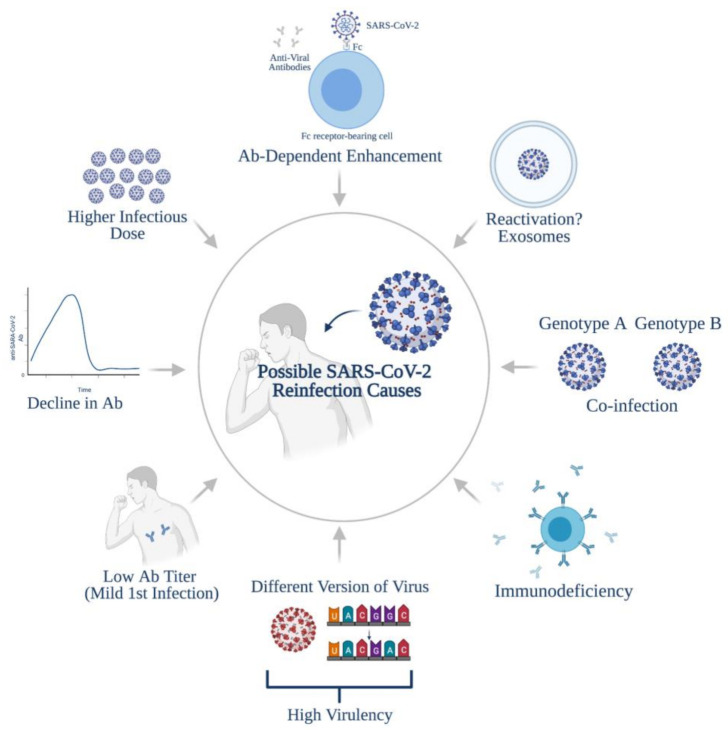
The COVID-19 pandemic is still posing a devastating threat to social life and economics. Despite the modest decrease in the number of cases during September-November 2020, the number of active cases is on the rise again. This increase was associated with the emergence and spread of the new SARS-CoV-2 variants of concern (VOCs), such as the U.K. (B1.1.7), South Africa (B1.351), Brazil (P1), and Indian (B1.617.2) strains. The rapid spread of these new variants has raised concerns about the multiple waves of infections and the effectiveness of available vaccines. In this review, we discuss SARS-CoV-2 reinfection rates in previously infected and vaccinated individuals in relation to humoral responses. Overall, a limited number of reinfection cases have been reported worldwide, suggesting long protective immunity. Most reinfected patients were asymptomatic during the second episode of infection. Reinfection was attributed to several viral and/or host factors, including (i) underlying immunological comorbidities; (ii) low antibody titers due to the primary infection or vaccination; (iii) rapid decline in antibody response after infection or vaccination; and (iv) reinfection with a different SARS-CoV-2 variant/lineage. Infections after vaccination were also reported on several occasions, but mostly associated with mild or no symptoms. Overall, findings suggest that infection- and vaccine-induced immunity would protect from severe illness, with the vaccine being effective against most VOCs.
Keywords: SARS-CoV-2; antibodies; coronavirus; reinfection; variants.
Conflict of interest statement
The authors declare no conflict of interest.
Figures
References
-
- Tegally H., Wilkinson E., Giovanetti M., Iranzadeh A., Fonseca V., Giandhari J., Doolabh D., Pillay S., San E.J., Msomi N. Emergence and rapid spread of a new severe acute respiratory syndrome-related coronavirus 2 (SARS-CoV-2) lineage with multiple spike mutations in South Africa. MedRxiv. 2020 doi: 10.1101/2020.12.21.20248640. - DOI
-
- Volz E., Mishra S., Chand M., Barrett J.C., Johnson R., Geidelberg L., Hinsley W.R., Laydon D.J., Dabrera G., O’Toole Á. Transmission of SARS-CoV-2 Lineage, B. 1.1. 7 in England: Insights from linking epidemiological and genetic data. medRxiv. 2021 doi: 10.1101/2020.12.30.20249034. - DOI
-
- Common Investigation Protocol for Investigating Suspected SARS-CoV-2 Reinfection. [(accessed on 29 March 2021)]; Available online: https://www.cdc.gov/coronavirus/2019-ncov/php/reinfection.html.
-
- Lee P.H., Tay W.C., Sutjipto S., Fong S.W., Ong S.W.X., Wei W.E., Chan Y.H., Ling L.M., Young B.E., Toh M.P.H. Associations of viral ribonucleic acid (RNA) shedding patterns with clinical illness and immune responses in Severe Acute Respiratory Syndrome Coronavirus 2 (SARS-CoV-2) infection. Clin. Transl. Immunol. 2020;9:e1160. doi: 10.1002/cti2.1160. - DOI - PMC - PubMed
Publication types
Grants and funding
LinkOut - more resources
Full Text Sources
Miscellaneous
