


School-Level Variation in Coverage of Co-Administered dTpa and HPV Dose 1 in Three Australian States
- PMID: 34696310
- PMCID: PMC8537995
- DOI: 10.3390/vaccines9101202
School-Level Variation in Coverage of Co-Administered dTpa and HPV Dose 1 in Three Australian States
Abstract
Background: Australian adolescents are routinely offered HPV and dTpa (diphtheria, tetanus, pertussis) vaccines simultaneously in the secondary school vaccination program. We identified schools where HPV initiation was lower than dTpa coverage and associated school-level factors across three states.
Methods: HPV vaccination initiation rates and dTpa vaccination coverage in 2016 were calculated using vaccine databases and school enrolment data. A multivariate analysis assessed sociodemographic and school-level factors associated with HPV initiation being >5% absolute lower than dTpa coverage.
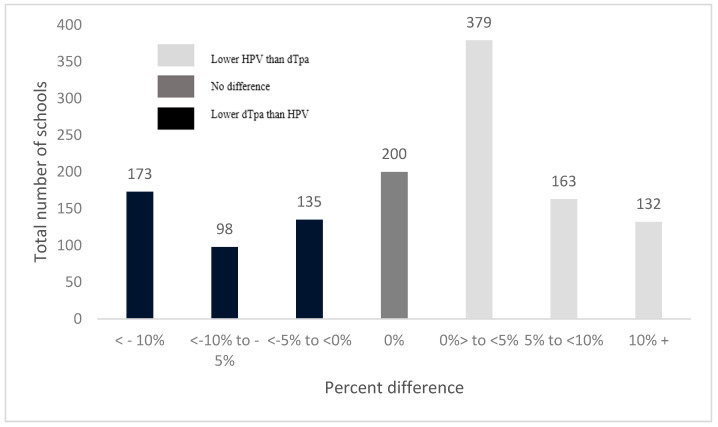
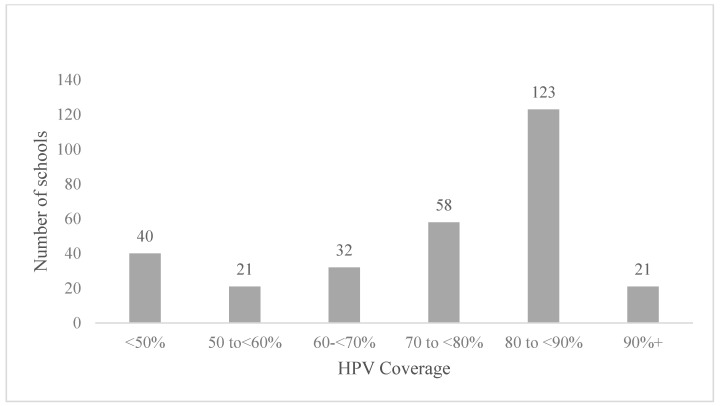
Results: Of 1280 schools included, the median school-level HPV initiation rate was 85% (interquartile range (IQR):75-90%) and the median dTpa coverage was 86% (IQR:75-92%). Nearly a quarter (24%) of all schools had HPV vaccination initiation >5% lower than dTpa coverage and 11 % had >10% difference. School-level factors independently associated with >5% difference were remote schools (aOR:3.5, 95% CI = 1.7-7.2) and schools in major cities (aOR:1.8, 95% CI = 1.0-3.0), small schools (aOR:3.3, 95% CI = 2.3-5.7), higher socioeconomic advantage (aOR:1.7, 95% CI = 1.1-2.6), and lower proportions of Language-background-other-than-English (aOR:1.9, 95% CI = 1.2-3.0).
Conclusion: The results identified a quarter of schools had lower HPV than dTpa initiation coverage, which may indicate HPV vaccine hesitancy, and the difference was more likely in socioeconomically advantaged schools. As hesitancy is context specific, it is important to understand the potential drivers of hesitancy and future research needs to understand the reasons driving differential uptake.
Keywords: adolescent vaccination; cancer prevention; differential uptake; evaluation and impact; implementation; school-based immunisation; vaccination; vaccine specific hesitancy.
Conflict of interest statement
The authors declare no conflict of interest.
Figures
References
-
- Bruni L., Diaz M., Barrionuevo-Rosas L., Herrero R., Bray F., Bosch F.X., de Sanjose S., Castellsague X. Global estimates of human papillomavirus vaccination coverage by region and income level: A pooled analysis. Lancet Glob. Health. 2016;4:e453–e463. doi: 10.1016/S2214-109X(16)30099-7. - DOI - PubMed
Grants and funding
LinkOut - more resources
Full Text Sources
Research Materials
