. 2021 Oct 25;7(1):37.
doi: 10.1186/s40959-021-00123-w.

Increased risk of non-hematological cancer in young patients with aortic stenosis: a retrospective cohort study

Affiliations

Increased risk of non-hematological cancer in young patients with aortic stenosis: a retrospective cohort study

Walid Saliba et al. Cardiooncology. .

Abstract

Background: We have previously reported an increased risk for non-hematological malignancies in young patients with moderate or severe aortic stenosis (AS). These findings were the result of a post-hoc analysis from a large echocardiography database and needed verification. Our aim was to determine, using a different study population, whether young patients with AS are at increased risk for cancer.

Methods: A large echocardiographic database was used to identify patients (age ≥ 20 years) with moderate or severe AS (study group) and patients without aortic stenosis (comparative group). The new occurrence of non-hematological malignancies was determined after the index date (first echo with moderate or severe AS or first recorded echo in the control group).

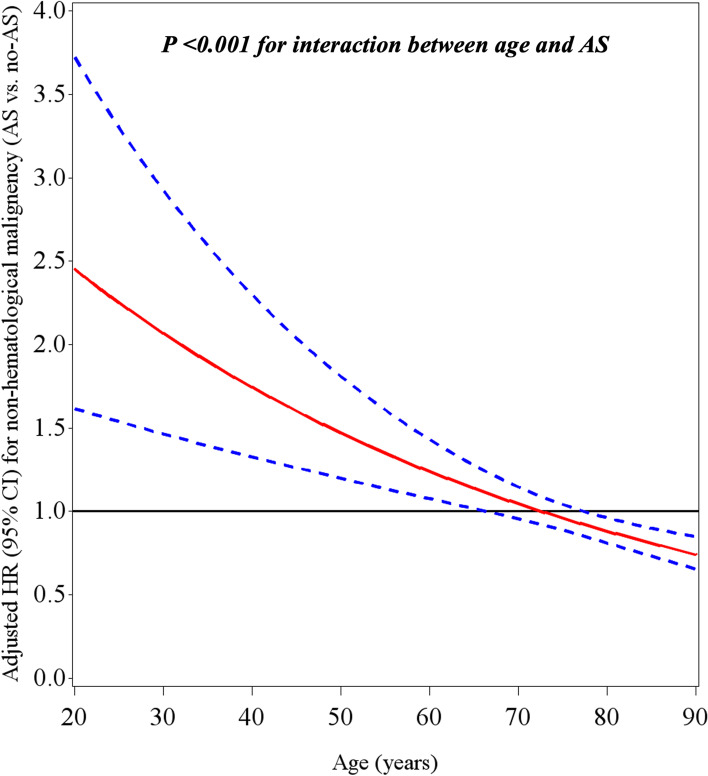
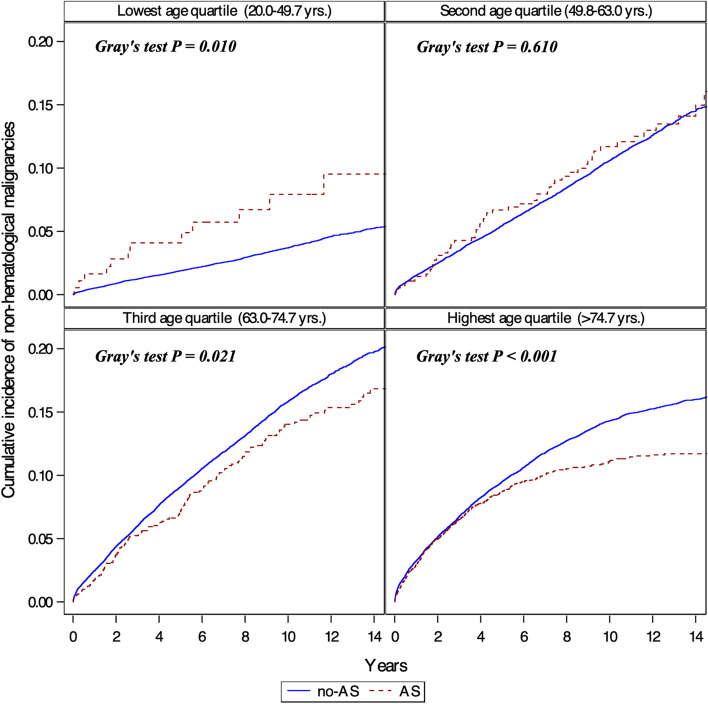
Results: The final study group included 7013 patients with AS and 98,884 without AS. During a median follow-up of 6.9 years (3.0-11.1) there were 10,705 new cases of non-hematological cancer. The crude incidence rate of cancer was higher in AS compared to non-AS patients (22.3 vs. 13.7 per 1000 patient-year, crude HR 1.58 (95%CI 1.46-1.71). After adjustment for relevant covariates, there was no difference between groups (HR 0.93, 95% CI 0.86-1.01). Only patients in the lowest age quartile (20-49.7 years), had an increased adjusted risk of cancer (HR 1.91, 95%CI 1.08-3.39). The HR for the risk of cancer associated with AS was inversely proportional to age (P < 0.001 for the interaction between AS and age).

Conclusions: Young patients with moderate or severe AS may have an increased risk for cancer. Cancer surveillance should be considered for young patients with AS.

Keywords: Age; Aortic stenosis; Cancer; Risk.


Conflict of interest statement

The authors declare that they have no competing interests.

Figures
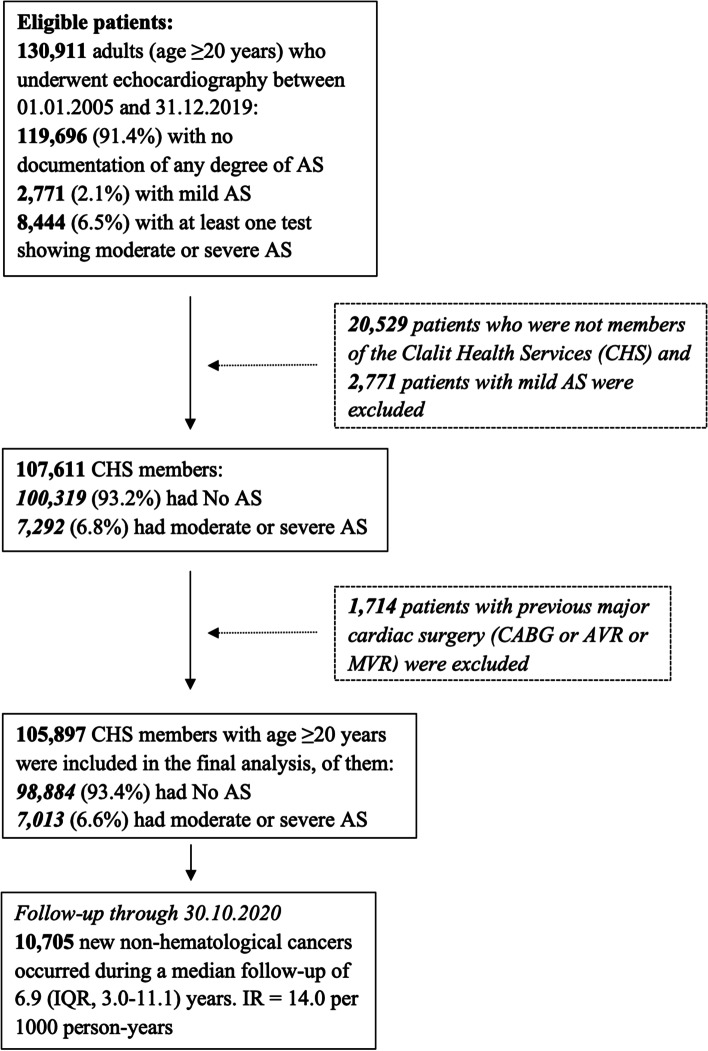
Fig. 1
Fig. 1
Study population selection flowchart. AS = aortic stenosis, AVR = aortic valve replacement, CABG = coronary artery bypass grafting, IQR = interquartile range, IR = incidence rate, MVR = mitral valve replacement
Fig. 2
Fig. 2
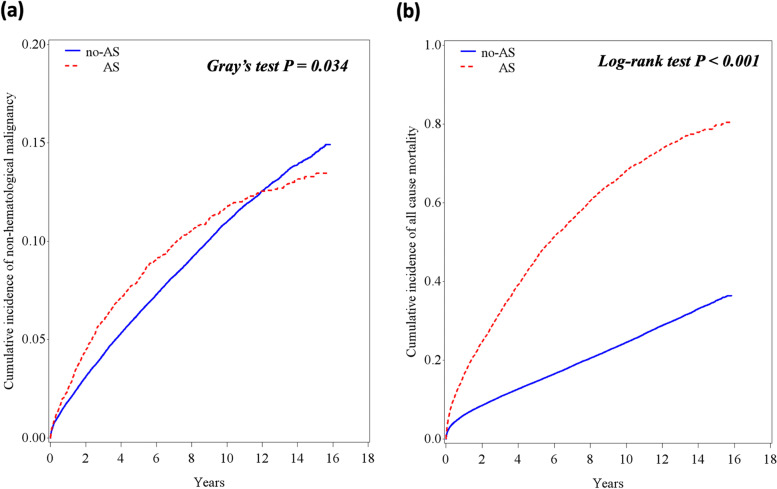
Incidence of cancer and mortality in patients with and without AS. Cumulative incidence function (CIF) for the distribution of time to non-hematological malignancies (a) and Kaplan-Meier curves for mortality (b). Death was considered a competing event for cancer (a). Solid line represents patients without AS and dotted line patients with AS
Fig. 3
Fig. 3
The interaction between age and AS and the risk of cancer. Adjusted HR* for non-hematological malignancies in AS as a function of age. Dotted lines represent the 95% confidence interval (CI). *Adjusted for age (continuous variable), sex, ethnicity, socioeconomic status, smoking, alcohol abuse, obesity, diabetes mellitus, previous history of cancer and aspirin and statin use. HR = hazard ratio
Fig. 4
Fig. 4
Incidence of cancer by age. Cumulative incidence function (CIF) for the distribution of time to non-hematological malignancies stratified by age quartiles. Death was considered a competing event for cancer. Increased incidence of cancer is evident only in the lowest age quartile. Solid line represents patients with no AS and dotted lines represent patients with AS

References

    1. Aboumsallem JP, Moslehi J, de Boer RA. Reverse cardio-oncology: Cancer development in patients with cardiovascular disease. J Am Heart Assoc. 2020;9:1–12. doi: 10.1161/JAHA.119.013754. - DOI - PMC - PubMed
    1. Meijers WC, De Boer RA. Common risk factors for heart failure and cancer. Cardiovasc Res. 2019;115:844–53. doi: 10.1093/cvr/cvz035. - DOI - PMC - PubMed
    1. Moslehi J, Zhang Q, Moore KJ. Crosstalk between the heart and cancer: beyond drug toxicity. Circulation. 2020;142:684–7. doi: 10.1161/CIRCULATIONAHA.120.048655. - DOI - PMC - PubMed
    1. Hasin T, Gerber Y, McNallan SM, Weston SA, Kushwaha SS, Nelson TJ, Cerhan JR, Roger VL. Patients with heart failure have an increased risk of incident cancer. J Am Coll Cardiol. 2013;62:881–886. doi: 10.1016/j.jacc.2013.04.088. - DOI - PMC - PubMed
    1. Hasin T, Gerber Y, Weston SA, Jiang R, Killian JM, Manemann SM, Cerhan JR, Roger VL. Heart failure after myocardial infarction is associated with increased risk of Cancer. J Am Coll Cardiol. 2016;68:265–271. doi: 10.1016/j.jacc.2016.04.053. - DOI - PMC - PubMed

LinkOut - more resources