


Health and social interventions to restore physical function of older adults post-hip fracture: a scoping review
- PMID: 34697124
- PMCID: PMC8547508
- DOI: 10.1136/bmjopen-2021-053992
Health and social interventions to restore physical function of older adults post-hip fracture: a scoping review
Abstract
Objectives: Despite inpatient rehabilitation, many older adults post-hip fracture have difficulty returning to their prefracture levels of function and activity. This scoping review aims to identify interventions for community-dwelling older adults discharged from inpatient rehabilitation and examine the function and activity outcomes associated with these interventions.
Design: This scoping review followed Arksey and O'Malley's five-stage framework.
Data sources: We searched MEDLINE, CINAHL, PsycINFO, EMBASE and Ageline electronic databases for English-language articles published between January 1946 and January 2020.
Eligibility criteria: We included studies with health and social interventions involving community-dwelling older adults and their caregivers after hip fracture and inpatient rehabilitation. The interventions were selected if initiated within 60 days post-hip fracture surgery.
Data extraction and synthesis: Two independent reviewers screened abstracts and full texts and extracted the data based on the inclusion criteria. A third reviewer adjudicated any disagreement and collated the extracted data.
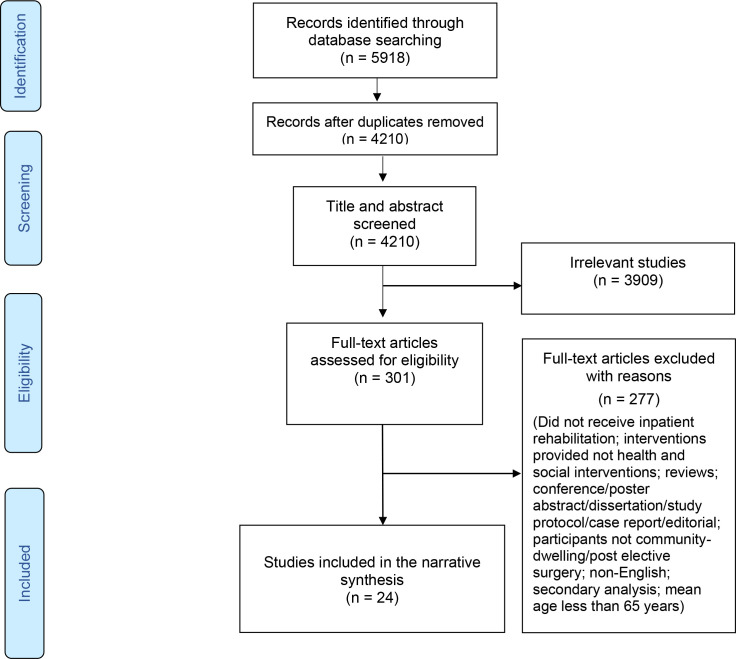
Results: Of the 24 studies included in the review, most studies (79%) used exercise-based interventions, over half (63%) included activities of daily living training and/or home assessment and environment modification as intervention components, and three studies used social intervention components. Over half of the interventions (58%) were initiated in the inpatient setting and physiotherapists provided 83% of the interventions. Only seven studies (29%) involved tailored interventions based on the older adults' unique needs and progress in exercise training. Six studies (25%) enrolled patients with cognitive impairment, and only one study examined caregiver-related outcomes. Exercise-based interventions led to improved function and activity outcomes. 29 different outcome measures were reported.
Conclusion: While exercise-based multicomponent interventions have evidence for improving outcomes in this population, there is a paucity of studies, including social interventions. Further, studies with standardised outcome measures are needed, particularly focusing on supporting caregivers and the recovery of older adults with cognitive impairment.
Keywords: geriatric medicine; hip; rehabilitation medicine.
© Author(s) (or their employer(s)) 2021. Re-use permitted under CC BY-NC. No commercial re-use. See rights and permissions. Published by BMJ.
Conflict of interest statement
Competing interests: None declared.
Figures
References
-
- World Health OrganizationTeam . Rehabilitation 2030: a call for action. World Health organization, 2017. Available: https://www.who.int/publications/m/item/rehabilitation-2030-a-call-for-a...
Publication types
MeSH terms
LinkOut - more resources
Full Text Sources
Medical
