


IPM reduces insecticide applications by 95% while maintaining or enhancing crop yields through wild pollinator conservation
- PMID: 34697238
- PMCID: PMC8612243
- DOI: 10.1073/pnas.2108429118
IPM reduces insecticide applications by 95% while maintaining or enhancing crop yields through wild pollinator conservation
Abstract
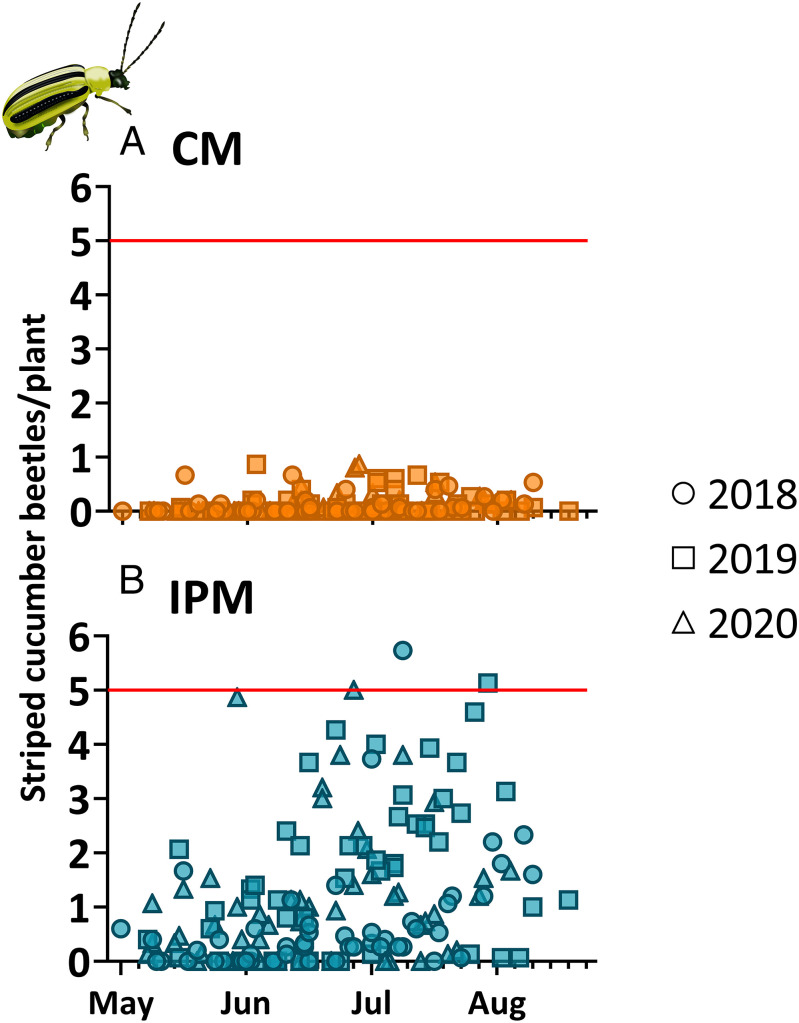
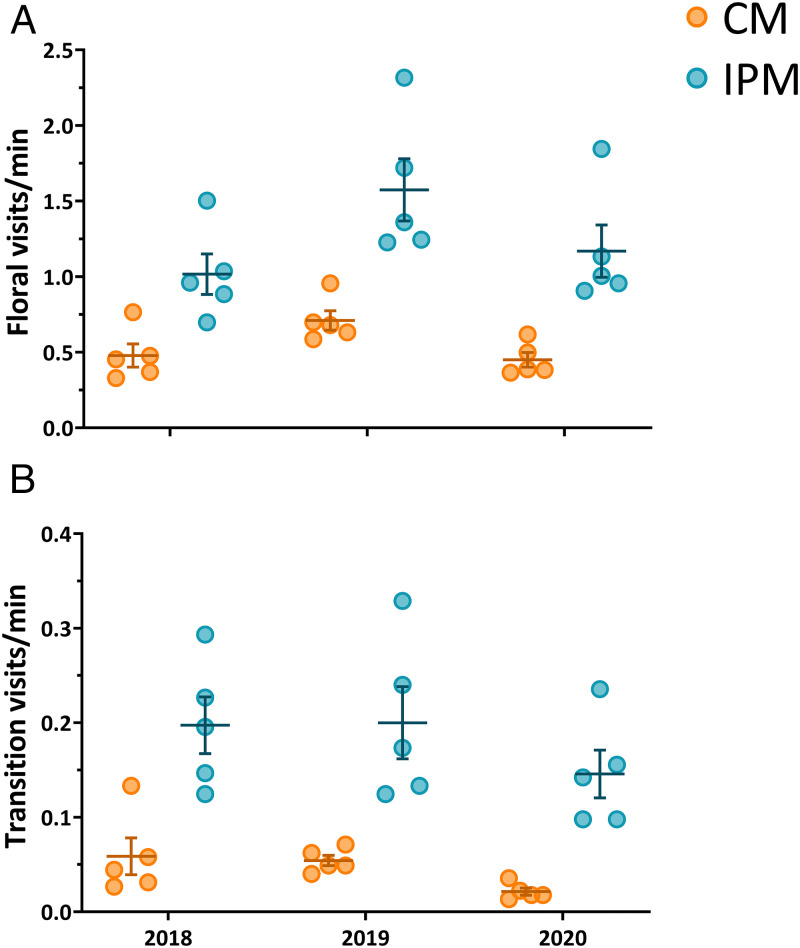
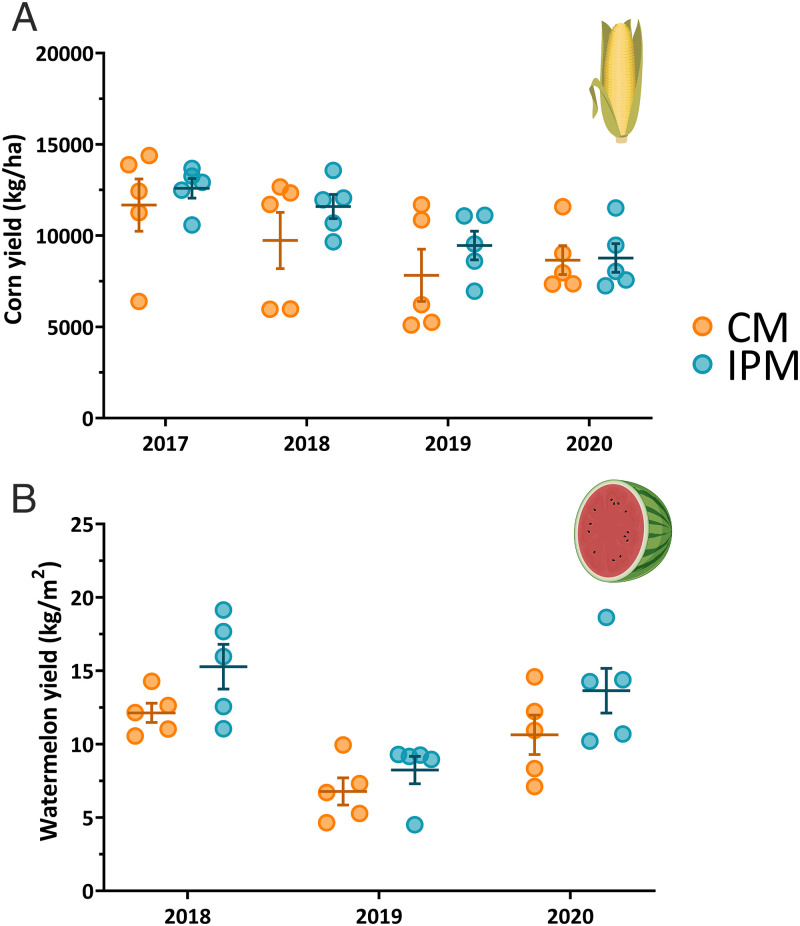
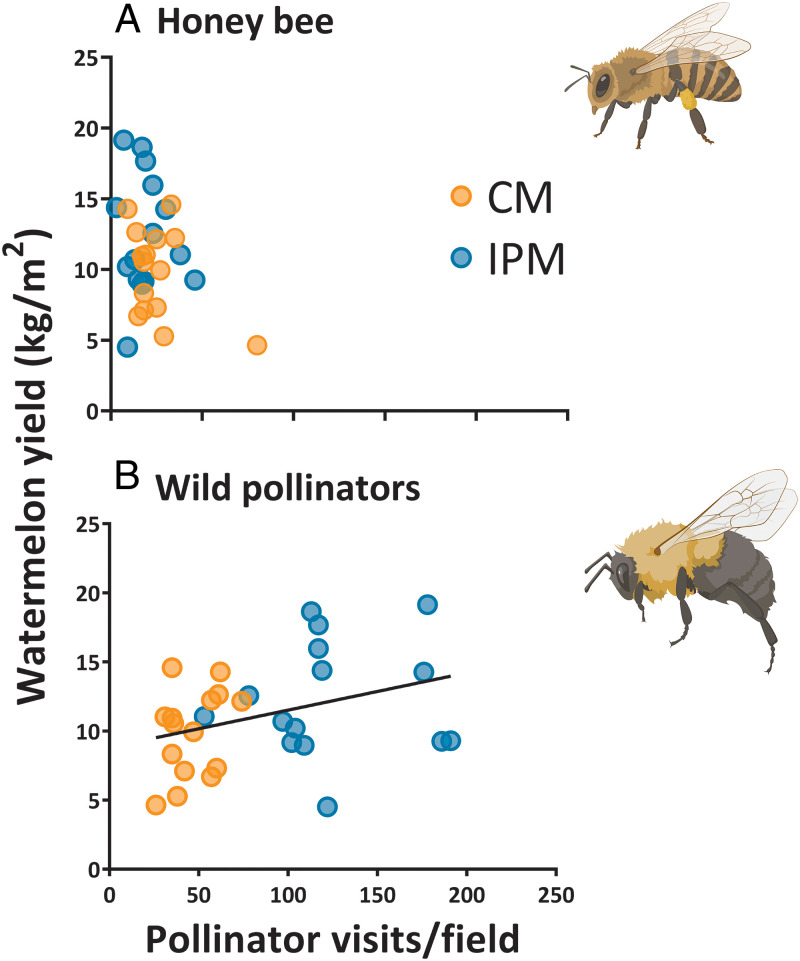
Pest management practices in modern industrial agriculture have increasingly relied on insurance-based insecticides such as seed treatments that are poorly correlated with pest density or crop damage. This approach, combined with high invertebrate toxicity for newer products like neonicotinoids, makes it challenging to conserve beneficial insects and the services that they provide. We used a 4-y experiment using commercial-scale fields replicated across multiple sites in the midwestern United States to evaluate the consequences of adopting integrated pest management (IPM) using pest thresholds compared with standard conventional management (CM). To do so, we employed a systems approach that integrated coproduction of a regionally dominant row crop (corn) with a pollinator-dependent specialty crop (watermelon). Pest populations, pollination rates, crop yields, and system profitability were measured. Despite higher pest densities and/or damage in both crops, IPM-managed pests rarely reached economic thresholds, resulting in 95% lower insecticide use (97 versus 4 treatments in CM and IPM, respectively, across all sites, crops, and years). In IPM corn, the absence of a neonicotinoid seed treatment had no impact on yields, whereas IPM watermelon experienced a 129% increase in flower visitation rate by pollinators, resulting in 26% higher yields. The pollinator-enhancement effect under IPM management was mediated entirely by wild bees; foraging by managed honey bees was unaffected by treatments and, overall, did not correlate with crop yield. This proof-of-concept experiment mimicking on-farm practices illustrates that cropping systems in major agricultural commodities can be redesigned via IPM to exploit ecosystem services without compromising, and in some cases increasing, yields.
Keywords: crop pollination; ecological intensification; integrated pest management; neonicotinoid seed treatments.
Copyright © 2021 the Author(s). Published by PNAS.
Conflict of interest statement
The authors declare no competing interest.
Figures
Comment in
-
Integrated pest management can still deliver on its promise, with help from the bees.Proc Natl Acad Sci U S A. 2021 Nov 30;118(48):e2118532118. doi: 10.1073/pnas.2118532118. Proc Natl Acad Sci U S A. 2021. PMID: 34819382 Free PMC article. No abstract available.
References
-
- Stern V. M., Smith R. Y., van den Bosch R., Hagen K. S., The integrated control concept. Hilgardia 29, 81–101 (1959).
-
- Zalucki M. P., Adamson D., Furlong M. J., The future of IPM: Whither or wither? Aust. J. Entomol. 48, 85–96 (2009).
-
- Peterson R. K. D., Higley L. G., Pedigo L. P., Whatever happened to IPM? Am. Entomol. (Lanham Md.) 64, 146–150 (2018).
-
- Sappington T. W., Hesler L. S., Allen K. C., Luttrell R. G., Papiernik S. K., Prevalence of sporadic insect pests of seedling corn and factors affecting risk of infestation. J. Integr. Pest Manag. 9, 1–27 (2018).
Publication types
MeSH terms
Substances
LinkOut - more resources
Full Text Sources
