


Association of brain white matter microstructure with cognitive performance in major depressive disorder and healthy controls: a diffusion-tensor imaging study
- PMID: 34697453
- PMCID: PMC9054669
- DOI: 10.1038/s41380-021-01330-8
Association of brain white matter microstructure with cognitive performance in major depressive disorder and healthy controls: a diffusion-tensor imaging study
Abstract
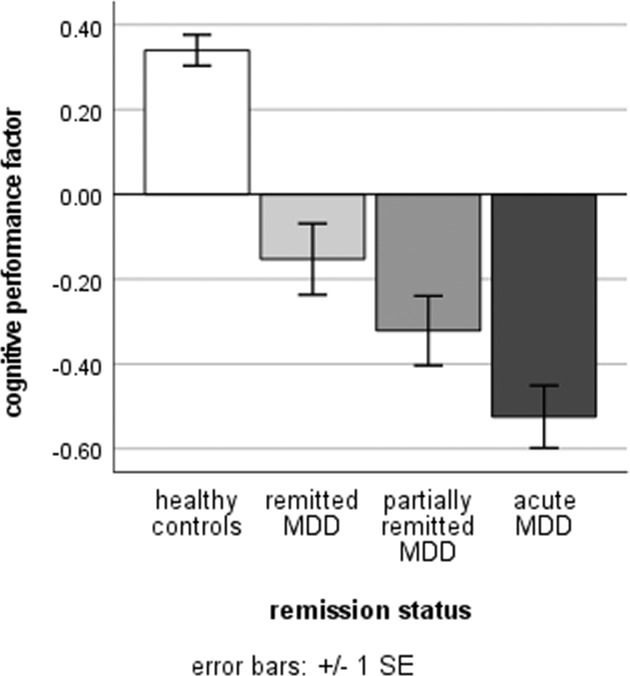
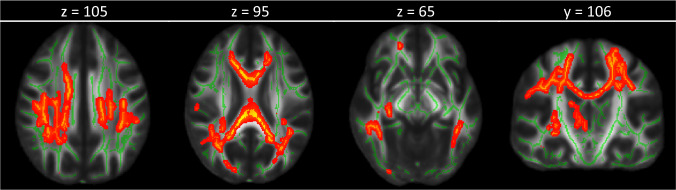
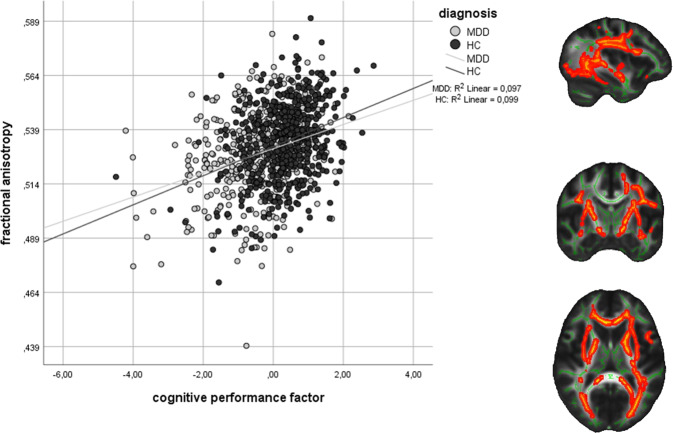
Cognitive deficits are central attendant symptoms of major depressive disorder (MDD) with a crucial impact in patients' everyday life. Thus, it is of particular clinical importance to understand their pathophysiology. The aim of this study was to investigate a possible relationship between brain structure and cognitive performance in MDD patients in a well-characterized sample. N = 1007 participants (NMDD = 482, healthy controls (HC): NHC = 525) were selected from the FOR2107 cohort for this diffusion-tensor imaging study employing tract-based spatial statistics. We conducted a principal component analysis (PCA) to reduce neuropsychological test results, and to discover underlying factors of cognitive performance in MDD patients. We tested the association between fractional anisotropy (FA) and diagnosis (MDD vs. HC) and cognitive performance factors. The PCA yielded a single general cognitive performance factor that differed significantly between MDD patients and HC (P < 0.001). We found a significant main effect of the general cognitive performance factor in FA (Ptfce-FWE = 0.002) in a large bilateral cluster consisting of widespread frontotemporal-association fibers. In MDD patients this effect was independent of medication intake, the presence of comorbid diagnoses, the number of previous hospitalizations, and depressive symptomatology. This study provides robust evidence that white matter disturbances and cognitive performance seem to be associated. This association was independent of diagnosis, though MDD patients show more pronounced deficits and lower FA values in the global white matter fiber structure. This suggests a more general, rather than the depression-specific neurological basis for cognitive deficits.
© 2021. The Author(s).
Conflict of interest statement
TK received unrestricted educational grants from Servier, Janssen, Recordati, Aristo, Otsuka, neuraxpharm. This funding is not associated with the current work. On behalf of all other authors, the corresponding author states no competing interests.
Figures
References
-
- World Health Organization. International classification of diseases for mortality and morbidity statistics (11th Revision). 2018. Retrieved from https://icd.who.int/.
Publication types
MeSH terms
LinkOut - more resources
Full Text Sources
