


Annual Report to the Nation on the Status of Cancer, Part 2: Patient Economic Burden Associated With Cancer Care
- PMID: 34698839
- PMCID: PMC9891103
- DOI: 10.1093/jnci/djab192
Annual Report to the Nation on the Status of Cancer, Part 2: Patient Economic Burden Associated With Cancer Care
Abstract
Background: The American Cancer Society, National Cancer Institute, Centers for Disease Control and Prevention, and North American Association of Central Cancer Registries provide annual information about cancer occurrence and trends in the United States. Part 1 of this annual report focuses on national cancer statistics. This study is part 2, which quantifies patient economic burden associated with cancer care.
Methods: We used complementary data sources, linked Surveillance, Epidemiology, and End Results-Medicare, and the Medical Expenditure Panel Survey to develop comprehensive estimates of patient economic burden, including out-of-pocket and patient time costs, associated with cancer care. The 2000-2013 Surveillance, Epidemiology, and End Results-Medicare data were used to estimate net patient out-of-pocket costs among adults aged 65 years and older for the initial, continuing, and end-of-life phases of care for all cancer sites combined and separately for the 21 most common cancer sites. The 2008-2017 Medical Expenditure Panel Survey data were used to calculate out-of-pocket costs and time costs associated with cancer among adults aged 18-64 years and 65 years and older.
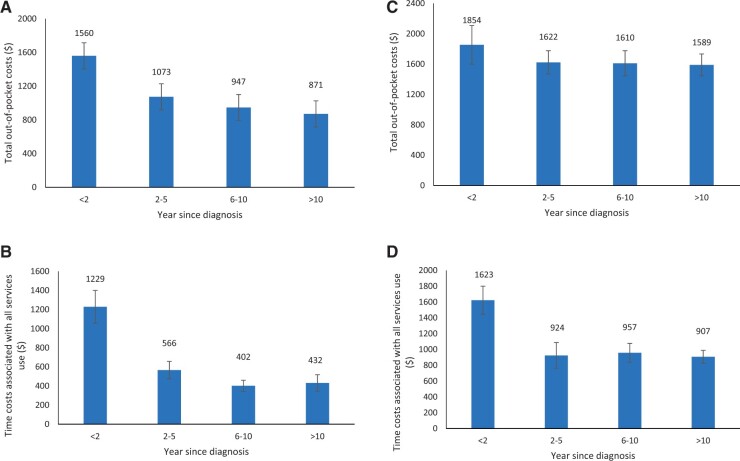
Results: Across all cancer sites, annualized net out-of-pocket costs for medical services and prescriptions drugs covered through a pharmacy benefit among adults aged 65 years and older were highest in the initial ($2200 and $243, respectively) and end-of-life phases ($3823 and $448, respectively) and lowest in the continuing phase ($466 and $127, respectively), with substantial variation by cancer site. Out-of-pocket costs were generally higher for patients diagnosed with later-stage disease. Net annual time costs associated with cancer were $304.3 (95% confidence interval = $257.9 to $350.9) and $279.1 (95% confidence interval = $215.1 to $343.3) for adults aged 18-64 years and ≥65 years, respectively, with higher time costs among more recently diagnosed survivors. National patient economic burden, including out-of-pocket and time costs, associated with cancer care was projected to be $21.1 billion in 2019.
Conclusions: This comprehensive study found that the patient economic burden associated with cancer care is substantial in the United States at the national and patient levels.
© The Author(s) 2021. Published by Oxford University Press.
Figures
Comment in
-
Addressing Cancer Financial Hardship Begins With Comprehensive Assessment of Patient Economic Burden.J Natl Cancer Inst. 2021 Nov 29;113(12):1606-1607. doi: 10.1093/jnci/djab193. J Natl Cancer Inst. 2021. PMID: 34698844 Free PMC article. No abstract available.
References
-
- Soni A. Trends in the five most costly conditions among the U.S. civilian noninstitutionalized population, 2002 and 2012. Agency for Healthcare Research and Quality, Rockville, MD. Statistical Brief #470 Web site. Published April 2015. http://www.meps.ahrq.gov/mepsweb/data_files/publications/st470/stat470.s.... Accessed April 7, 2021. - PubMed
MeSH terms
LinkOut - more resources
Full Text Sources
Medical
