


First molecular evidence of border disease virus in wild boars in Turkey
- PMID: 34699017
- PMCID: PMC8546789
- DOI: 10.1007/s11259-021-09852-w
First molecular evidence of border disease virus in wild boars in Turkey
Abstract
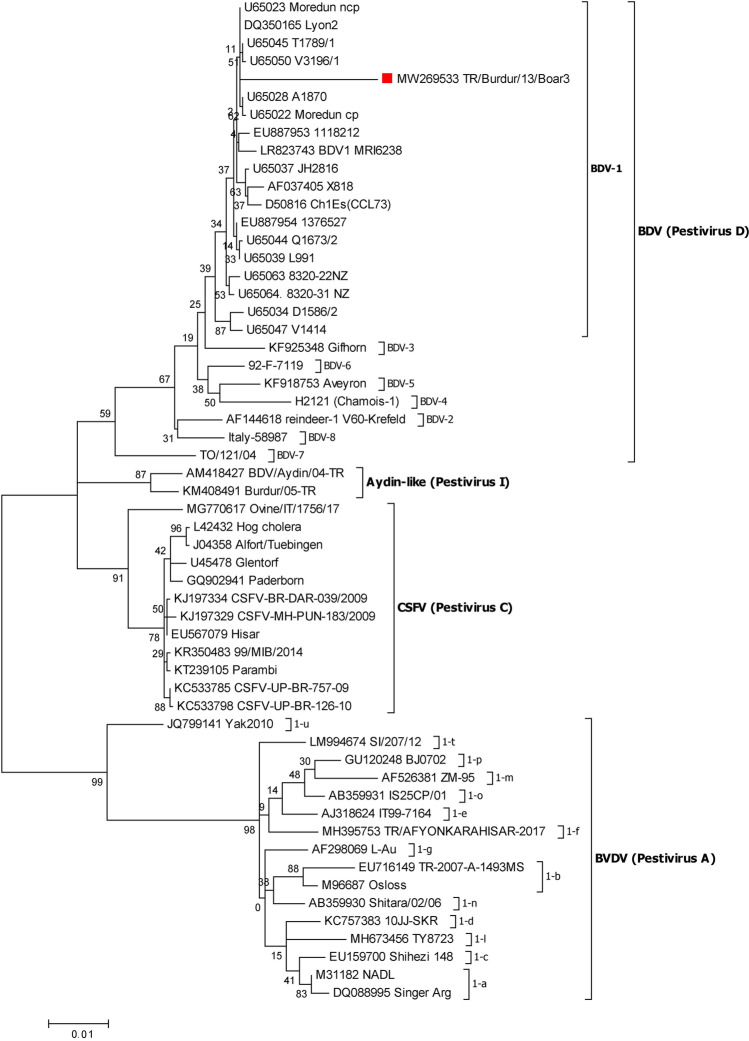
Molecular studies on viral diseases in wildlife are limited in Turkey. Pestiviruses infect domestic animals such as pig, cattle, sheep, goats and many other wild ungulates. Cross-species transmission of pestiviruses between wildlife and domestic livestock is a subject of recent concern where wild ungulates are in close contact with domestic ruminants. The International Committee on Virus Taxonomy (ICTV) has named the genus Pestivirus, which belongs to the Flaviviridae family, using the format Pestivirus A, Pestivirus B, Pestivirus C, and so on. Pestivirus A-D replaces Bovine viral diarrhea virus-1 (BVDV-1), Bovine viral diarrhea virus-2 (BVDV-2), Classical swine fever virus (CSFV) and Border disease virus (BDV) respectively. During the 2013-2014 hunting season, a total of 40 samples were collected from wild boars (Sus scrofa ferus) in the area of Western Mediterranean Turkey. In the samples, nucleic acids were investigated for pestivirus, Aujeszky's disease virus, Borna disease virus, coronavirus, mastadenovirus and rotavirus. RT-PCR was performed using primary sets to detect specific partial gene region specific to each virus. Sequence analysis was performed on a positive sample. Phylogenetic analysis revealed that the positive sample, TR/Burdur/13/Boar3, belonged to BDV genotype 1 (Pestivirus D). The first molecular findings of BDV in wild boars in Turkey are reported in this study. This study highlights the importance of further research into diseases that might be transmitted from wild boars to ruminants in Turkey.
Keywords: PCR; Pestivirus; Sequence; Sus scrofa ferus; Wildlife.
© 2021. The Author(s), under exclusive licence to Springer Nature B.V.
Conflict of interest statement
The authors declare that they have no conflict of interest.
Figures

References
-
- Becher P, Orlich M, Shannon AD, Horner G, Thiel HJ. Phylogenetic analysis of pestiviruses from domestic and wild ruminants. J Gen Virol. 1997;78(6):1357–1366. - PubMed
-
- Becher P, Orlich M, Kosmidou A, König M, Baroth M, Thiel HJ. Genetic diversity of pestiviruses: identification of novel groups and implications for classification. Virology. 1999;262(1):64–71. - PubMed
-
- Becher P, Ramirez RA, Orlich M, Rosales SC, König M, Schweizer M, Stalder H, Schirrmeier H, Thiel HJ. Genetic and antigenic characterization of novel pestivirus genotypes: implications for classification. Virology. 2003;311(1):96–104. - PubMed
MeSH terms
LinkOut - more resources
Full Text Sources
