. 2021 Oct 26;11(1):21122.
doi: 10.1038/s41598-021-00510-4.

Pseudogenization of the chloroplast threonine (trnT-GGU) gene in the sunflower family (Asteraceae)

Affiliations

Pseudogenization of the chloroplast threonine (trnT-GGU) gene in the sunflower family (Asteraceae)

Abdullah et al. Sci Rep. .

Abstract

The chloroplast genome evolves through the course of evolution. Various types of mutational events are found within the chloroplast genome, including insertions-deletions (InDels), substitutions, inversions, gene rearrangement, and pseudogenization of genes. The pseudogenization of the chloroplast threonine (trnT-GGU) gene was previously reported in Cryptomeria japonica (Cupressaceae), Pelargonium × hortorum (Geraniaceae), and Anaphalis sinica and Leontopodium leiolepis of the tribe Gnaphalieae (Asteroideae, Asteraceae). Here, we performed a broad analysis of the trnT-GGU gene among the species of 13 subfamilies of Asteraceae and found this gene as a pseudogene in core Asteraceae (Gymnarrhenoideae, Cichorioideae, Corymbioideae, and Asteroideae), which was linked to an insertion event within the 5' acceptor stem and is not associated with ecological factors such as habit, habitat, and geographical distribution of the species. The pseudogenization of trnT-GGU was not predicted in codon usage, indicating that the superwobbling phenomenon occurs in core Asteraceae in which a single transfer RNA (trnT-UGU) decodes all four codons of threonine. To the best of our knowledge, this is the first evidence of a complete clade of a plant species using the superwobbling phenomenon for translation.


Conflict of interest statement

The authors declare no competing interests.

Figures
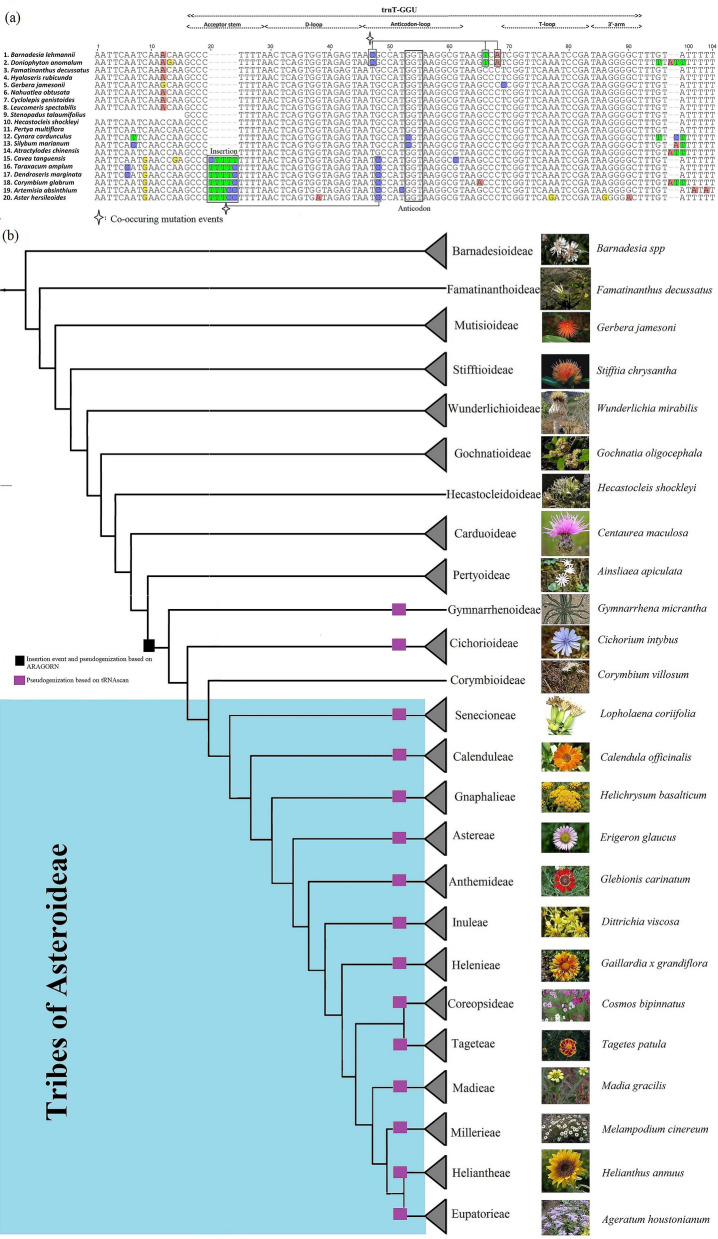
Figure 1
Figure 1
Multiple sequence alignment of the plastid threonine (trnT-GGU) gene and the position of pseudogenes within the phylogenetic tree. (a) All functional parts of the gene have been noted above the alignment. The insertion occurring in the acceptor stem is highlighted. Co-occurrence of mutational events in some species are shown above and below the alignment. (b) The black block indicates the starting node of the insertion event in the 5′ acceptor stem and pseudogene detected by ARAGORN among species of the ‘Core Asteraceae’ clade, whereas the purple block indicates the presence of pseudogenes based on tRNAscan-SE. Leaves of the phylogenetic tree from Barnadesioideae to Corymbioideae represent subfamilies of Asteraceae, while all other leaves of phylogenetic trees represent 13 tribes of the Asteroideae subfamily (indicated in blue background), followed by the icon size photo of a representative species used in our analysis. The species from 13 tribes of Asteroideae were included in the analysis and their names are noted at each node in the highlighted background. The representative photos of each subfamily and tribe are included in the figure and the species names are provided in front of each photo.
Figure 2
Figure 2
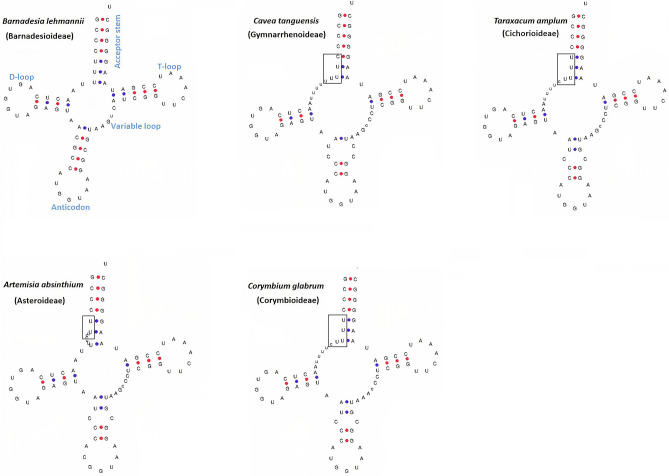
Structure of trnT-GGU gene of species of 13 subfamilies. One species was taken from each subfamily of core Asteraceae. The trnT-GGU gene of Barnadesia lehmannii is labeled to show the functional parts as representative of all species. The perfect clover leaf structure of trnT-GGU exists in the species of nine subfamilies, including Barnadesioideae, Famatinanthoideae, Stifftioideae, Mutisioideae, Gochnatioideae, Wunderlichioideae, Hecastocleidoideae, Pertyoideae, and Carduoideae. The B. lehmannii represent the structure of trnT-GGU of the species of all nine subfamilies. The insertion occurred in the species of four subfamilies of core Asteraceae (Gymnarrhenoideae, Cichorioideae, Corymbioideae, and Asteroideae), which also correspond to mismatches above the anticodon loop. The insertion is highlighted with a box.
Figure 3
Figure 3
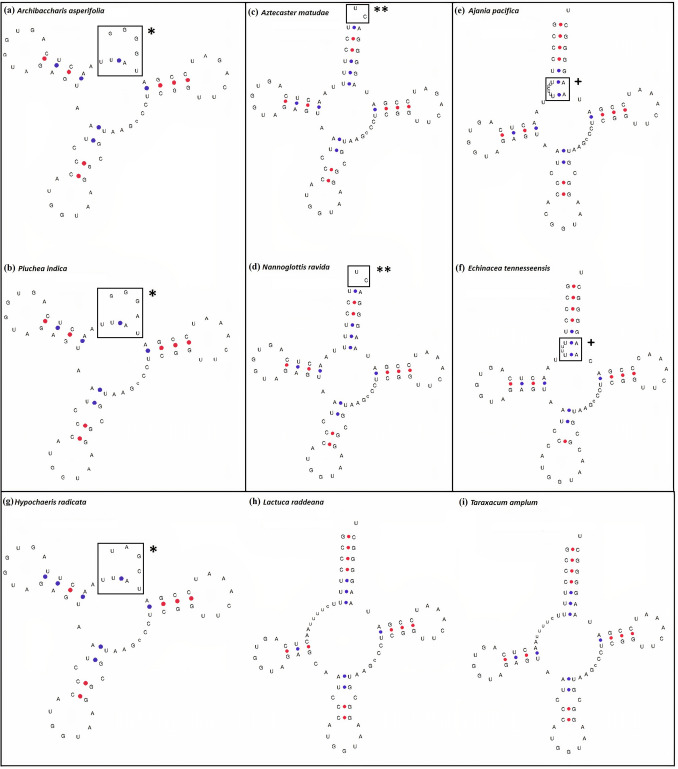
Structure of pseudo or low infernal score trnT-GGU gene in Asteroideae and Cichorioideae. The structure of the gene from ‘a’ to ‘f’ shows the species of Asteroideae, whereas from ‘g’ to ‘i’ represents species of Cichorioideae. (a and b) Pseudogenization of the gene occurred due to loss of the acceptor stem. (c and d) The genes are predicted with low infernal score (22.6) only by tRNAscan-SE and were not predicted by ARAGORN. However, the mismatch at 5′ and 3′ indicates that this gene may also be non-functional. (e and f) The gene of trnT-GGU predicted as mismatch isotypes for isoleucine. The clear insertion is visible in the acceptor stem, which disturbs the cloverleaf structure. (g) Pseudogenization of the gene occurred due to loss of the acceptor stem. (h) Indicates the tRNAscan predicted pseudo gene. (i) Indicates the tRNAscan predicted gene with low infernal score of 34.6. All the species show the mismatch of c–c, which forms an extra loop-like structure above the codon loop. * indicates loss of the acceptor arm, ** indicates mismatch at 5′ and 3′, + indicates the missing of base pair of uridines in the acceptor arm due to insertion.

References

    1. Mandel JR, et al. A fully resolved backbone phylogeny reveals numerous dispersals and explosive diversifications throughout the history of Asteraceae. Proc. Natl. Acad. Sci. U. S. A. 2019;116:14083–14088. doi: 10.1073/pnas.1903871116. - DOI - PMC - PubMed
    1. Barreda VD, et al. Early evolution of the angiosperm clade Asteraceae in the Cretaceous of Antarctica. Proc. Natl. Acad. Sci. U. S. A. 2015;112:10989–10994. doi: 10.1073/pnas.1423653112. - DOI - PMC - PubMed
    1. Panero JL, et al. Resolution of deep nodes yields an improved backbone phylogeny and a new basal lineage to study early evolution of Asteraceae. Mol. Phylogenet. Evol. 2014;80:43–53. doi: 10.1016/j.ympev.2014.07.012. - DOI - PubMed
    1. Panero JL, Crozier BS. Macroevolutionary dynamics in the early diversification of Asteraceae. Mol. Phylogenet. Evol. 2016;99:116–132. doi: 10.1016/j.ympev.2016.03.007. - DOI - PubMed
    1. Bonifácio SKV, Moura LL, Marzinek J, De-Paula OC. Comparative embryology of Stifftia and Wunderlichia and implications for its evolution in Asteraceae. Bot. J. Linn. Soc. 2019;189:169–185. doi: 10.1093/botlinnean/boy044. - DOI