Randomized Controlled Trial
. 2022 Feb;65(2):301-314.
doi: 10.1007/s00125-021-05596-z. Epub 2021 Oct 26.

Dietary palmitate and oleate differently modulate insulin sensitivity in human skeletal muscle

Affiliations
Randomized Controlled Trial

Dietary palmitate and oleate differently modulate insulin sensitivity in human skeletal muscle

Theresia Sarabhai et al. Diabetologia. 2022 Feb.

Abstract

Aims/hypothesis: Energy-dense nutrition generally induces insulin resistance, but dietary composition may differently affect glucose metabolism. This study investigated initial effects of monounsaturated vs saturated lipid meals on basal and insulin-stimulated myocellular glucose metabolism and insulin signalling.

Methods: In a randomised crossover study, 16 lean metabolically healthy volunteers received single meals containing safflower oil (SAF), palm oil (PAL) or vehicle (VCL). Whole-body glucose metabolism was assessed from glucose disposal (Rd) before and during hyperinsulinaemic-euglycaemic clamps with D-[6,6-2H2]glucose. In serial skeletal muscle biopsies, subcellular lipid metabolites and insulin signalling were measured before and after meals.

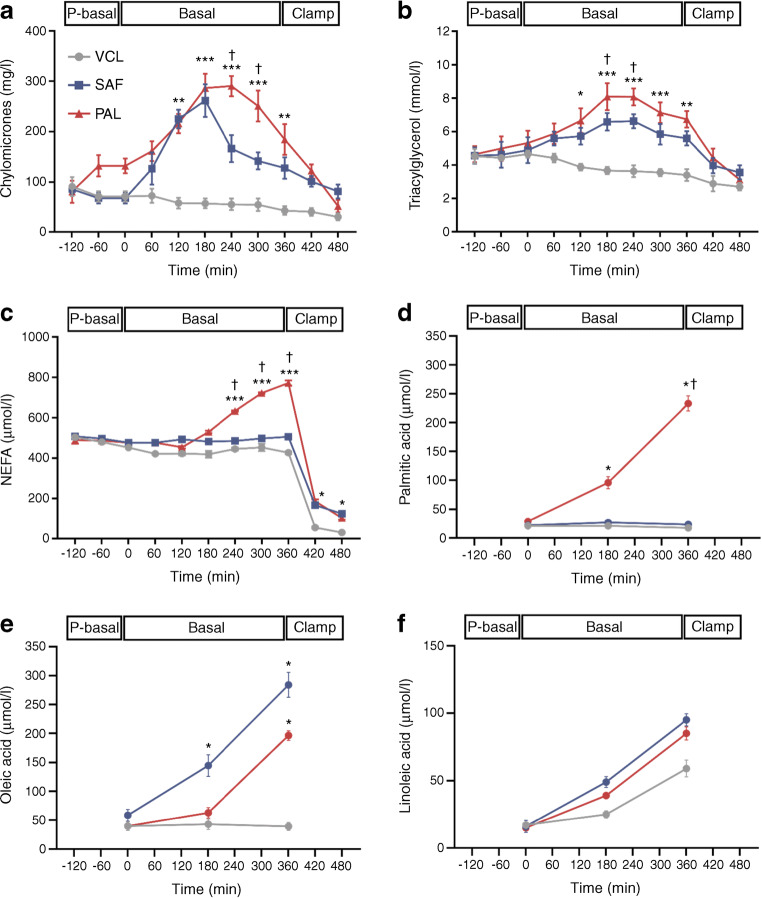
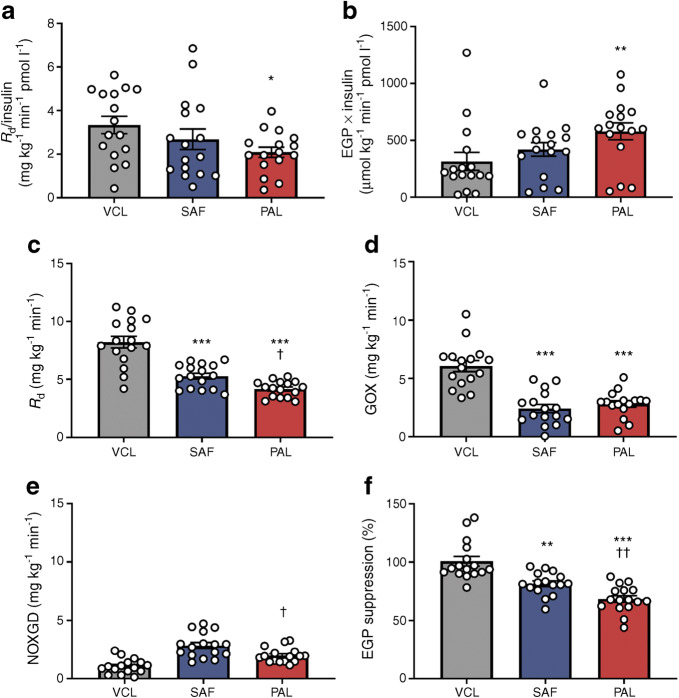
Results: SAF and PAL raised plasma oleate, but only PAL significantly increased plasma palmitate concentrations. SAF and PAL increased myocellular diacylglycerol and activated protein kinase C (PKC) isoform θ (p < 0.05) but only PAL activated PKCɛ. Moreover, PAL led to increased myocellular ceramides along with stimulated PKCζ translocation (p < 0.05 vs SAF). During clamp, SAF and PAL both decreased insulin-stimulated Rd (p < 0.05 vs VCL), but non-oxidative glucose disposal was lower after PAL compared with SAF (p < 0.05). Muscle serine1101-phosphorylation of IRS-1 was increased upon SAF and PAL consumption (p < 0.05), whereas PAL decreased serine473-phosphorylation of Akt more than SAF (p < 0.05).

Conclusions/interpretation: Lipid-induced myocellular insulin resistance is likely more pronounced with palmitate than with oleate and is associated with PKC isoforms activation and inhibitory insulin signalling.

Trial registration: ClinicalTrials.gov .NCT01736202.

Funding: German Federal Ministry of Health, Ministry of Culture and Science of the State North Rhine-Westphalia, German Federal Ministry of Education and Research, European Regional Development Fund, German Research Foundation, German Center for Diabetes Research.

Keywords: Glucose metabolism; Insulin signalling; Lipotoxicity; Monounsaturated fatty acids; Saturated fat; Skeletal muscle.


Figures

Fig. 1
Fig. 1
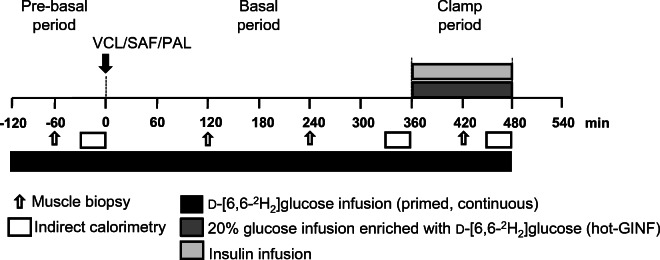
Study design. Lean, healthy adults (10 male and 6 female) randomly ingested either one dose of PAL, SAF or VCL (water) at time point 0 min on three occasions during a period of 12 weeks. Starting at −120 min, d-[6,6-2H2]glucose was infused up to +480 min. Muscle biopsies were taken at time points −60 min, +120 min, +240 min and +420 min. From +360 min to +480 min, a hyperinsulinaemic–euglycaemic clamp test was performed according to the ‘hot’ glucose infusion (hot-GINF) protocol
Fig. 2
Fig. 2
Time courses of circulating lipid metabolites in healthy humans. Plasma concentrations of chylomicrons (a), triacylglycerol (b), total NEFA (c), palmitic acid (d), oleic acid (e) and linoleic acid (f) after ingestion of PAL (red), SAF (blue) or VCL (water, grey) at 0 min. Data are shown as means ± SEM; n = 16 (chylomicrons n = 10). *p < 0.05, **p < 0.01 and ***p < 0.001 vs VCL at same time point; p < 0.05 for PAL vs SAF at same time point (ANOVA adjusted for repeated measures with Tukey–Kramer correction for each time point between interventions). P-basal, pre-basal
Fig. 3
Fig. 3
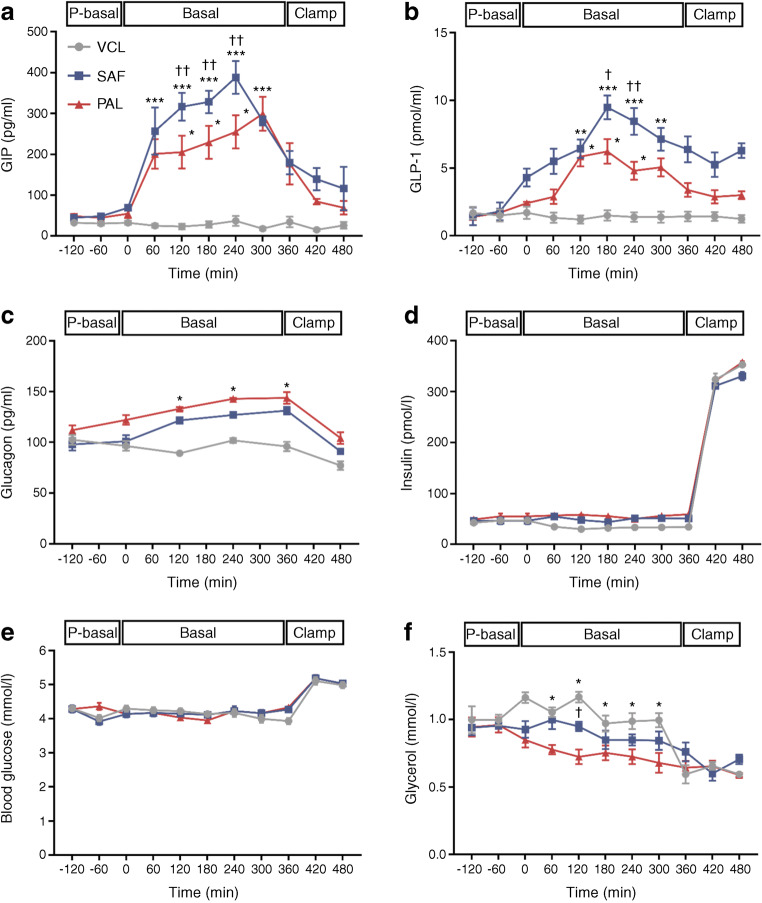
Time courses of circulating hormones and metabolites in healthy humans. Concentrations of plasma GIP (a), plasma GLP-1 (b), plasma glucagon (c), plasma insulin (d), blood glucose (e) and plasma glycerol (f) are presented after ingestion of PAL (red), SAF (blue) or VCL (water, grey) at 0 min. Data are shown as means ± SEM; insulin and blood glucose n = 16; GIP, GLP-1, glucagon and glycerol, n = 4. *p < 0.05, **p < 0.01 and ***p < 0.001 vs VCL at same time point; p < 0.05 and ††p < 0.01 for PAL vs SAF at same time point (ANOVA adjusted for repeated measures with Tukey–Kramer correction for each time point between interventions). P-basal, pre-basal
Fig. 4
Fig. 4
Rates of whole-body glucose disposal (Rd) and EGP during basal and clamp periods in healthy humans. (a, b) During the last 30 min of basal period (+330 min to +360 min), rates of glucose metabolism are presented in the context of the ambient plasma insulin concentration: Rd/insulin (a) and EGP × insulin (b). (cf) During clamp steady-state (+450 min to +480 min), insulin-stimulated Rd (c), rate of GOX (d), rate of NOXGD (e) and EGP suppression (f) are presented after PAL (red), SAF (blue) or VCL (water, grey) ingestion at 0 min. Data are shown as means ± SEM; n = 16. *p < 0.05, **p < 0.01 and ***p < 0.001 vs VCL; p < 0.05 and ††p < 0.01 for PAL vs SAF (ANOVA adjusted for repeated measures with Tukey–Kramer correction)
Fig. 5
Fig. 5
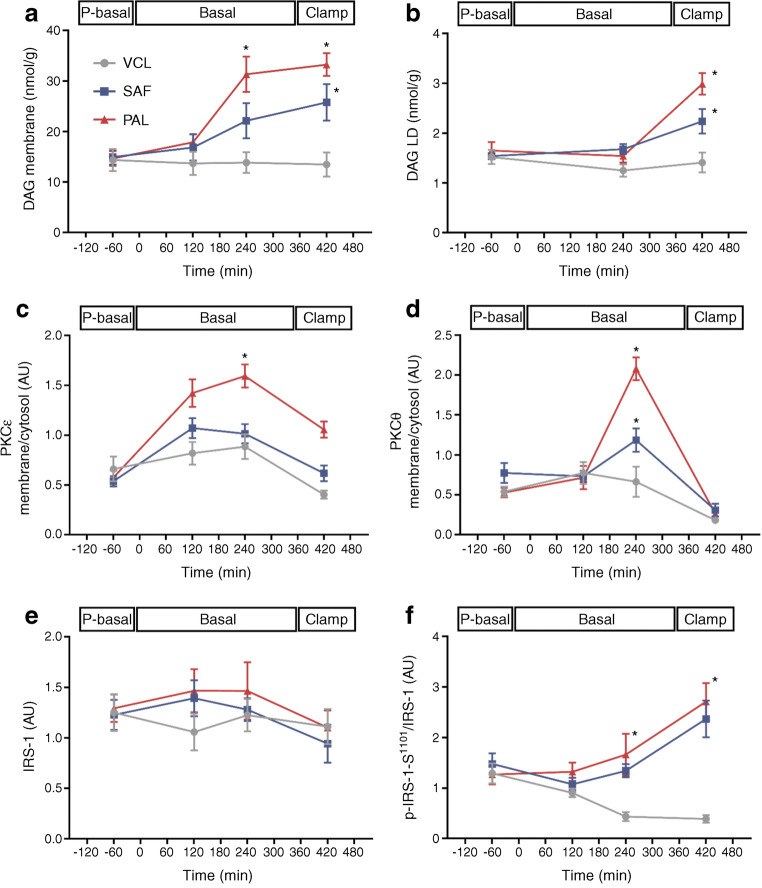
Myocellular lipid metabolites and insulin signalling (DAG–nPKC pathway) in healthy humans. DAG species 18–1:18–1, 16–0:16–0 and 16–0:18–1 in the cell membrane fraction (a), DAG species 18–1:18–1, 16–0:16–0 and 16–0:18–1 in the lipid droplet fraction (b), nPKCε activation (c), nPKCθ activation (d) and IRS-1 levels (e) as well as serine1101-phosphorylation of IRS-1 relative to IRS-1 (f) during the pre-basal, basal and clamp periods after ingestion of PAL (red), SAF (blue) or VCL (water, grey) at 0 min. Expression signals on immunoblots are expressed in arbitrary units (AU) after normalising against GAPDH for total and cytosolic proteins and against Na+/K+-ATPase for membrane proteins. Data are shown as means ± SEM; n = 16 at time point −60 min, n = 10 at +120 min, n = 6 at +240 min and +420 min. *p < 0.05 vs VCL at same time point (ANOVA adjusted for repeated measures with Tukey–Kramer correction for each time point between interventions). LD, lipid droplet fraction; P-basal, pre-basal
Fig. 6
Fig. 6
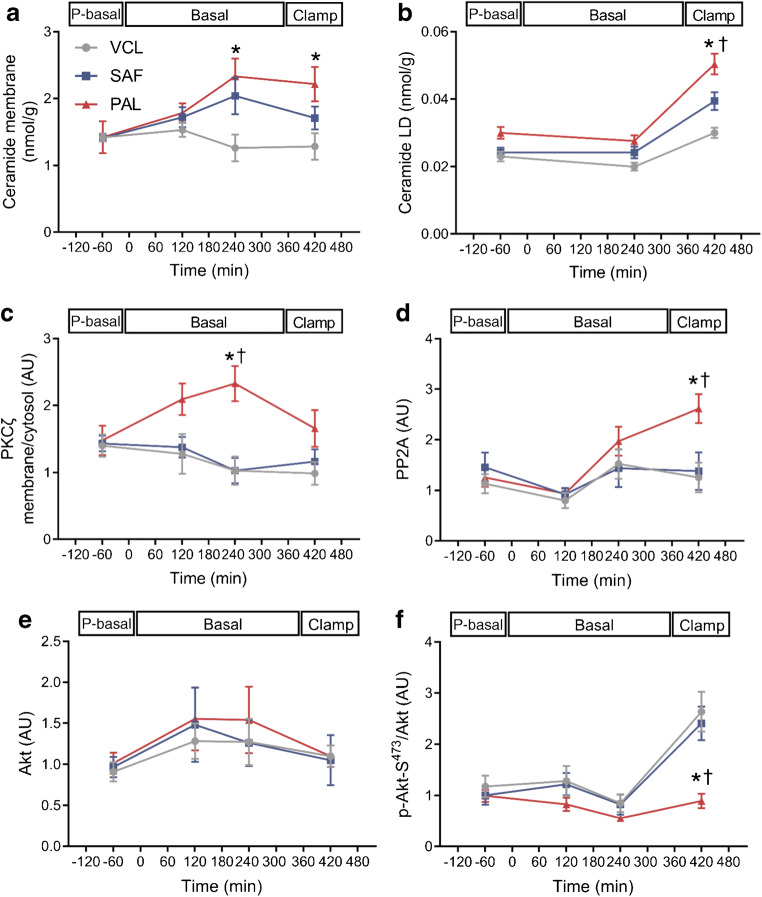
Myocellular lipid metabolites and insulin signalling (ceramide–aPKC pathway) in healthy humans. Ceramide species 16:0, 18:0 and 18:1 in the cell membrane fraction (a), ceramide species 16:0, 18:0 and 18:1 in the lipid droplet fraction (b), aPKCζ activation (c), PP2A (d), Akt (e) and serine473-phosphorylation of Akt relative to Akt (f) after ingestion of PAL (red), SAF (blue) or VCL (water, grey) at 0 min. Expression signals on immunoblots are expressed in arbitrary units (AU) after normalising against GAPDH for total and cytosolic proteins and against Na+/K+-ATPase for membrane proteins. Data are shown as means ± SEM; n = 16 at time point −60 min, n = 10 at +120 min, n = 6 at +240 min and +420 min. *p < 0.05 vs VCL at same time point; p < 0.05 for PAL vs SAF at same time point (ANOVA adjusted for repeated measures with Tukey–Kramer correction for each time point between interventions). P-basal; pre-basal

References

    1. Roden M, Shulman GI. The integrative biology of type 2 diabetes. Nature. 2019;576(7785):51–60. doi: 10.1038/s41586-019-1797-8. - DOI - PubMed
    1. Echouffo-Tcheugui JB, Ahima RS. Does diet quality or nutrient quantity contribute more to health? J Clin Invest. 2019;129(10):3969–3970. doi: 10.1172/JCI131449. - DOI - PMC - PubMed
    1. Piepoli MF, Hoes AW, Agewall S et al (2016) 2016 European guidelines on cardiovascular disease prevention in clinical practice: the sixth joint task force of the European Society of Cardiology and Other Societies on cardiovascular disease prevention in clinical practice (constituted by representatives of 10 societies and by invited experts) developed with the special contribution of the European Association for Cardiovascular Prevention & rehabilitation (EACPR). Eur Heart J 37(29):2315–2381. 10.1093/eurheartj/ehw106 - PMC - PubMed
    1. American Diabetes Association 4. Lifestyle management: standards of medical Care in Diabetes-2018. Diabetes Care. 2018;41(Suppl 1):S38–s50. doi: 10.2337/dc18-S004. - DOI - PubMed
    1. Nowotny B, Zahiragic L, Krog D, et al. Mechanisms underlying the onset of oral lipid-induced skeletal muscle insulin resistance in humans. Diabetes. 2013;62:2240–2248. doi: 10.2337/db12-1179. - DOI - PMC - PubMed

Publication types

MeSH terms

Associated data