Evaluation of Commercial Anti-SARS-CoV-2 Antibody Assays and Comparison of Standardized Titers in Vaccinated Health Care Workers
- PMID: 34705539
- PMCID: PMC8769743
- DOI: 10.1128/JCM.01746-21
Evaluation of Commercial Anti-SARS-CoV-2 Antibody Assays and Comparison of Standardized Titers in Vaccinated Health Care Workers
Abstract
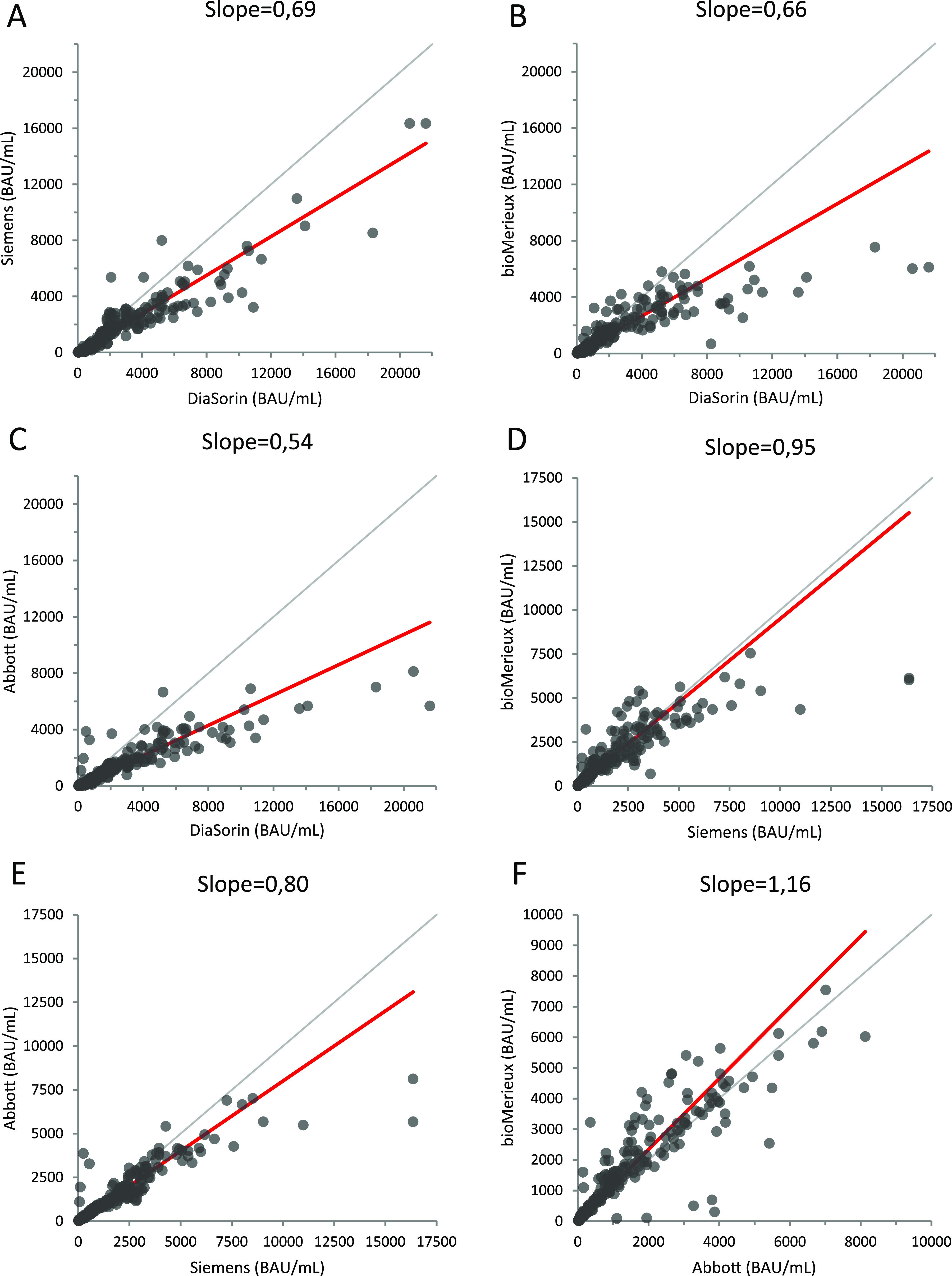
With the availability of vaccines, commercial assays detecting anti-severe acute respiratory syndrome coronavirus-2 antibodies (Ab) evolved toward quantitative assays directed to the spike glycoprotein or its receptor binding domain (RBD). The main objective of the present study was to compare the Ab titers obtained with quantitative commercial binding Ab assays, after one dose (convalescent individuals) or two doses (naive individuals) of vaccine, in health care workers (HCW). Antibody titers were measured in 255 sera (from 150 HCW) with five quantitative immunoassays (Abbott RBD IgG II quant, bioMérieux RBD IgG, DiaSorin Trimeric spike IgG, Siemens Healthineers RBD IgG, Wantai RBD IgG). One qualitative total antibody anti-RBD detection assay (Wantai) was used to detect previous infection before vaccination. The results are presented in binding Ab units (BAU)/mL after application, when possible, of a conversion factor provided by the manufacturers and established from a World Health Organization internal standard. There was a 100% seroconversion with all assays evaluated after two doses of vaccine. With assays allowing BAU/mL correction, Ab titers were correlated (Pearson correlation coefficient, ρ, range: 0.85-0.94). The titer differences varied by a mean of 10.6% between Siemens and bioMérieux assays to 60.9% between Abbott and DiaSorin assays. These results underline the importance of BAU conversion for the comparison of Ab titer obtained with the different quantitative assays. However, significant differences persist, notably, between kits detecting Ab against the different antigens. A true standardization of the assays would be to include the International Standard in the calibration of each assay to express the results in IU/mL.
Keywords: SARS-CoV-2 antibodies; commercial assays; health care workers; immunization; quantification; standardized titers; vaccination.
Figures


References
-
- Bonelli F, Blocki FA, Bunnell T, Chu E, De La O A, Grenache DG, Marzucchi G, Montomoli E, Okoye L, Pallavicini L, Streva VA, Torelli A, Wagner A, Zanin D, Zierold C, Wassenberg JJ. 2021. Evaluation of the automated LIAISON SARS-CoV-2 trimericS IgG assay for the detection of circulating antibodies. Clin Chem Lab Med 59:1463–1467. 10.1515/cclm-2021-0023. - DOI - PubMed
-
- Bradley BT, Bryan A, Fink SL, Goecker EA, Roychoudhury P, Huang M-L, Zhu H, Chaudhary A, Madarampalli B, Lu JYC, Strand K, Whimbey E, Bryson-Cahn C, Schippers A, Mani NS, Pepper G, Jerome KR, Morishima C, Coombs RW, Wener M, Cohen S, Greninger AL. 2021. Anti-SARS-CoV-2 antibody levels measured by the advise Dx SARS-CoV-2 assay are concordant with previously available serologic assays but are not fully predictive of sterilizing immunity. J Clin Microbiol 59:e00989-21. 10.1128/JCM.00989-21. - DOI - PMC - PubMed
-
- English E, Cook LE, Piec I, Dervisevic S, Fraser WD, John WG. 2021. Performance of the Abbott SARS-CoV-2 IgG II quantitative antibody assay including the new variants of concern (VOC 202012/V1 (UK) and VOC 202012/V2 (South Africa)): And first steps towards global harmonization of COVID-19 antibody methods. J Clin Microbiol 59:e00288-21. 10.1128/JCM.00288-21. - DOI - PMC - PubMed
-
- Irsara C, Egger AE, Prokop W, Nairz M, Loacker L, Sahanic S, Pizzini A, Sonnweber T, Holzer B, Mayer W, Schennach H, Loeffler-Ragg J, Bellmann-Weiler R, Hartmann B, Tancevski I, Weiss G, Binder CJ, Anliker M, Griesmacher A, Hoermann G. 2021. Clinical validation of the siemens quantitative SARS-CoV-2 spike IgG assay (SCOVG) reveals improved sensitivity and a good correlation with virus neutralization titers. Clin Chem Lab Med 59:1453–1462. 10.1515/cclm-2021-0214. - DOI - PubMed
Publication types
MeSH terms
Substances
Grants and funding
LinkOut - more resources
Full Text Sources
Medical
Miscellaneous