. 2022 Jan 26;96(2):e0159921.
doi: 10.1128/JVI.01599-21. Epub 2021 Oct 27.

Protective Efficacy of Gastrointestinal SARS-CoV-2 Delivery against Intranasal and Intratracheal SARS-CoV-2 Challenge in Rhesus Macaques

Affiliations

Protective Efficacy of Gastrointestinal SARS-CoV-2 Delivery against Intranasal and Intratracheal SARS-CoV-2 Challenge in Rhesus Macaques

Jingyou Yu et al. J Virol. .

Abstract

Live oral vaccines have been explored for their protective efficacy against respiratory viruses, particularly for adenovirus serotypes 4 and 7. The potential of a live oral vaccine against severe acute respiratory syndrome coronavirus 2 (SARS-CoV-2), however, remains unclear. In this study, we assessed the immunogenicity of live SARS-CoV-2 delivered to the gastrointestinal tract in rhesus macaques and its protective efficacy against intranasal and intratracheal SARS-CoV-2 challenge. Postpyloric administration of SARS-CoV-2 by esophagogastroduodenoscopy resulted in limited virus replication in the gastrointestinal tract and minimal to no induction of mucosal antibody titers in rectal swabs, nasal swabs, and bronchoalveolar lavage fluid. Low levels of serum neutralizing antibodies were induced and correlated with modestly diminished viral loads in nasal swabs and bronchoalveolar lavage fluid following intranasal and intratracheal SARS-CoV-2 challenge. Overall, our data show that postpyloric inoculation of live SARS-CoV-2 is weakly immunogenic and confers partial protection against respiratory SARS-CoV-2 challenge in rhesus macaques. IMPORTANCE SARS-CoV-2 remains a global threat, despite the rapid deployment but limited coverage of multiple vaccines. Alternative vaccine strategies that have favorable manufacturing timelines, greater ease of distribution, and improved coverage may offer significant public health benefits, especially in resource-limited settings. Live oral vaccines have the potential to address some of these limitations; however, no studies have yet been conducted to assess the immunogenicity and protective efficacy of a live oral vaccine against SARS-CoV-2. Here, we report that oral administration of live SARS-CoV-2 in nonhuman primates may offer prophylactic benefits, but the formulation and route of administration will require further optimization.

Keywords: COVID-19; SARS-CoV-2; immunogenicity; live oral vaccine; protective efficacy.


Figures
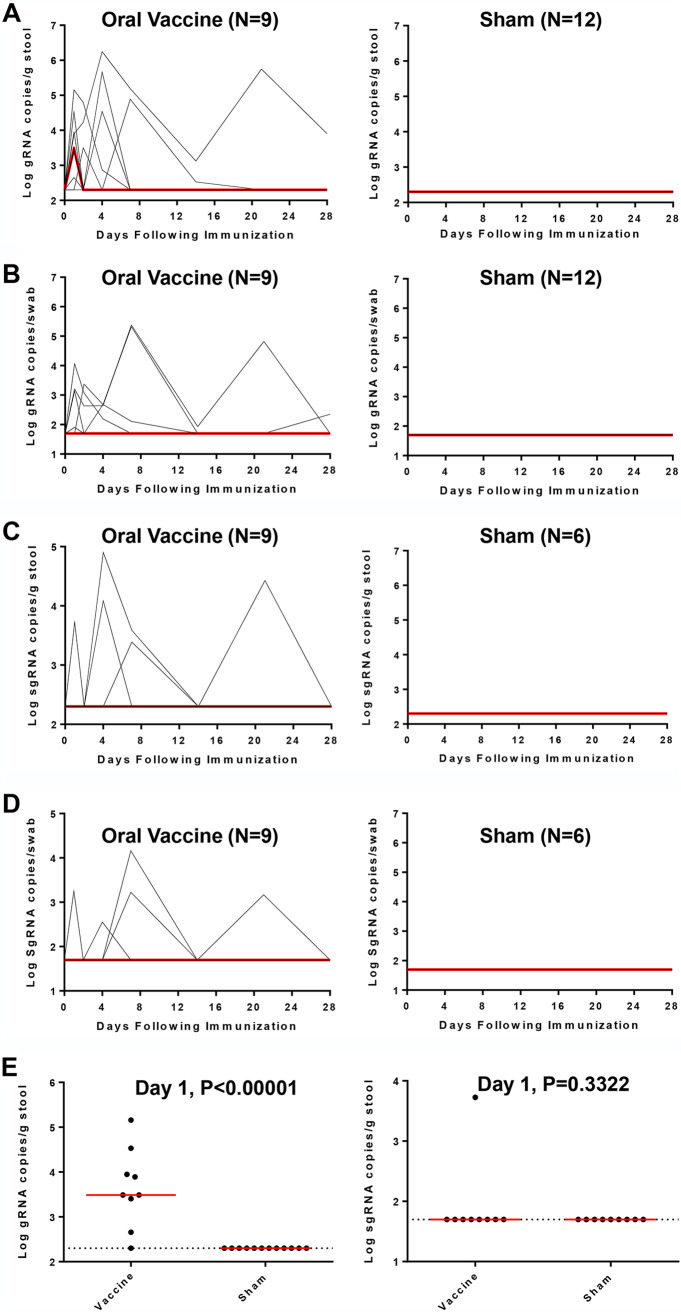
FIG 1
FIG 1
Viral shedding in rhesus macaques following live vaccine EGD administration. The GI of rhesus macaques was administered 106 TCID50 SARS-CoV-2 via EGD. (A) Log10 gRNA copies/g stool (limit of 200 copies/mL) or (C) Log10 sgRNA copies/g stool were assessed in stools in sham controls and in vaccinated animals following challenge. (B) Log10 gRNA copies/swab or (D) Log10 sgRNA copies/swab (limit of 50 copies/swab) were assessed in rectal swabs (RS) in sham controls and in vaccinated animals following challenge. Red lines reflect median values. (E) Peak viral loads in stool on day 1 following vaccination. Red lines reflect median viral loads. P values indicate two-sided Mann-Whitney tests.
FIG 2
FIG 2
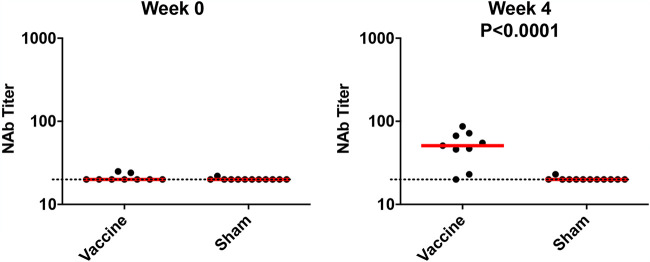
Humoral immune responses in vaccinated rhesus macaques. Humoral immune responses were assessed at weeks 0 and 4 by pseudovirus neutralization assays. Red bars reflect median responses. Dotted lines reflect the assay limit of detection.
FIG 3
FIG 3
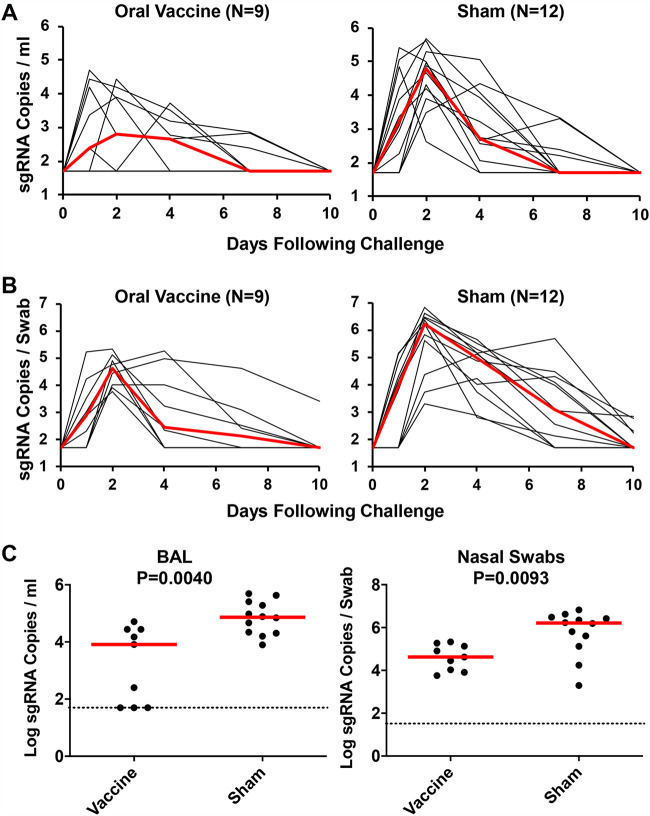
Viral loads in rhesus macaques following SARS-CoV-2 challenge. Rhesus macaques were challenged by the intranasal and intratracheal routes with 105 TCID50 SARS-CoV-2. (A) Log10 sgRNA copies/mL (limit of 50 copies/mL) were assessed in bronchoalveolar lavage (BAL) fluid in sham controls and in vaccinated animals following challenge. (B) Log10 sgRNA copies/swab (limit of 50 copies/swab) were assessed in nasal swabs (NS) in sham controls and in vaccinated animals following challenge. Red lines reflect median values. (C) Peak viral loads in BAL fluid and NS following challenge. Peak viral loads occurred on day 2 following challenge. Red lines reflect median viral loads. P values indicate two-sided Mann-Whitney tests.
FIG 4
FIG 4
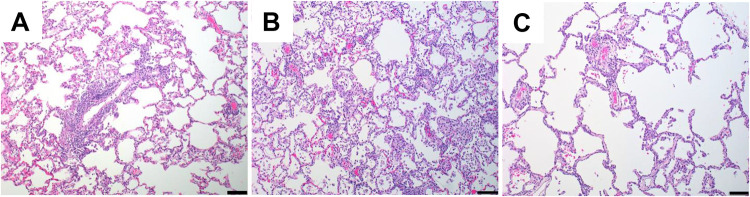
Histopathologic examination following SARS-CoV-2 challenge. Lung tissues were collected at necropsy on day 14 postchallenge, fixed with neutral buffered formalin, and stained with hematoxylin and eosin (H&E) for standard microscopic examination. Shown are representative lung tissue sections from the PBS control (A), high-dose (106 TCID50)-vaccinated (B), and low-dose (104 TCID50)-vaccinated (C) SARS-CoV-2-challenged rhesus macaques. Minimal to mild interstitial pneumonia is characterized by inflammatory cellular infiltrates and type II pneumocyte hyperplasia. Scale bars, 100 μm.
FIG 5
FIG 5
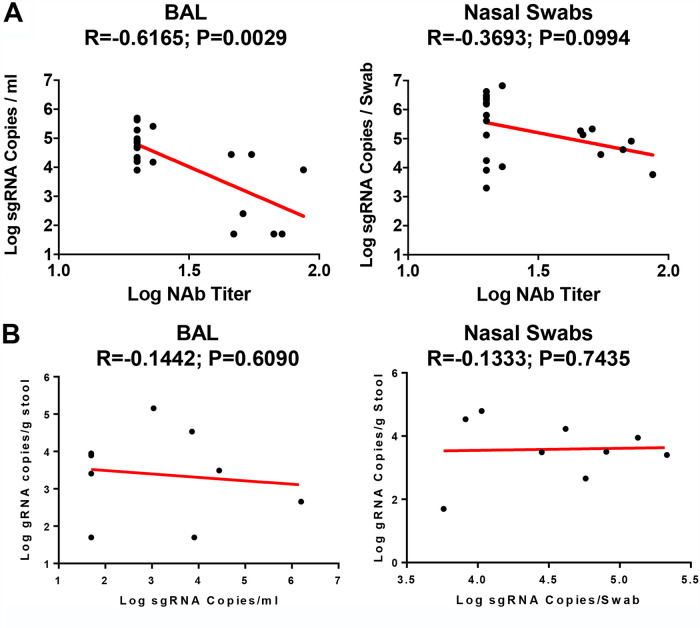
Immune correlates of protection. (A) Correlations of pseudovirus NAb titers at week 4 with log peak sgRNA copies/mL in BAL fluid and NS following challenge. (B) Correlations of log peak sgRNA copies/mL in BAL fluid and NS with log peak gRNA copies/g stool. Red lines reflect the best-fit relationship between these variables. P and R values reflect two-sided Spearman rank-correlation tests.

References

    1. Corey L, Mascola JR, Fauci AS, Collins FS. 2020. A strategic approach to COVID-19 vaccine R&D. Science 368:948–950. 10.1126/science.abc5312. - DOI - PubMed
    1. Dagotto G, Yu J, Barouch DH. 2020. Approaches and challenges in SARS-CoV-2 vaccine development. Cell Host Microbe 28:364–370. 10.1016/j.chom.2020.08.002. - DOI - PMC - PubMed
    1. Mowat AM, Agace WW. 2014. Regional specialization within the intestinal immune system. Nat Rev Immunol 14:667–685. 10.1038/nri3738. - DOI - PubMed
    1. Holmgren J, Czerkinsky C. 2005. Mucosal immunity and vaccines. Nat Med 11:S45–S53. 10.1038/nm1213. - DOI - PubMed
    1. Robert-Guroff M. 2007. Replicating and non-replicating viral vectors for vaccine development. Curr Opin Biotechnol 18:546–556. 10.1016/j.copbio.2007.10.010. - DOI - PMC - PubMed

Publication types