. 2021 Oct 27;22(1):904.
doi: 10.1186/s12891-021-04596-9.

Results of multiple ligament reconstruction after knee dislocation--A prospective study with 95 patients and minimum 2-year follow up

Affiliations

Results of multiple ligament reconstruction after knee dislocation--A prospective study with 95 patients and minimum 2-year follow up

Tao Li et al. BMC Musculoskelet Disord. .

Abstract

Background: There is still a lack of clinical data in arthroscopic treatment for treating multiple ligament injuries. This study aims to evaluate the clinical outcomes of patients with multiple ligament injuries undergoing treatment based on the classification stage and type of injury.

Methods: A prospective, clinical trial on multiple ligament injuries was planned, which included 95 patients (58 men and 37 women; age: 42.8 ± 11.9 [range, 18-63] years) from October 2017 to June 2018. Injuries were classified into three stages (emergency stage < 24 h; acute stage: 24 h to 3 weeks, and chronic stage: > 3 weeks) and six types (KD I-VI) based on injuries time and structures, which indicated appropriate treatments. The clinical outcomes were evaluated at 2, 4, 6, 8, and 12 weeks and at 6, 9, 12 months and 24 months after surgery. The final choices in efficacy index included International Knee Documentation Committee (IKDC) score, Lysholm score, visual analog scale (VAS) score, and range of motion.

Results: During the follow-up, all patients exhibited statistically significant functional improvement in the injured limb compared with their preoperative situation. The mean postoperative scores of acute stage patients at 2-year follow-up were IKDC subjective score, 77.54 ± 11.53; Lysholm score, 85.96 ± 9.39; Tegner score, 4.13 ± 1.08; and VAS score, 1.21 ± 0.76. The mean postoperative scores of chronic stage patents at 2-year follow-up were IKDC subjective score, 74.61 ± 12.38; Lysholm score, 81.71 ± 10.80; Tegner score, 3.96 ± 1.14; and VAS score, 1.71 ± 0.60. The IKDC subjective score, Lysholm score, and Tegner score were significantly improved (P < 0.01) and the VAS score was significantly decreased (P < 0.01) at 2-year follow-up. Regarding the multiple ligament injuries classification, patients with more structural damage in stages V and VI showed less progress in functional recovery than those in stages I-IV.

Conclusions: This new classification with three stages and six types helps to identify the severity of injury and plan the management effectively. The outcomes were encouraging and the subjective functional results showed significant improvement at 2-year follow-up.

Study design: Prospective clinical trial.

Level of evidence: II.

Keywords: Classification; Knee dislocation; Multiple ligament injuries; Operative surgical procedure.


Conflict of interest statement

The authors declare that they have no competing interests.

Figures
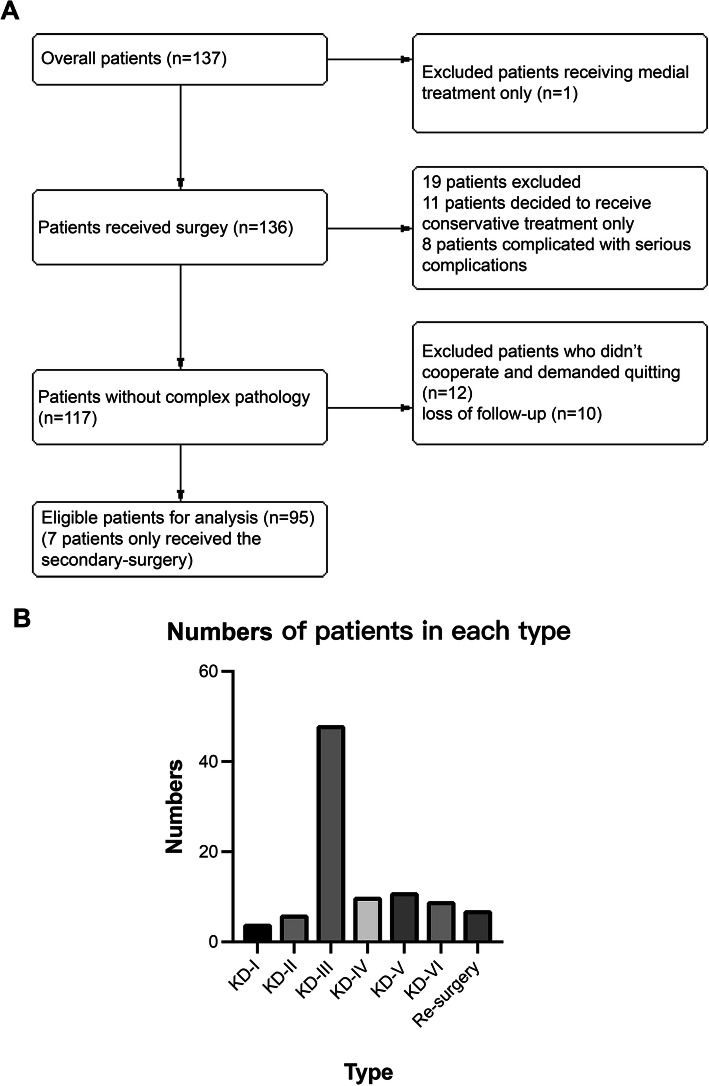
Fig. 1
Fig. 1
(A-B): Patient flow through the study (A). Number of patients with each dislocation type (B)
Fig. 2
Fig. 2
(A-C): A 48-year-old male patient suffered movement obstruction for 18 days after being hit by a heavy object on the superior part of the left knee. The whole diagnosis was acute stage KD-III: ACL + PCL + LCL, no fracture or cartilage injury, and accompanied by medial and lateral meniscus injury (A). The surgery was performed including arthroscope probing in left knee + ACL/PCL reconstruction + LCL repairing + medial and lateral meniscus repairing (B). An X-ray stress examination showed that the knee maintained good stability at the last follow-up (C). Functional scores after 1 year were International Knee Documentation Committee score: 75; Lysholm score: 83; and Tegner score: 4
Fig. 3
Fig. 3
(A-D): A 21-year-old male patient suffered painful swelling of the right knee with functional obstruction for more than 2 months. Clinical diagnosis was chronic stage complicated right knee dislocation (KD-III: ACL + PCL + MCL) with bone contusion, no fracture or cartilage injury, and accompanied by medial and lateral meniscus injury (A, B). The surgery performed included arthroscopic probing in the right knee + ACL/PCL reconstruction + MCL repairing + medial and lateral meniscus repair. An X-ray stress examination showed that the knee maintained good stability at the last follow-up. The appearance of the ligament repair (ACL, PCL) and reconstructions (MCL) were as expected at 1 year after surgery (C, D). Functional scores after 1 year were International Knee Documentation Committee score: 73; Lysholm score: 85; and Tegner score: 5
Fig. 4
Fig. 4
The postoperative X-rays of a 45-year-old man with PMC injury
Fig. 5
Fig. 5
The postoperative X-rays of a 59-year-old man with PLC injury
Fig. 6
Fig. 6
(A-E): The 2-year patient-reported outcomes for the acute stage and chronic stage groups over time: International Knee Documentation Committee (IKDC) score (A), IKDC grade at 12 months (B), visual analog scale (VAS) score (C), Tegner score (D), and Lysholm score (E)
Fig. 7
Fig. 7
(A-B): The 2-year patient-reported outcomes for the acute stage and chronic stage groups over time: Active range of motion at 12 months (A) and Passive range of motionat 12 months (B)

References

    1. Howells NR, Brunton LR, Robinson J, Porteus AJ, Eldridge JD, Murray JR. Acute knee dislocation: an evidence based approach to the management of the multiligament injured knee. Injury. 2011;42(11):1198–1204. doi: 10.1016/j.injury.2010.11.018. - DOI - PubMed
    1. Natsuhara KM, Yeranosian MG, Cohen JR, Wang JC, McAllister DR, Petrigliano FA. What is the frequency of vascular injury after knee dislocation? Clin Orthop Relat Res. 2014;472(9):2615–2620. doi: 10.1007/s11999-014-3566-1. - DOI - PMC - PubMed
    1. Rihn JA, Groff YJ, Harner CD, Cha PS. The acutely dislocated knee: evaluation and management. J Am Acad Orthop Surg. 2004;12(5):334–346. doi: 10.5435/00124635-200409000-00008. - DOI - PubMed
    1. Robertson A, Nutton RW, Keating JF. Dislocation of the knee. J Bone Joint Surg (Br) 2006;88(6):706–711. doi: 10.1302/0301-620X.88B6.17448. - DOI - PubMed
    1. Maxwell GT, Warth RJ, Amin A, Darlow MA, Bailey L, Lowe WR, Harner CD. Multiple ligament knee injuries: does the knee dislocation classification predict the type of surgical management? J Knee Surg. 2021;34(3):273–279. doi: 10.1055/s-0039-1695739. - DOI - PubMed
