Review
. 2021 Oct 27;14(1):554.
doi: 10.1186/s13071-021-04953-6.

On the role of dauer in the adaptation of nematodes to a parasitic lifestyle

Affiliations
Review

On the role of dauer in the adaptation of nematodes to a parasitic lifestyle

Lieke E Vlaar et al. Parasit Vectors. .

Abstract

Nematodes are presumably the most abundant Metazoa on Earth, and can even be found in some of the most hostile environments of our planet. Various types of hypobiosis evolved to adapt their life cycles to such harsh environmental conditions. The five most distal major clades of the phylum Nematoda (Clades 8-12), formerly referred to as the Secernentea, contain many economically relevant parasitic nematodes. In this group, a special type of hypobiosis, dauer, has evolved. The dauer signalling pathway, which culminates in the biosynthesis of dafachronic acid (DA), is intensively studied in the free-living nematode Caenorhabditis elegans, and it has been hypothesized that the dauer stage may have been a prerequisite for the evolution of a wide range of parasitic lifestyles among other nematode species. Biosynthesis of DA is not specific for hypobiosis, but if it results in exit of the hypobiotic state, it is one of the main criteria to define certain behaviour as dauer. Within Clades 9 and 10, the involvement of DA has been validated experimentally, and dauer is therefore generally accepted to occur in those clades. However, for other clades, such as Clade 12, this has hardly been explored. In this review, we provide clarity on the nomenclature associated with hypobiosis and dauer across different nematological subfields. We discuss evidence for dauer-like stages in Clades 8 to 12 and support this with a meta-analysis of available genomic data. Furthermore, we discuss indications for a simplified dauer signalling pathway in parasitic nematodes. Finally, we zoom in on the host cues that induce exit from the hypobiotic stage and introduce two hypotheses on how these signals might feed into the dauer signalling pathway for plant-parasitic nematodes. With this work, we contribute to the deeper understanding of the molecular mechanisms underlying hypobiosis in parasitic nematodes. Based on this, novel strategies for the control of parasitic nematodes can be developed.

Keywords: Clade 12; Dauer; Globodera; Parasitic nematodes; Quiescence.


Conflict of interest statement

The authors declare that they have no competing interests.

Figures
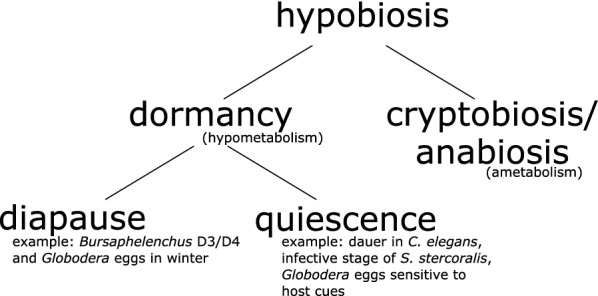
Fig. 1
Fig. 1
Hypobiosis can be divided into cryptobiosis and dormancy. The latter can in turn be divided in diapause and quiescence. An important example of quiescence is dauer in Caenorhabditis elegans and its related stages in parasitic nematodes
Fig. 2
Fig. 2
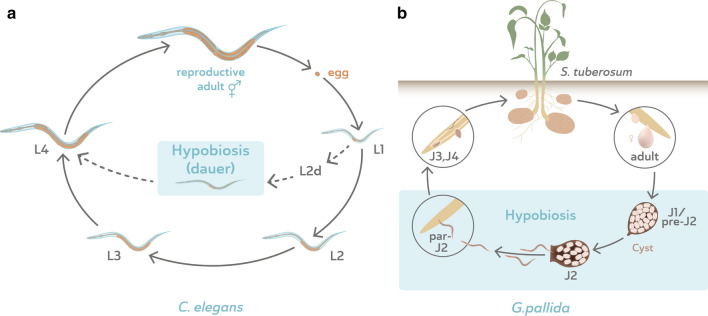
The life cycles of the free-living model nematode Caenorhabditis elegans (a) and the parasitic potato cyst nematode Globodera pallida (b). The hypobiotic stage in each species is indicated with a blue box. L1, L2, L3, L4 = larval stage 1, 2, 3 and 4. J1, J2, J3, J4 = juvenile stage 1, 2, 3 and 4. Pre-J2 = pre-parasitic juvenile stage 2. Par-J2 = parasitic juvenile stage 2
Fig. 3
Fig. 3
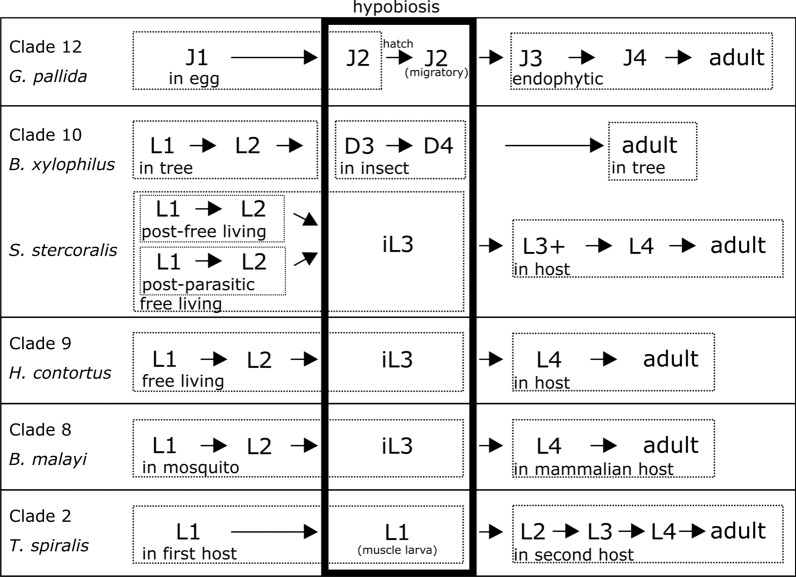
Schematic overview of life cycles of representatives of parasitic nematode of clades 2, 8, 9, 10 and 12. The hypobiotic stage is marked with a box. J1, J2, J3, J4 = juvenile stage 1, 2, 3 and 4. L1, L2, L3, L4 = larval stage 1, 2, 3 and 4. iL3 = infective larval stage 3. L3+ = post-infective third larval stage. D3, D4 = dauer stage 3 and 4
Fig. 4
Fig. 4
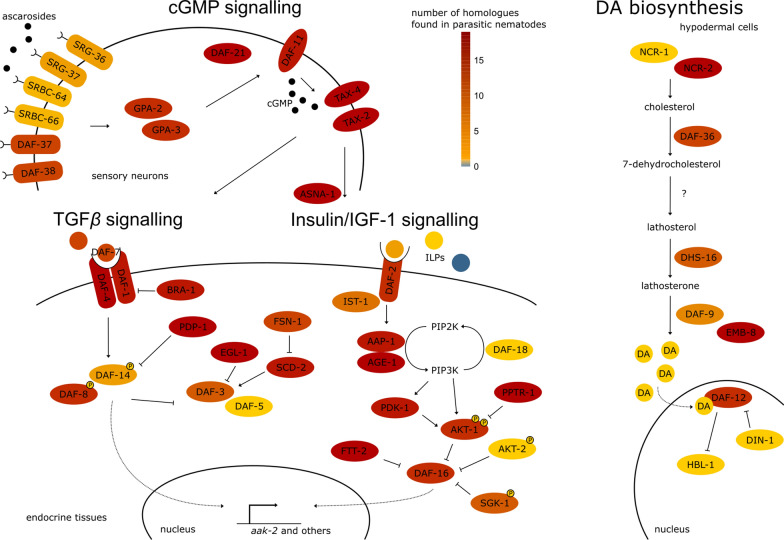
Schematic overview of the dauer signalling pathway in Caenorhabditis elegans consisting of the cGMP signalling pathway, the parallel TGF-β and insulin/IGF-1 pathways, and the concluding DA biosynthetic pathway. The colour scale indicates how conserved each gene is across parasitic nematodes: blue is not conserved, yellow towards red indicates that a gene is less or more conserved. This figure was redrawn from references [1, 166]
Fig. 5
Fig. 5
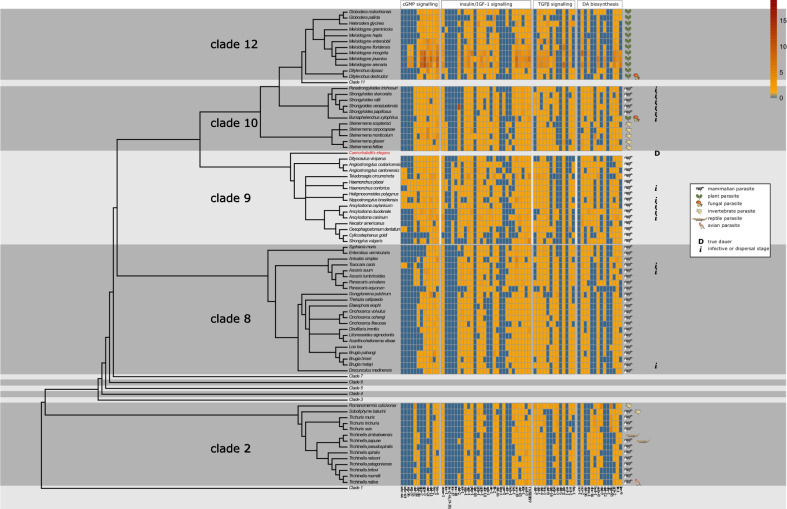
Phylogenetic tree of Caenorhabditis elegans and parasitic nematodes of which the genome was sequenced and a heat map showing which genes of the dauer signalling pathway are conserved. The type of parasitism each species displays is indicated, as well as whether they have a life cycle with a dauer (only C. elegans) or a confirmed dauer-derived infective stage. The same colour scale as in Fig. 4 was used, blue indicating no homologue, and yellow towards red indicating one or more homologues were detected. In order to assemble this information, we used the WormBase ParaSite (release number 14.0) BioMart orthologue finder tool on a comprehensive list of dauer-related genes and queried all available genomes of parasitic nematodes available in this database (ref. [85], parasite.wormbase.org) using the ‘gene stable ID’, ‘gene name’, ‘homology type’, and the two ‘% identity options’ within the Orthologues tab in ‘Output Attributes’. BioMart orthologue finder tool outputs were generated individually for each C. elegans-to-parasitic species comparison. One-to-one orthologues were taken directly from the output files into the matrix used to prepare the figure. For all other homology types, the most likely orthologues in the parasitic species were chosen by the highest pair of % identity values. Accession numbers are retrievable in Additional file 1: Table S1

References

    1. Stoltzfus JD, Minot S, Berriman M, Nolan TJ, Lok JB. RNAseq analysis of the parasitic nematode Strongyloides stercoralis reveals divergent regulation of canonical dauer pathways. PLoS Negl Trop Dis. 2012;6:e1854. doi: 10.1371/journal.pntd.0001854. - DOI - PMC - PubMed
    1. Blaxter M, Koutsovoulos G. The evolution of parasitism in Nematoda. Parasitology. 2015;142(Suppl 1):S26–39. doi: 10.1017/S0031182014000791. - DOI - PMC - PubMed
    1. Holterman M, Karegar A, Mooijman P, Van Megen H, Van Den Elsen S, Vervoort MTW, et al. Disparate gain and loss of parasitic abilities among nematode lineages. PLoS ONE. 2017;12:e0185445. doi: 10.1371/journal.pone.0185445. - DOI - PMC - PubMed
    1. Roeber F, Jex AR, Gasser RB. Impact of gastrointestinal parasitic nematodes of sheep, and the role of advanced molecular tools for exploring epidemiology and drug resistance—an Australian perspective. Parasites Vectors. 2013;6:153. doi: 10.1186/1756-3305-6-153. - DOI - PMC - PubMed
    1. Payne L, Fitchett JR. Bringing neglected tropical diseases into the spotlight. Trends Parasitol. 2010;26:421–423. doi: 10.1016/j.pt.2010.06.002. - DOI - PubMed

LinkOut - more resources