. 2021 Oct 11:12:700863.
doi: 10.3389/fmicb.2021.700863. eCollection 2021.

Evaluating the Cost of Pharmaceutical Purification for a Long-Duration Space Exploration Medical Foundry

Affiliations

Evaluating the Cost of Pharmaceutical Purification for a Long-Duration Space Exploration Medical Foundry

Matthew J McNulty et al. Front Microbiol. .

Abstract

There are medical treatment vulnerabilities in longer-duration space missions present in the current International Space Station crew health care system with risks, arising from spaceflight-accelerated pharmaceutical degradation and resupply lag times. Bioregenerative life support systems may be a way to close this risk gap by leveraging in situ resource utilization (ISRU) to perform pharmaceutical synthesis and purification. Recent literature has begun to consider biological ISRU using microbes and plants as the basis for pharmaceutical life support technologies. However, there has not yet been a rigorous analysis of the processing and quality systems required to implement biologically produced pharmaceuticals for human medical treatment. In this work, we use the equivalent system mass (ESM) metric to evaluate pharmaceutical purification processing strategies for longer-duration space exploration missions. Monoclonal antibodies, representing a diverse therapeutic platform capable of treating multiple space-relevant disease states, were selected as the target products for this analysis. We investigate the ESM resource costs (mass, volume, power, cooling, and crew time) of an affinity-based capture step for monoclonal antibody purification as a test case within a manned Mars mission architecture. We compare six technologies (three biotic capture methods and three abiotic capture methods), optimize scheduling to minimize ESM for each technology, and perform scenario analysis to consider a range of input stream compositions and pharmaceutical demand. We also compare the base case ESM to scenarios of alternative mission configuration, equipment models, and technology reusability. Throughout the analyses, we identify key areas for development of pharmaceutical life support technology and improvement of the ESM framework for assessment of bioregenerative life support technologies.

Keywords: equivalent system mass; human exploration mission; in situ resource utilization; monoclonal antibody purification; pharmaceutical foundry; space exploration medical foundry; space systems bioengineering; techno-economic analysis.


Conflict of interest statement

The authors declare that the research was conducted in the absence of any commercial or financial relationships that could be construed as a potential conflict of interest.

Figures
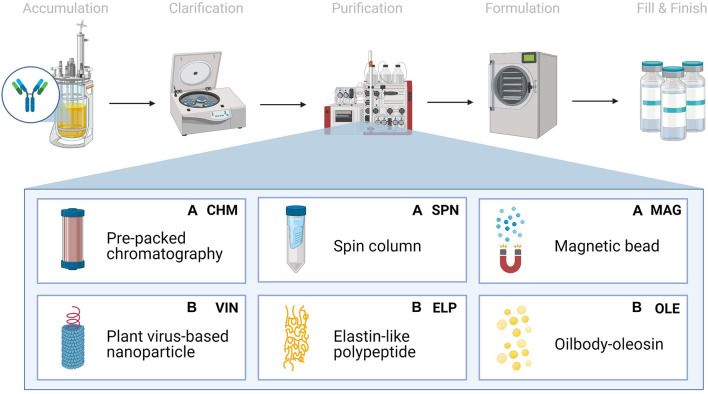
FIGURE 1
FIGURE 1
Monoclonal antibody production consists generically of product accumulation, clarification, initial purification, formulation, and fill & finish. Here we investigate six technologies for the capture step within the first purification step in a space mission context using extended equivalent system mass. The manufacturing origin of the capture reagent is denoted as either (A) abiotic or (B) biotic.
FIGURE 2
FIGURE 2
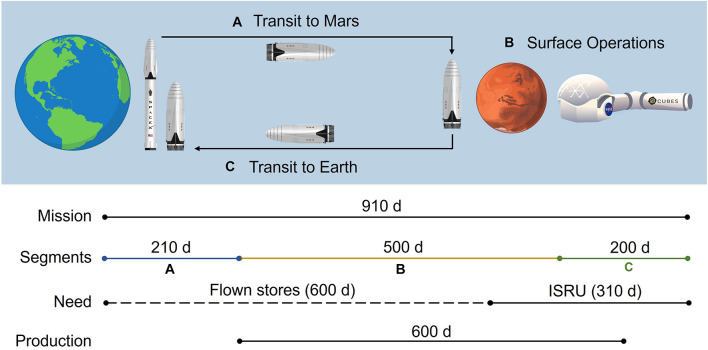
An illustration of the reference mission architecture in which (A) a crewed ship is launched from the surface of Earth and lands on Mars and (B) assembles a pre-deployed habitat on the Martian surface to perform operations before (C) a return transit to Earth on the same ship. Pharmaceutical needs are supported by flown stores until partway through surface operations, at which point needs are met by pharmaceuticals produced using in situ resource utilization. Production is initiated prior to the need window to ensure adequate stocks are generated by the time it is needed. Rocket artwork adapted from Musk (2017). Habitat artwork by Davian Ho.
FIGURE 3
FIGURE 3
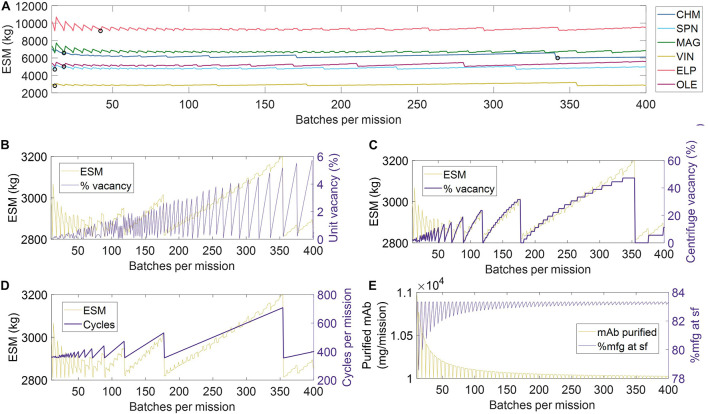
(A) Scheduling optimization for the establishment of base case scenarios for each unit procedure. The value for number of batches corresponding to the minimum equivalent system mass for each unit procedure, as indicated by black circle (∘) markers. Key operational parameters impacted by mission scheduling (shown using the VIN procedure) include (B) unit underutilization or vacancy, (C) equipment underutilization or vacancy, in this case represented by the centrifuge as the bottleneck, (D) the number of use cycles, and (E) the total quantity of monoclonal antibody (mAb) per mission and per surface operation (sf). CHM, pre-packed chromatography; SPN, spin column; MAG, magnetic bead; VIN, plant virus-based nanoparticle; ELP, elastin-like polypeptide; OLE, oilbody-oleosin.
FIGURE 4
FIGURE 4
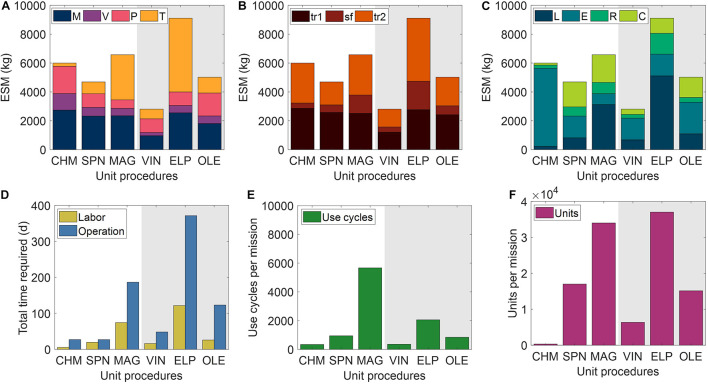
Base case equivalent system mass results broken down by (A) mass (M), volume (V), power (P), and labor time (T) constituents, (B) transit to Mars (tr1), surface operations (sf), and return transit (tr2) mission segments, and (C) labor (L), equipment (E), raw materials (R), and consumables (C) cost category for the six tested Protein A-based monoclonal antibody affinity capture step unit procedures segregated by abiotic (white background) and biotic (gray background) technologies. Also shown are the (D) labor and operation times, (E) number of use cycles, and (F) number of units required for each unit procedure to meet the reference mission demand. CHM, pre-packed chromatography; SPN, spin column; MAG, magnetic bead; VIN, plant virus-based nanoparticle; ELP, elastin-like polypeptide; OLE, oilbody-oleosin.
FIGURE 5
FIGURE 5
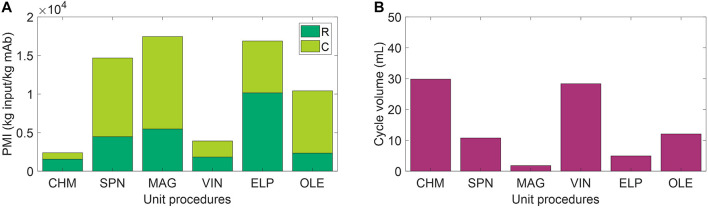
(A) Process mass intensity (PMI) evaluation of the unit procedures broken down by raw materials (R) and consumables (C) contributions. (B) Cycle volume for each unit procedure. CHM, pre-packed chromatography; SPN, spin column; MAG, magnetic bead; VIN, plant virus-based nanoparticle; ELP, elastin-like polypeptide; OLE, oilbody-oleosin.
FIGURE 6
FIGURE 6
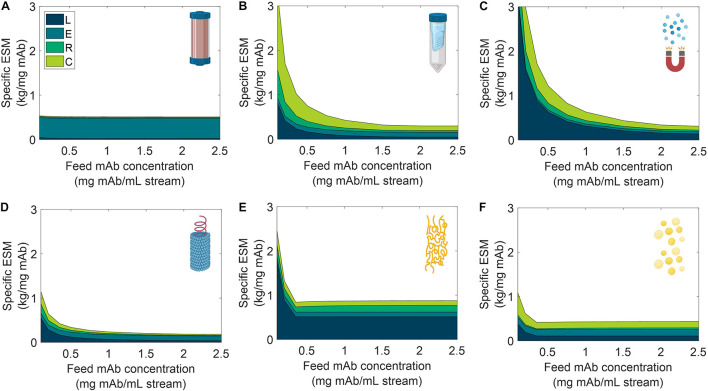
Specific equivalent system mass (per unit mass monoclonal antibody produced) broken down by labor (L), equipment (E), raw materials (R), and consumables (C) cost categories as a function of feed monoclonal antibody (mAb) concentration for (A) CHM, (B) SPN, (C) MAG, (D) VIN, (E) ELP, and (F) OLE. CHM, pre-packed chromatography; SPN, spin column; MAG, magnetic bead; VIN, plant virus-based nanoparticle; ELP, elastin-like polypeptide; OLE, oilbody-oleosin.
FIGURE 7
FIGURE 7
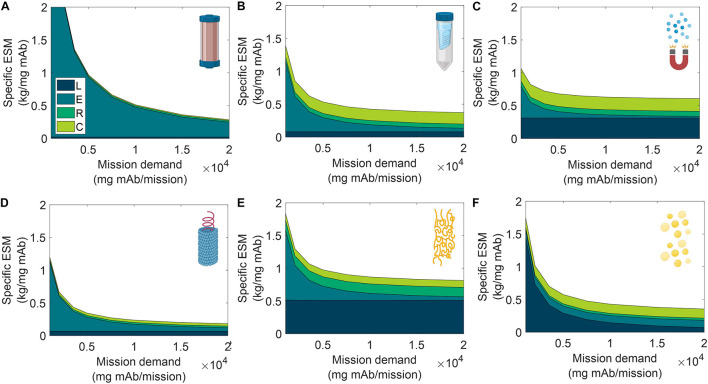
Specific equivalent system mass (per unit mass monoclonal antibody produced) broken down by labor (L), equipment (E), raw materials (R), and consumables (C) cost categories as a function of mission production demand for monoclonal antibody for (A) CHM, (B) SPN, (C) MAG, (D) VIN, (E) ELP, and (F) OLE. CHM, pre-packed chromatography; SPN, spin column; MAG, magnetic bead; VIN, plant virus-based nanoparticle; ELP, elastin-like polypeptide; OLE, oilbody-oleosin.
FIGURE 8
FIGURE 8
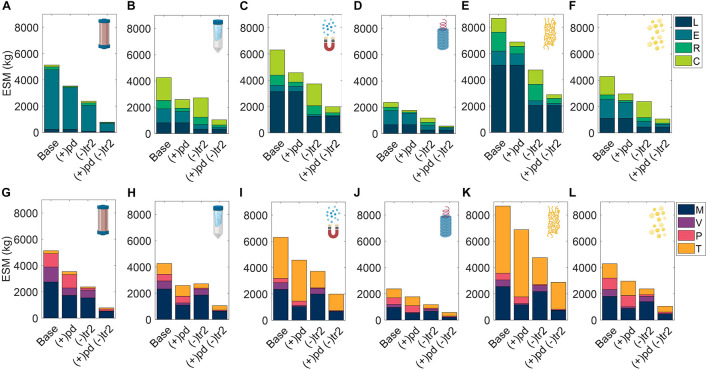
Evaluation of extended equivalent system mass values in various mission configurations broken down by labor (L), equipment (E), raw materials (R), and consumables (C) cost categories cost category and mass (M), volume (V), power (P), and labor time (T) constituents for CHM, (A,G), SPN, (B,H), MAG, (C,I), VIN, (D,J), ELP (E,K), and OLE, (F,L). Configurations include the base case scenario of manufacturing resources flown with the crew for pharmaceutical production on the surface and return transit (Base), and alternatives in which the manufacturing resources are flown prior to the crew in pre-deployment, (+)pd, the production window is limited to surface operations, (–)tr2, and a combination of the two previously stated alternatives, (+)pd (–)tr2. CHM, pre-packed chromatography; SPN, spin column; MAG, magnetic bead; VIN, plant virus-based nanoparticle; ELP, elastin-like polypeptide; OLE, oilbody-oleosin.
FIGURE 9
FIGURE 9
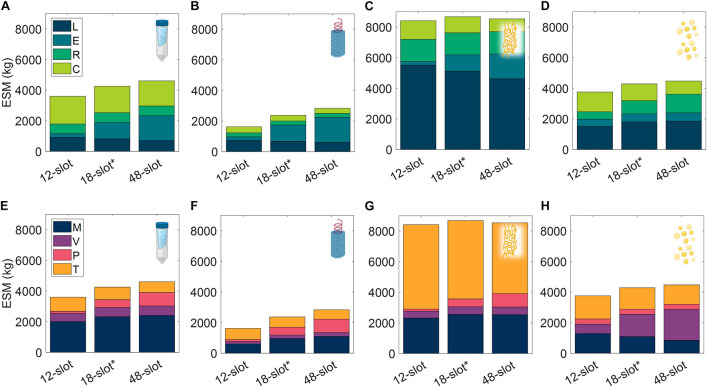
Changes in extended equivalent system mass values with different capacity centrifuge models broken down by labor (L), equipment (E), raw materials (R), and consumables (C) cost categories and mass (M), volume (V), power (P), and labor time (T) constituents for SPN (A,E), VIN (B,F), ELP (C,G), and OLE (D,H). SPN, spin column; VIN, plant virus-based nanoparticle; ELP, elastin-like polypeptide; OLE, oilbody-oleosin.
FIGURE 10
FIGURE 10
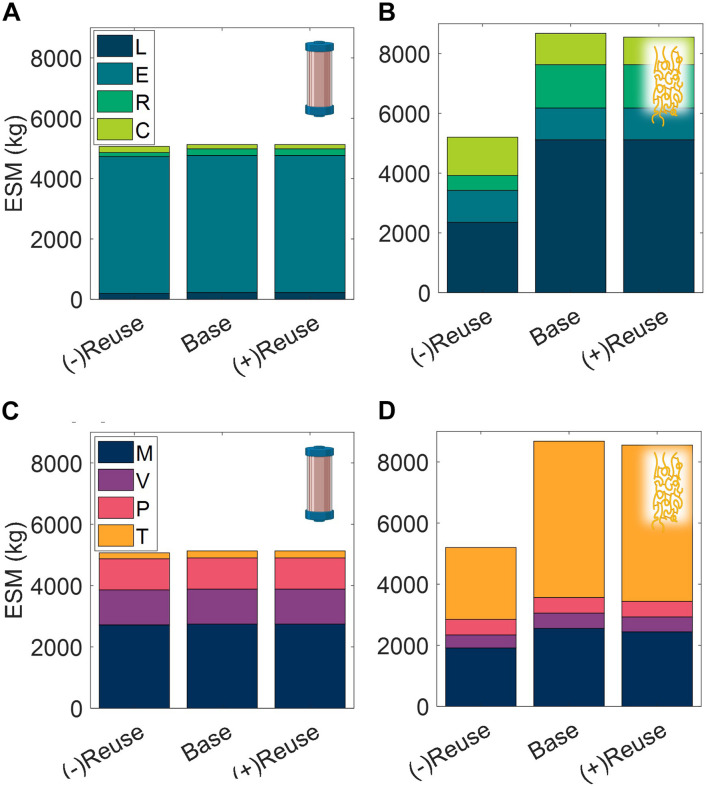
Changes in extended equivalent system mass values with reusability of purification technology broken down by labor (L), equipment (E), raw materials (R), and consumables (C) cost categories and mass (M), volume (V), power (P), and labor time (T) constituents for CHM (A,C), and ELP (B,D). (–)Reuse considers the technology as single-use and accordingly discards the unit procedure cleaning operations; (+) Reuse considers additional reuse cycles of the technology. CHM, pre-packed chromatography; ELP, elastin-like polypeptide.

References

    1. Adiga R., Al-adhami M., Andar A., Borhani S., Brown S., Burgenson D., et al. (2018). Point-of-care production of therapeutic proteins of good-manufacturing-practice quality. Nat. Biomed. Eng. 2 675–686. 10.1038/s41551-018-0259-1 - DOI - PubMed
    1. Afshinnekoo E., Scott R. T., MacKay M. J., Pariset E., Cekanaviciute E., Barker R., et al. (2020). Fundamental biological features of spaceflight: advancing the field to enable deep-space exploration. Cell 183 1162–1184. 10.1016/j.cell.2020.10.050 - DOI - PMC - PubMed
    1. Anderson M. S., Ewert M. K., Keener J. F. (2018). Life Support Baseline Values and Assumptions Document. NASA/TP-2015–218570/REV1. Houston, TX: NASA.
    1. Anselmo A. C., Gokarn Y., Mitragotri S. (2018). Non-invasive delivery strategies for biologics. Nat. Rev. Drug Discov. 18 19–40. 10.1038/nrd.2018.183 - DOI - PubMed
    1. Antonsen E., Bayuse T., Blue R., Daniels V., Hailey M., Hussey S., et al. (2017). Evidence Report: Risk of Adverse Health Outcomes and Decrements in Performance due to In-Flight Medical Conditions Human Research Program Exploration Medical Capabilities Element Approved for Public Release. Houston, TX: NASA.