Review
. 2021 Oct 11:12:738762.
doi: 10.3389/fimmu.2021.738762. eCollection 2021.

New Insights on CD8+ T Cells in Inflammatory Bowel Disease and Therapeutic Approaches

Affiliations
Review

New Insights on CD8+ T Cells in Inflammatory Bowel Disease and Therapeutic Approaches

Rosaely Casalegno Garduño et al. Front Immunol. .

Abstract

CD8+ T cells are involved in the pathogenesis of inflammatory bowel disease (IBD), a complex multifactorial chronic disease. Here, we present an overview of the current research with the controversial findings of CD8+ T cell subsets and discuss some possible perspectives on their therapeutic value in IBD. Studies on the role of CD8+ T cells in IBD have contradictory outcomes, which might be related to the heterogeneity of the cells. Recent data suggest that cytotoxic CD8+ T cells (Tc1) and interleukin (IL) 17-producing CD8+ (Tc17) cells contribute to the pathogenesis of IBD. Moreover, subsets of regulatory CD8+ T cells are abundant at sites of inflammation and can exhibit pro-inflammatory features. Some subsets of tissue resident memory CD8+ T cells (Trm) might be immunosuppressant, whereas others might be pro-inflammatory. Lastly, exhausted T cells might indicate a positive outcome for patients. The function and plasticity of different subsets of CD8+ T cells in health and IBD remain to be further investigated in a challenging field due to the limited availability of mucosal samples and adequate controls.

Keywords: CD8+ Tc1; Crohn´s disease; IBD; T regs; TRM; Tc17; ulcerative colitis.


Conflict of interest statement

The authors declare that the research was conducted in the absence of any commercial or financial relationships that could be construed as a potential conflict of interest.

Figures
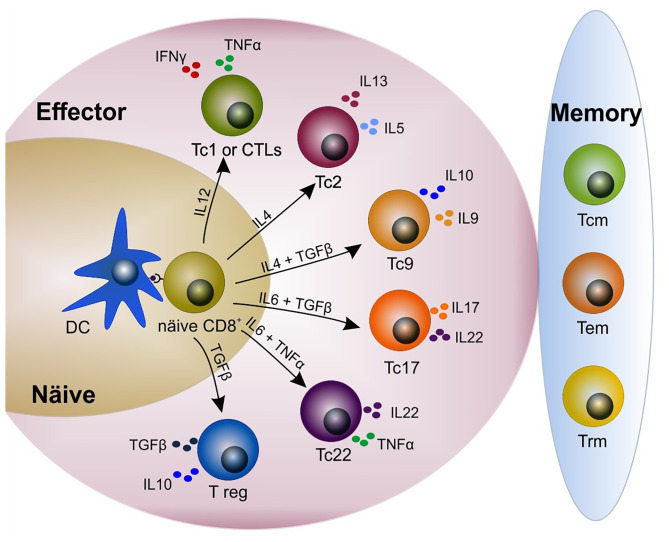
Figure 1
Figure 1
Heterogeneity in the CD8+ T cell pool. Upon antigen presentation and cytokine release by dendritic cells (DCs), naïve CD8+ T cells differentiate into different subsets including cytotoxic/cytolytic (Tc1 or CTLs), Tc2, Tc9, Tc17, Tc22, and immunosuppressant T regulatory (T reg). CD8+ T cells produce different cytokines according to their phenotype. A few clones remain and constitute the memory compartment (i.e. central memory, effector memory, tissue-resident memory). Modified from Golubovskaya and Wu (15), Mittrücker et al. (22) and St. Paul and Ohashi (23). CTL, cytotoxic T lymphocyte; DC, dendritic cell; Tcm, central memory T cell; Tem, effector memory T cell; Trm, tissue-resident memory T cell.
Figure 2
Figure 2
Potential mechanisms of the adaptive immune response towards gut microbiota in homeostasis and chronic inflammation. Under homeostasis, microbiota is restricted to the lumen of the gut by both an epithelial cell layer and a mucus layer, produced by goblet cells and full of antibacterial peptides. Dendritic cells (DCs), M cells and macrophages acquired antigens from the lumen. Antigen presenting cells (APCs) carrying those antigens migrate to Peyer´s patches (PP) where they present the antigens to naïve T cells to prime them. Regulatory CD8+ T cells are able to immunosuppress Tc1 by interleukin (e.g. IL10) release and cell-cell contact, leading Tc1 cells towards anergy, a non-responsive stage, or even re-directed towards a T reg phenotype. Some double positive Foxp3+ IL17+ cells might be in an intermediate stage towards Tc17, relevant cells for mucosal maintenance. Trm cells contribute to the homeostasis of the tissue by releasing IL10. DC, dendritic cell; IL, interleukin; PP, Peyer´s patch; Tc1 or CTL, cytotoxic T lymphocyte; Tc17, IL17-producing CD8+ T cells; T reg, CD8+ T regulatory cell.
Figure 3
Figure 3
Potential mechanisms of the adaptive immune response towards gut microbiota in chronic inflammation. Increased numbers of pathogenic bacteria (e.g. Clostridium difficile, Chlamydia pneumonia, Listeria monocytogenes) have been reported in IBD patients (50). During chronic inflammation, functional cytotoxic CD8+ Tc1 cells might be predominantly generated. The disruption of the epithelial barrier might occur by the cytotoxic effect of commensal-specific Tc1 recognizing peptides derived from commensal bacteria on the MHC-I of epithelial cells. Once the epithelial barrier is broken, bacteria can pass freely to the lamina propria initiating an immune response by members of the innate immune system (e.g. macrophages). Due to the plasticity of the cells and a highly pro-inflammatory milieu, CD8+ T regs might be driven towards Tc1 or IFN+ T regs, making the damage even greater. Trm express pro-inflammatory genes in the context of inflammation. Those pro-inflammatory Trm might be derived from pro-inflammatory Tc1 and Tc17, and some clones might exit the tissue via the blood stream and initiate inflammation in other tissue outside the gastrointestinal tract. DC, dendritic cell; GrB, granzyme B; IFNγ, interferon gamma; IL, interleukin; MHC-I, major histocompatibility complex class I; PP, Peyer´s patch; Tc1 or CTL, cytotoxic T lymphocyte; Tc17, IL17-producing CD8+ T cells; TGFβ, transforming growth factor beta; T reg, CD8+ T regulatory cell.

References

    1. Alatab S, Sepanlou SG, Ikuta K, Vahedi H, Bisignano C, Safiri S, et al. . The Global, Regional, and National Burden of Inflammatory Bowel Disease in 195 Countries and Territories, 1990–2017: A Systematic Analysis for the Global Burden of Disease Study 2017. Lancet Gastroenterol Hepatol (2020) 5(1):17–30. doi: 10.1016/S2468-1253(19)30333-4 - DOI - PMC - PubMed
    1. Khor B, Gardet A, Xavier RJ. Genetics and Pathogenesis of Inflammatory Bowel Disease. Nature (2011) 474(7351):307–17. doi: 10.1038/nature10209 - DOI - PMC - PubMed
    1. Chang JT. Pathophysiology of Inflammatory Bowel Diseases. N Engl J Med (2020) 383(27):2652–64. doi: 10.1056/NEJMra2002697 - DOI - PubMed
    1. Däbritz J, Gerner P, Enninger A, Claßen M, Radke M. Inflammatory Bowel Disease in Childhood and Adolescence. Dtsch Arztebl Int (2017) 114(19):331–8. doi: 10.3238/arztebl.2017.0331 - DOI - PMC - PubMed
    1. Lee JC, Lyons PA, McKinney EF, Sowerby JM, Carr EJ, Bredin F, et al. . Gene Expression Profiling of CD8+ T Cells Predicts Prognosis in Patients With Crohn Disease and Ulcerative Colitis. J Clin Invest (2011) 121(10):4170–9. doi: 10.1172/JCI59255 - DOI - PMC - PubMed

Publication types

MeSH terms
