


Exploration of Epigenetic State Hyperdopaminergia (Surfeit) and Genetic Trait Hypodopaminergia (Deficit) During Adolescent Brain Development
- PMID: 34707969
- PMCID: PMC8547282
- DOI: 10.2174/2211556010666210215155509
Exploration of Epigenetic State Hyperdopaminergia (Surfeit) and Genetic Trait Hypodopaminergia (Deficit) During Adolescent Brain Development
Abstract
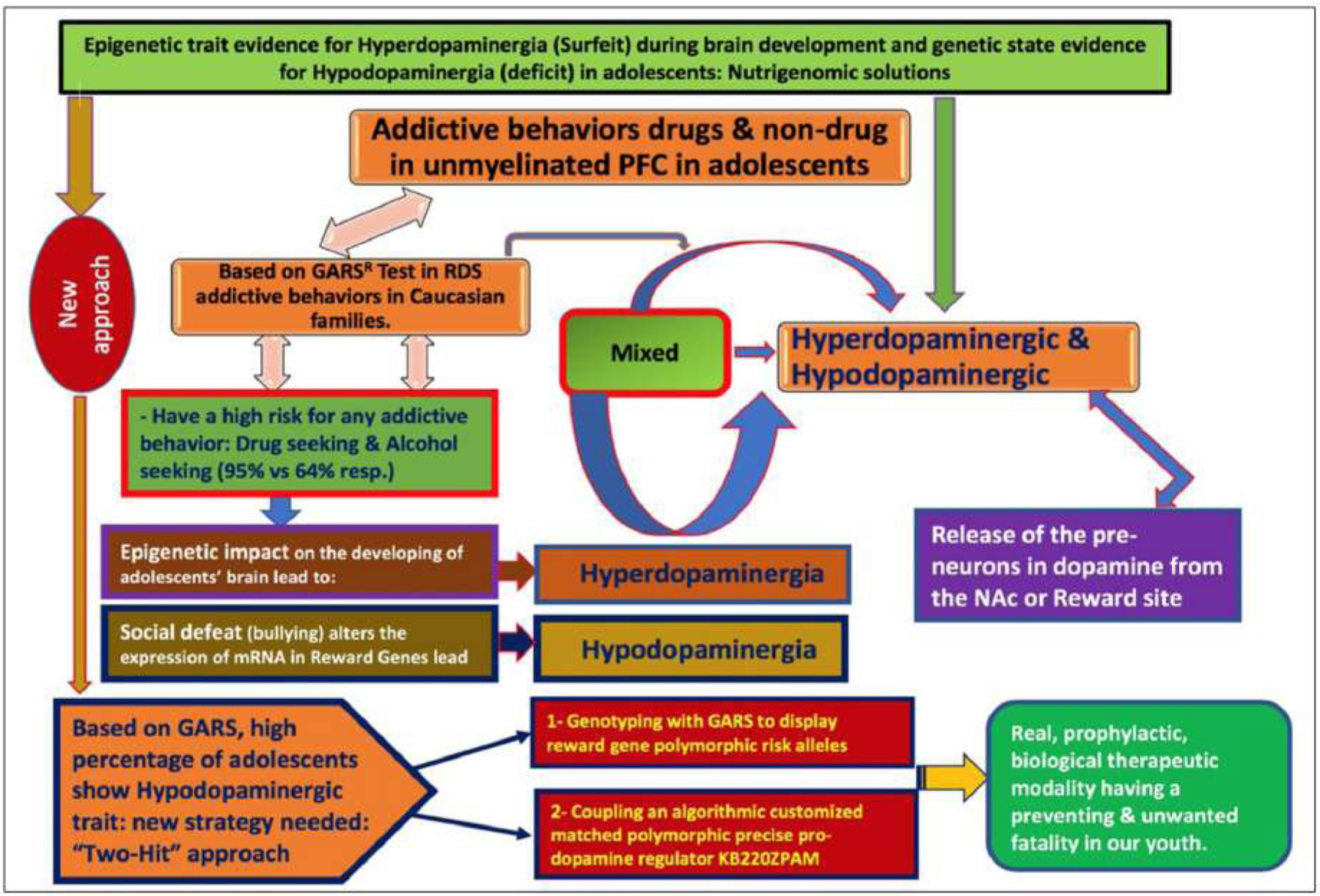
Background: The risk for all addictive drug and non-drug behaviors, especially, in the unmyelinated Prefrontal Cortex (PFC) of adolescents, is important and complex. Many animal and human studies show the epigenetic impact on the developing brain in adolescents, compared to adults. Some reveal an underlying hyperdopaminergia that seems to set our youth up for risky behaviors by inducing high quanta pre-synaptic dopamine release at reward site neurons. In addition, altered reward gene expression in adolescents caused epigenetically by social defeat, like bullying, can continue into adulthood. In contrast, there is also evidence that epigenetic events can elicit adolescent hypodopaminergia. This complexity suggests that neuroscience cannot make a definitive claim that all adolescents carry a hyperdopaminergia trait.
Objective: The primary issue involves the question of whether there exists a mixed hypo or hyper-dopaminergia in this population.
Method: Genetic Addiction Risk Score (GARS®) testing was carried out of 24 Caucasians of ages 12-19, derived from families with RDS.
Results: We have found that adolescents from this cohort, derived from RDS parents, displayed a high risk for any addictive behavior (a hypodopaminergia), especially, drug-seeking (95%) and alcohol-seeking (64%).
Conclusion: The adolescents in our study, although more work is required, show a hypodopaminergic trait, derived from a family with Reward Deficiency Syndrome (RDS). Certainly, in future studies, we will analyze GARS in non-RDS Caucasians between the ages of 12-19. The suggestion is first to identify risk alleles with the GARS test and, then, use well-researched precision, pro-dopamine neutraceutical regulation. This "two-hit" approach might prevent tragic fatalities among adolescents, in the face of the American opioid/psychostimulant epidemic.
Keywords: Adolescents; Genetic Addiction Risk Score (GARS); Precision Addiction Management (PAM); hyperdopaminergia; hypodopaminergia; meso-limbic system; prefrontal cortex.
Figures


References
-
- Merikangas KR, Gelernter CS. Comorbidity for alcoholism and depression. Psychiatr Clin North Am 1990; 13(4): 613–32. - PubMed
-
- Blum K, Noble EP, Sheridan PJ, et al. Allelic association of human dopamine D2 receptor gene in alcoholism. JAMA 1990; 263(15): 2055–60. - PubMed
-
- Noble EP, Blum K, Ritchie T, Montgomery A, Sheridan PJ. Allelic association of the D2 dopamine receptor gene with receptor-binding characteristics in alcoholism. Arch Gen Psychiatry 1991; 48(7): 648–54. - PubMed
-
- Blum K. Reward Deficiency Syndrome.The Sage Encyclopedia of Abnormal Clinical Psychology Pensylvania Sage Publications; 2017.
Grants and funding
LinkOut - more resources
Full Text Sources
Miscellaneous