Review
. 2021 Oct 11:8:741581.
doi: 10.3389/fmolb.2021.741581. eCollection 2021.

Emerging Contributions of Solid-State NMR Spectroscopy to Chromatin Structural Biology

Affiliations
Review

Emerging Contributions of Solid-State NMR Spectroscopy to Chromatin Structural Biology

Bryce E Ackermann et al. Front Mol Biosci. .

Abstract

The eukaryotic genome is packaged into chromatin, a polymer of DNA and histone proteins that regulates gene expression and the spatial organization of nuclear content. The repetitive character of chromatin is diversified into rich layers of complexity that encompass DNA sequence, histone variants and post-translational modifications. Subtle molecular changes in these variables can often lead to global chromatin rearrangements that dictate entire gene programs with far reaching implications for development and disease. Decades of structural biology advances have revealed the complex relationship between chromatin structure, dynamics, interactions, and gene expression. Here, we focus on the emerging contributions of magic-angle spinning solid-state nuclear magnetic resonance spectroscopy (MAS NMR), a relative newcomer on the chromatin structural biology stage. Unique among structural biology techniques, MAS NMR is ideally suited to provide atomic level information regarding both the rigid and dynamic components of this complex and heterogenous biological polymer. In this review, we highlight the advantages MAS NMR can offer to chromatin structural biologists, discuss sample preparation strategies for structural analysis, summarize recent MAS NMR studies of chromatin structure and dynamics, and close by discussing how MAS NMR can be combined with state-of-the-art chemical biology tools to reconstitute and dissect complex chromatin environments.

Keywords: chemical biology; gene regulation; histone dynamics; magic angle spinning; nucleosome dynamics.


Conflict of interest statement

The authors declare that the research was conducted in the absence of any commercial or financial relationships that could be construed as a potential conflict of interest.

Figures
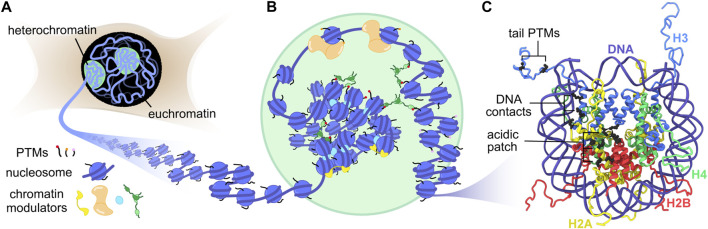
FIGURE 1
FIGURE 1
Genome organization from the nucleus to the nucleosome. (A) The nucleus contains two distinct chromatin states, heterochromatin and euchromatin. Compact heterochromatin compartments may form by phase separation. (B) Chromatin fibers in different states contain distinct PTM signatures and interact with specific chromatin modulators. (C) The structure of the nucleosome with highlighted regions of interest for MAS NMR studies (PDB:1KX5) (Davey et al., 2002).
FIGURE 2
FIGURE 2
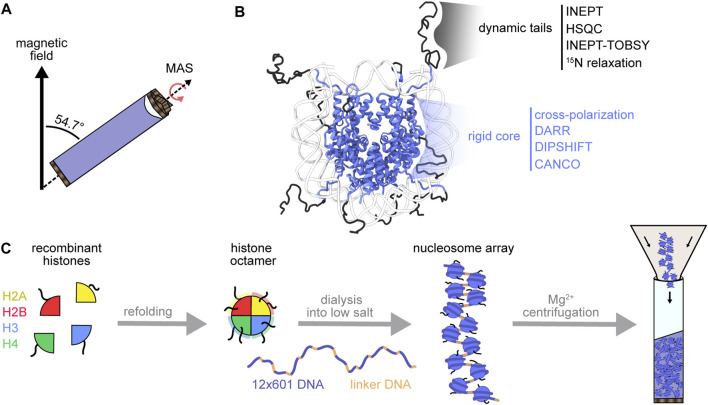
MAS NMR toolbox for chromatin structural biology. (A) During MAS NMR, the sample rotor is spun at frequencies between 10 and 100 kHz at the magic angle (54.7° relative to the external magnetic field). (B) MAS NMR can probe the dynamic range of the nucleosome with experiments designed to detect either the mobile histone tails or the rigid nucleosome core (PDB:1KX5) (Davey et al., 2002). (C) Chromatin reconstitution begins with the formation of histone octamers from recombinant histones, followed by DNA wrapping at low salt. Mg2+ can be used to purify arrays and to compact chromatin during rotor packing.
FIGURE 3
FIGURE 3
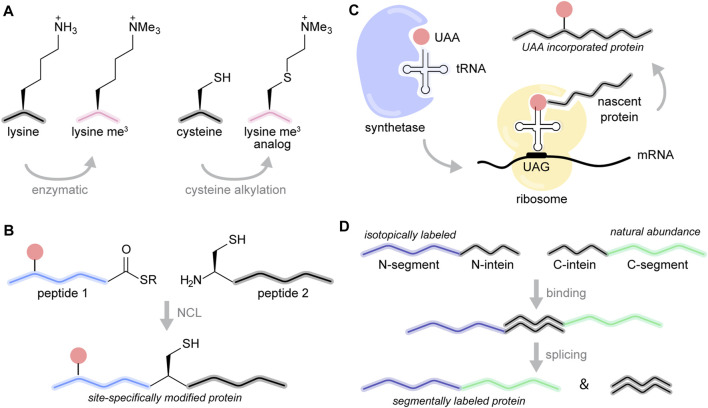
Chemical biology toolbox for chromatin studies. (A) Lysine trimethylation (me3) can be installed enzymatically or by cysteine alkylation to yield a methylated lysine analog. (B) In native chemical ligation, a synthetic peptide containing a C-terminal thioester (1) is linked to a second polypeptide bearing an N-terminal cysteine (2). (C) In unnatural amino acid incorporation, the UAA is loaded onto the corresponding tRNA by an engineered tRNA synthetase. The tRNA recognizes the amber stop codon UAG, allowing the ribosome to install the UAA at the desired position in the protein sequence. (D) Segmental isotopic labeling is mediated by intein splicing of an isotopically labeled protein segment with a segment at natural abundance, producing the full-length protein.

References

    1. Abramov G., Velyvis A., Rennella E., Wong L. E., Kay L. E. (2020). A Methyl-TROSY Approach for NMR Studies of High-Molecular-Weight DNA with Application to the Nucleosome Core Particle. Proc. Natl. Acad. Sci. USA 117 (23), 12836–12846. 10.1073/pnas.2004317117 - DOI - PMC - PubMed
    1. Ackermann B. E., Debelouchina G. T. (2019). Heterochromatin Protein HP1α Gelation Dynamics Revealed by Solid‐State NMR Spectroscopy. Angew. Chem. Int. Ed. 58 (19), 6300–6305. 10.1002/anie.201901141 - DOI - PMC - PubMed
    1. Adhireksan Z., Sharma D., Lee P. L., Davey C. A. (2020). Near-atomic Resolution Structures of Interdigitated Nucleosome Fibres. Nat. Commun. 11 (1), 4747. 10.1038/s41467-020-18533-2 - DOI - PMC - PubMed
    1. Allis C. D., Muir T. W. (2011). Spreading Chromatin into Chemical Biology. ChemBioChem 12 (2), 264–279. 10.1002/cbic.201000761 - DOI - PubMed
    1. Alvarado W., Moller J., Ferguson A. L., de Pablo J. J. (2021). Tetranucleosome Interactions Drive Chromatin Folding. ACS Cent. Sci. 7, 1019–1027. 10.1021/acscentsci.1c00085 - DOI - PMC - PubMed

LinkOut - more resources