. 2021 Oct 11:8:704416.
doi: 10.3389/frobt.2021.704416. eCollection 2021.

Experimental Evaluation of Tactile Sensors for Compliant Robotic Hands

Affiliations

Experimental Evaluation of Tactile Sensors for Compliant Robotic Hands

Werner A Friedl et al. Front Robot AI. .

Abstract

The sense of touch is a key aspect in the human capability to robustly grasp and manipulate a wide variety of objects. Despite many years of development, there is still no preferred solution for tactile sensing in robotic hands: multiple technologies are available, each one with different benefits depending on the application. This study compares the performance of different tactile sensors mounted on the variable stiffness gripper CLASH 2F, including three commercial sensors: a single taxel sensor from the companies Tacterion and Kinfinity, the Robotic Finger Sensor v2 from Sparkfun, plus a self-built resistive 3 × 3 sensor array, and two self-built magnetic 3-DoF touch sensors, one with four taxels and one with one taxel. We verify the minimal force detectable by the sensors, test if slip detection is possible with the available taxels on each sensor, and use the sensors for edge detection to obtain the orientation of the grasped object. To evaluate the benefits obtained with each technology and to assess which sensor fits better the control loop in a variable stiffness hand, we use the CLASH gripper to grasp fruits and vegetables following a published benchmark for pick and place operations. To facilitate the repetition of tests, the CLASH hand is endowed with tactile buttons that ease human-robot interactions, including execution of a predefined program, resetting errors, or commanding the full robot to move in gravity compensation mode.

Keywords: grasp benchmarking; grasp stiffness; hand design; slippage detection; tactile sensors.


Conflict of interest statement

The authors declare that the research was conducted in the absence of any commercial or financial relationships that could be construed as a potential conflict of interest.

Figures
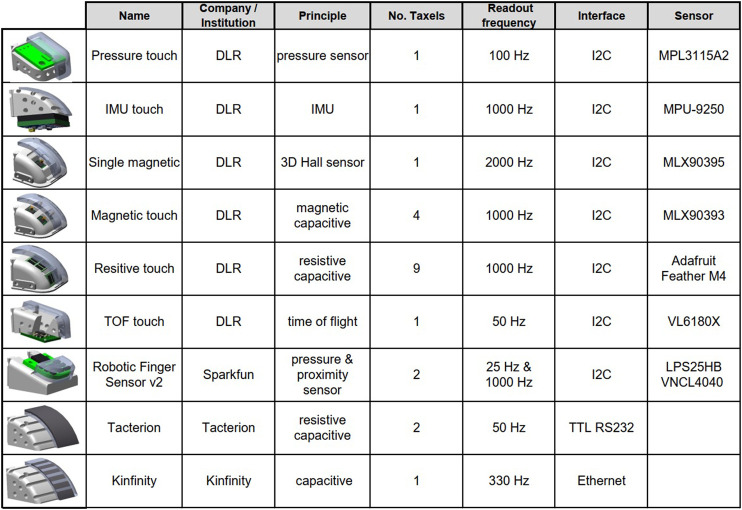
FIGURE 1
FIGURE 1
Tactile sensors used in the comparative study, including self-made and commercially available sensors.
FIGURE 2
FIGURE 2
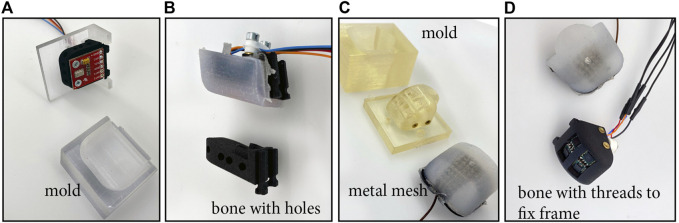
Self-made tactile sensors: (A) casting mold for the pressure sensor (before casting); (B) casted pressure sensor and “bone” (fingertip structure) with holes for simple sensors such as pressure sensors, IMU, or VL6180X; (C) casting mold and resulting silicone pad for the magnetic four-axis sensor; and (D) fingertip structure with four integrated MLX90393 sensor chips and silicone pad ready for assembly.
FIGURE 3
FIGURE 3
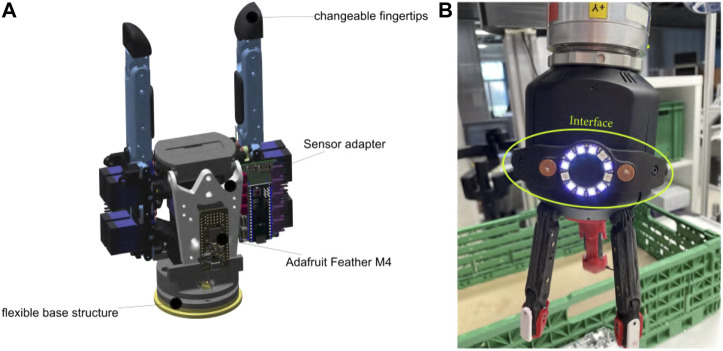
CLASH 2F gripper. (A) Two-fingered gripper with two thumb modules and a flexible base structure. (B) User interface for commanding the hand.
FIGURE 4
FIGURE 4
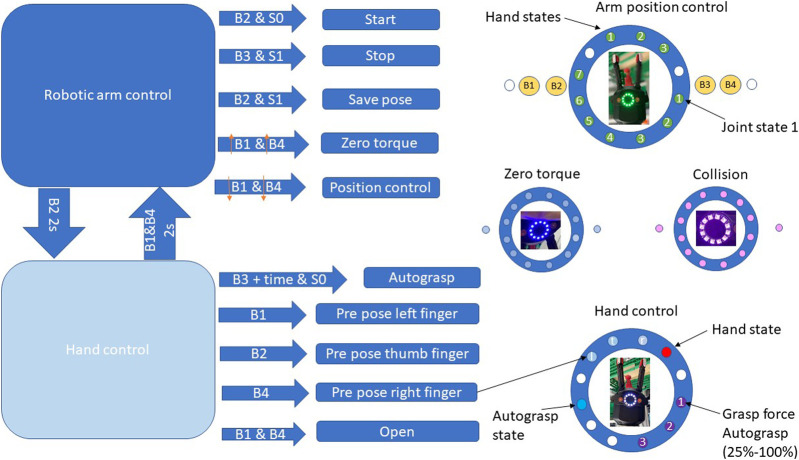
Modes of operation of the user interface in the CLASH hand. The left side shows the two operation modes and the possible button combinations to control the arm or hand. On the right side, the possible LED status information is shown. For example, for teaching one waypoint the user should press button B2 to switch on the robot, and the control state changes from S0 to S1. Now the user can press B1 and B4 for the zero-torque (gravity compensation) mode and can move the robot to a desired position. The zero-torque mode is confirmed by a blue LED ring. To save a new position, the user presses B2 and gets a short feedback with pink LEDs, to confirm that the position is saved. To grasp an object, the user has to press B2 for at least 2 s to switch to the hand control (grasp) mode. With the buttons B1, B3, and B4, the user can change the pre-grasp pose of each finger. To grasp the object the user has to press B3. The press duration changes the grasp force, as indicated by the LED ring.
FIGURE 5
FIGURE 5
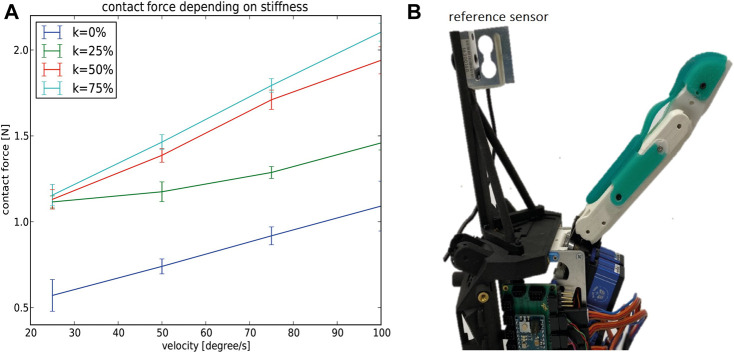
Sensor sensibility depending on finger stiffness. (A) Contact force depending on stiffness and finger velocity for the CLASH 3F thumb. (B) Testbed with the thumb, and a fixed resistive sensor array.
FIGURE 6
FIGURE 6
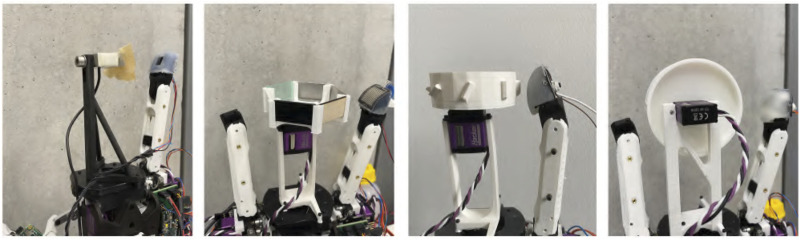
Testbeds for verification of the tactile sensors on the CLASH 2F. From left to right, testbeds for: sensibility depending on stiffness, sensibility depending on surface materials, edge detection, and slippage detection.
FIGURE 7
FIGURE 7
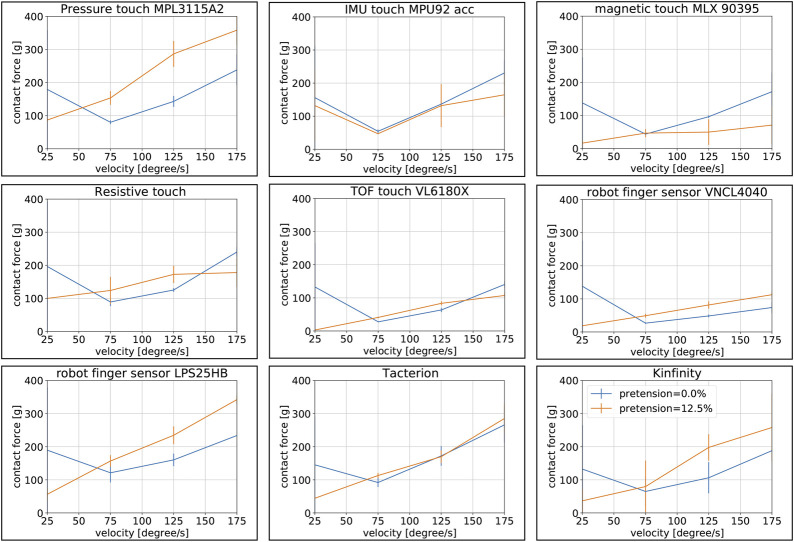
Detected contact force for all nine sensors depending on joint stiffness and joint velocity. The blue line shows 0% pretension (corresponding to a stiffness of 0.23 Nm/rad and 0.12 Nm/rad in the base and distal joint, respectively) and the orange line 12.5% pretension (corresponding to a stiffness of 0.34 Nm/rad and 0.16 Nm/rad in the base and distal joint, respectively).
FIGURE 8
FIGURE 8
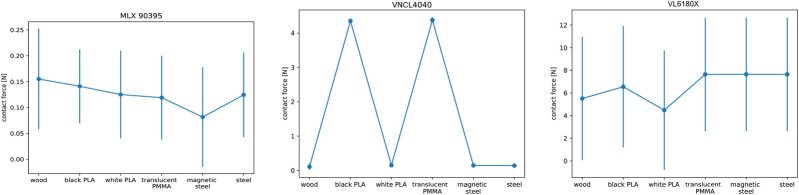
Contact force depending on the material, for the magnetic, proximity and ToF sensors (left to right).
FIGURE 9
FIGURE 9
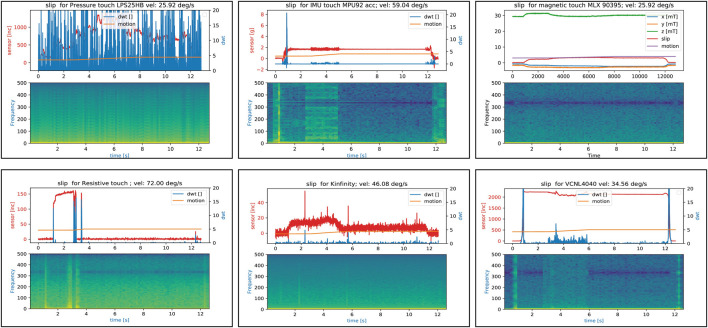
Slippage detection using different sensors. For each sensor we show the raw sensor signal, Discrete Wavelet Transform (DWT) and the motion of the wheel in one plot, and a spectrogram plot of the sensor signal in the plot below. Note that for MLX90395 instead of the DWT we show a slip signal, based on Eq. 1. A high response in the spectrogram indicates that the signal can be well detected using the DWT, for example, for the IMU, which shows a clear response when the wheel starts to rotate. On the other hand, the Kinfinity signal is too noisy to differentiate slip from noise.
FIGURE 10
FIGURE 10
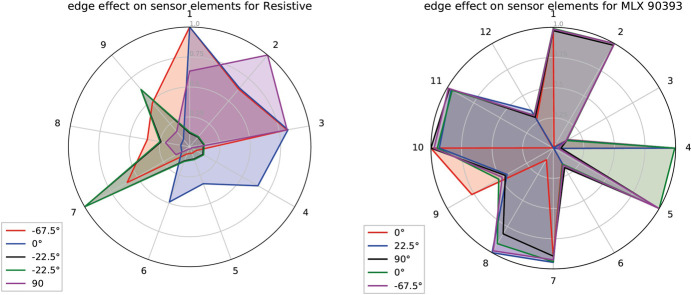
Radar plot to show the edge effect on the different sensor taxels for the resistive and MLX90393 sensors.
FIGURE 11
FIGURE 11
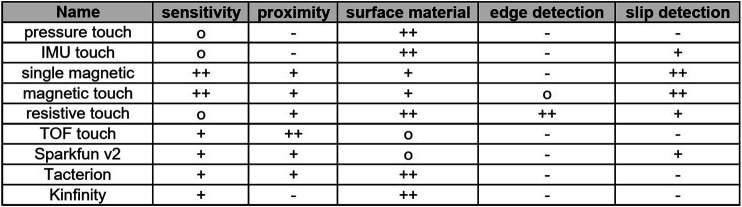
Summary of performance characteristics for all the tested sensors.
FIGURE 12
FIGURE 12
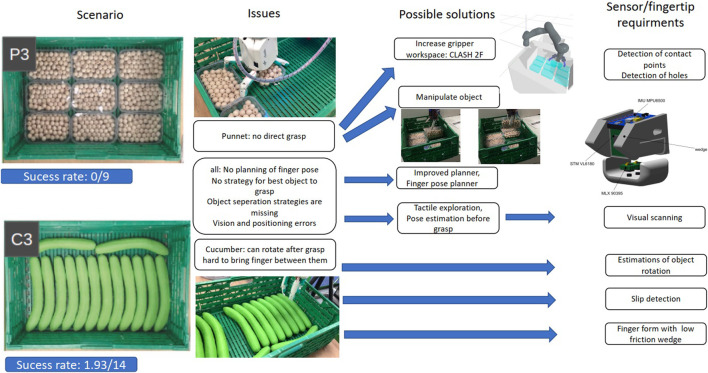
Derivation of requirements from the benchmark tests by analyzing the original failures for the study from Mnyusiwalla et al. (2020) for a crate completely filled with punnets (scenario P3) or cucumbers (scenario C3).
FIGURE 13
FIGURE 13
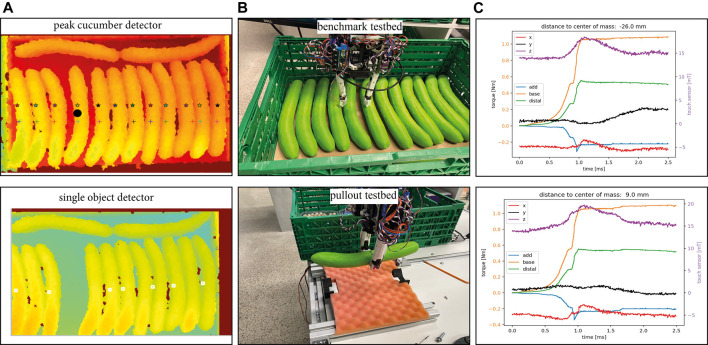
Scenario C3. (A) Vision algorithms. (B) benchmark testbed and pullout testbed. (C) Output of the MLX90395 sensor during pullout tests, where the y-component (black line) clearly signals if a cucumber rotates inside the hand. The orange, green, and blue lines (with corresponding scale in the left y-axis) show the finger joint torques; the object rotation cannot be detected by them, as they do not change after the rotation starts. The red, black and magenta lines (with corresponding scale in the right y-axis) show the response of the tactile sensor in the three directions x, y and z.
FIGURE 14
FIGURE 14
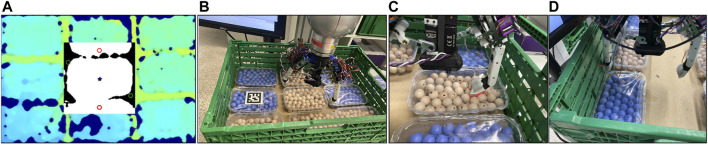
Scenario P3. From left to right: (A) finger position planner output, (B) CLASH 2F pose to grasp the first punnet, (C) finger failed to push the punnet away from the wall, (D) second push strategy with the help of the free space around the objects.

References

    1. Ajoudani A., Hocaoglu E., Altobelli A., Rossi M., Battaglia E., Tsagarakis N., et al. (2016). “Reflex Control of the Pisa/IIT SoftHand during Object Slippage,” in Proc. IEEE Int. Conf. Robotics and Automation (ICRA) (IEEE; ), 1972–1979. 10.1109/icra.2016.7487344 - DOI
    1. Bhatt A., Sieler A., Puhlmann S., Brock O. (2021). Surprisingly Robust In-Hand Manipulation: An Empirical Study, Proc. Robotics Science and Systems (RSS).
    1. Büscher G., Meier M., Walck G., Haschke R., Ritter H. J. (2015). “Augmenting Curved Robot Surfaces with Soft Tactile Skin,” in Proc. IEEE/RSJ Int. Conf. On Intelligent Robots and Systems (IROS) (IEEE; ), 1514–1519. 10.1109/iros.2015.7353568 - DOI
    1. Butterfass J., Grebenstein M., Liu H., Hirzinger G. (2001). “DLR-Hand II: Next Generation of a Dextrous Robot Hand,” in Proc. IEEE Int. Conf. Robotics and Automation (ICRA) (IEEE; ), 109–114. 10.1109/ROBOT.2001.932538 - DOI
    1. Catalano M. G., Grioli G., Farnioli E., Serio A., Piazza C., Bicchi A. (2014). Adaptive Synergies for the Design and Control of the Pisa/IIT SoftHand. Int. J. Robotics Res. 33, 768–782. 10.1177/0278364913518998 - DOI

LinkOut - more resources