


Implementation, Adoption, and Perceptions of Telemental Health During the COVID-19 Pandemic: Systematic Review
- PMID: 34709179
- PMCID: PMC8664153
- DOI: 10.2196/31746
Implementation, Adoption, and Perceptions of Telemental Health During the COVID-19 Pandemic: Systematic Review
Abstract
Background: Early in 2020, mental health services had to rapidly shift from face-to-face models of care to delivering the majority of treatments remotely (by video or phone call or occasionally messaging) due to the COVID-19 pandemic. This resulted in several challenges for staff and patients, but also in benefits such as convenience or increased access for people with impaired mobility or in rural areas. There is a need to understand the extent and impacts of telemental health implementation, and barriers and facilitators to its effective and acceptable use. This is relevant both to future emergency adoption of telemental health and to debates on its future use in routine mental health care.
Objective: To investigate the adoption and impacts of telemental health approaches during the COVID-19 pandemic, and facilitators and barriers to optimal implementation.
Methods: Four databases (PubMed, PsycINFO, CINAHL, and Web of Science) were searched for primary research relating to remote working, mental health care, and the COVID-19 pandemic. Preprint servers were also searched. Results of studies were synthesized using framework synthesis.
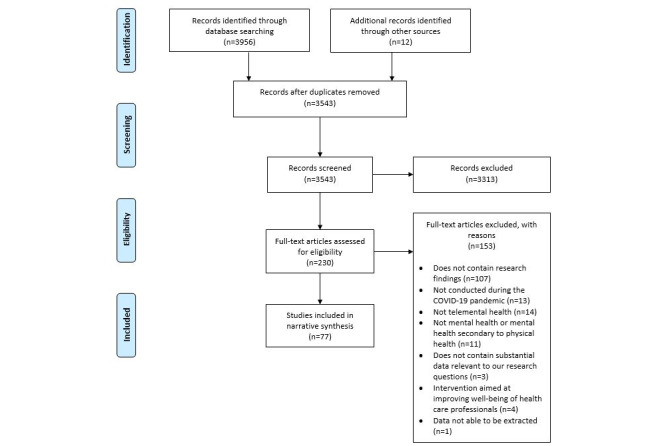
Results: A total of 77 papers met our inclusion criteria. In most studies, the majority of contacts could be transferred to a remote form during the pandemic, and good acceptability to service users and clinicians tended to be reported, at least where the alternative to remote contacts was interrupting care. However, a range of impediments to dealing optimal care by this means were also identified.
Conclusions: Implementation of telemental health allowed some continuing support to the majority of service users during the COVID-19 pandemic and has value in an emergency situation. However, not all service users can be reached by this means, and better evidence is now needed on long-term impacts on therapeutic relationships and quality of care, and on impacts on groups at risk of digital exclusion and how to mitigate these.
Trial registration: PROSPERO International prospective register of systematic reviews CRD42021211025; https://www.crd.york.ac.uk/prospero/display_record.php?ID=CRD42021211025.
Keywords: COVID-19; mental health; remote care; systematic review, implementation science; telemedicine; telemental health.
©Rebecca Appleton, Julie Williams, Norha Vera San Juan, Justin J Needle, Merle Schlief, Harriet Jordan, Luke Sheridan Rains, Lucy Goulding, Monika Badhan, Emily Roxburgh, Phoebe Barnett, Spyros Spyridonidis, Magdalena Tomaskova, Jiping Mo, Jasmine Harju-Seppänen, Zoë Haime, Cecilia Casetta, Alexandra Papamichail, Brynmor Lloyd-Evans, Alan Simpson, Nick Sevdalis, Fiona Gaughran, Sonia Johnson. Originally published in the Journal of Medical Internet Research (https://www.jmir.org), 09.12.2021.
Conflict of interest statement
Conflicts of Interest: NS is the director of the London Safety and Training Solutions Ltd, which offers training in patient safety, implementation solutions and human factors to healthcare organizations and the pharmaceutical industry. The other authors have no conflicts of interest to declare.
Figures
References
-
- World Health Organization The Impact of COVID-19 on Mental, Neurological and Substance Use Services: Results of a Rapid Assessment. 2020. [2021-11-29]. https://www.who.int/publications/i/item/978924012455 .
-
- Rajkumar RP. COVID-19 and mental health: A review of the existing literature. Asian J Psychiatr. 2020 Aug;52:102066. doi: 10.1016/j.ajp.2020.102066. http://europepmc.org/abstract/MED/32302935 S1876-2018(20)30177-5 - DOI - PMC - PubMed
-
- Sheridan Rains Luke, Johnson S, Barnett P, Steare T, Needle J, Carr S, Lever Taylor Billie, Bentivegna Francesca, Edbrooke-Childs Julian, Scott Hannah Rachel, Rees Jessica, Shah Prisha, Lomani Jo, Chipp Beverley, Barber Nick, Dedat Zainab, Oram Sian, Morant Nicola, Simpson Alan, COVID-19 Mental Health Policy Research Unit Group Early impacts of the COVID-19 pandemic on mental health care and on people with mental health conditions: framework synthesis of international experiences and responses. Soc Psychiatry Psychiatr Epidemiol. 2021 Jan;56(1):13–24. doi: 10.1007/s00127-020-01924-7. http://europepmc.org/abstract/MED/32804258 10.1007/s00127-020-01924-7 - DOI - PMC - PubMed
-
- Moreno C, Wykes T, Galderisi S, Nordentoft M, Crossley N, Jones N, Cannon M, Correll CU, Byrne L, Carr S, Chen EYH, Gorwood P, Johnson S, Kärkkäinen Hilkka, Krystal JH, Lee J, Lieberman J, López-Jaramillo Carlos, Männikkö Miia, Phillips MR, Uchida H, Vieta E, Vita A, Arango C. How mental health care should change as a consequence of the COVID-19 pandemic. Lancet Psychiatry. 2020 Sep;7(9):813–824. doi: 10.1016/S2215-0366(20)30307-2. http://europepmc.org/abstract/MED/32682460 S2215-0366(20)30307-2 - DOI - PMC - PubMed
Publication types
MeSH terms
LinkOut - more resources
Full Text Sources
Medical
Miscellaneous
