


Competitiveness of Xinjiang's mutton industry based on diamond model
- PMID: 34710103
- PMCID: PMC8553171
- DOI: 10.1371/journal.pone.0257669
Competitiveness of Xinjiang's mutton industry based on diamond model
Abstract
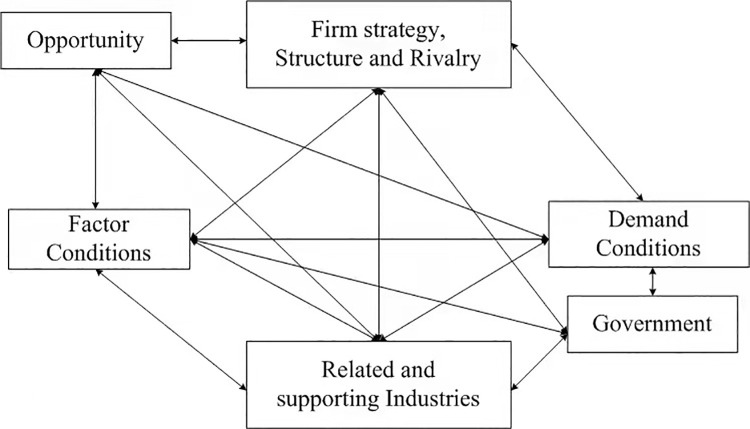
In recent years, Xinjiang mutton production has experienced a growth trend; however, it cannot meet the new consumer demand. Based on Michael Porter's "diamond model," this study presents a case study on the Xinjiang mutton industry in China and establishes an index system for the competitiveness of the industry. The competitiveness of the mutton industry is analyzed quantitatively via correlation analysis and principal component analysis by investigating the relevant data of 10 Chinese provinces topping in mutton production. On account of the related elements of the diamond model, a qualitative analysis is also performed. The quantitative analysis shows that among the 10 provinces (regions) topping in mutton production in China, Inner Mongolia wins in competitiveness, followed by Xinjiang, and Henan ranks at the bottom. The qualitative analysis shows that the Xinjiang mutton industry is inferior in three main factors compared to its competitors, and these are the production factors related to and supporting the industries and the enterprise strategies. Xinjiang performs moderately in terms of the auxiliary government factors. However, Xinjiang is in an advantageous position with respect to the main factors of demand conditions and auxiliary elements of opportunities. Given the existing problems, this study discusses the main reasons for the lack of competitiveness of the Xinjiang mutton industry. It also puts forward some strategic suggestions to enhance the competitiveness of the Xinjiang mutton industry based on the six elements of diamond model.
Conflict of interest statement
The authors have declared that no competing interests exist.
Figures
References
-
- Ma HL, Lin HL, Xiong XY, Han XP. The impact of the grassland ecological reward policy on grassland vegetation in Qinghai-Tibet plateau. Acta Agrestia Sinica. 2021; 3:545–554.
-
- Sheng Y, Ding J. The study on performance evaluation policy of “Suspending Grazing” in Inner Mongolia based on the theory of public value. Chinese Journal of Grassland. 2019; 2:71–79.
-
- Yang C, Meng ZX, Yang XD. Livestock production and pastoralists income in pastoral and semi-pastoral area under grassland ecological protection award and subsidy policy. Chinese Agricultural Science Bulletin. 2016; 8:8–12.
-
- Ding CZ, Xiao HF. Analysis on current situation and trend of mutton supply and demand in China. Fisheries Economy Research. 2016; 3:86–96.
-
- Liu Y. Present situation and future development trend of mutton industry in China. China Feed. 2019; 17:112–117.
MeSH terms
LinkOut - more resources
Full Text Sources
