


The economic and public health impact of intellectual property licensing of medicines for low-income and middle-income countries: a modelling study
- PMID: 34710359
- PMCID: PMC8809901
- DOI: 10.1016/S2468-2667(21)00202-4
The economic and public health impact of intellectual property licensing of medicines for low-income and middle-income countries: a modelling study
Abstract
Background: Non-exclusive voluntary licensing that is access-oriented has been suggested as an option to increase access to medicines to address the COVID-19 pandemic. To date, there has been little research on the effect of licensing, mainly focused on economic and supply chain considerations, and not on the benefits in terms of health outcomes. We aimed to study the economic and health effect of voluntary licensing for medicines for HIV and hepatitis C virus (HCV) in low-income and middle-income countries (LMICs).
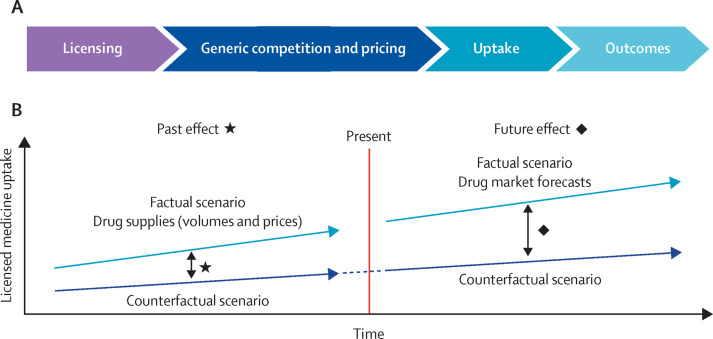
Methods: A robust modelling framework was created to examine the difference between scenarios, with (factual) and without (counterfactual) a Medicines Patent Pool (MPP) licence for two medicines, dolutegravir and daclatasvir. Data were obtained from MPP licensees, as well as a large number of external sources. The primary outcomes were the cost savings and health impact between scenarios with and without MPP licences across all LMICs. Through its licences, MPP had access to the volumes and prices of licensed generic products sold in all covered countries on a quarterly basis. These data informed the volumes, prices, and uptake for the past factual scenarios and were the basis for modelling the future factual scenarios. These scenarios were then compared with a set of counterfactual scenarios in the absence of the studied licences.
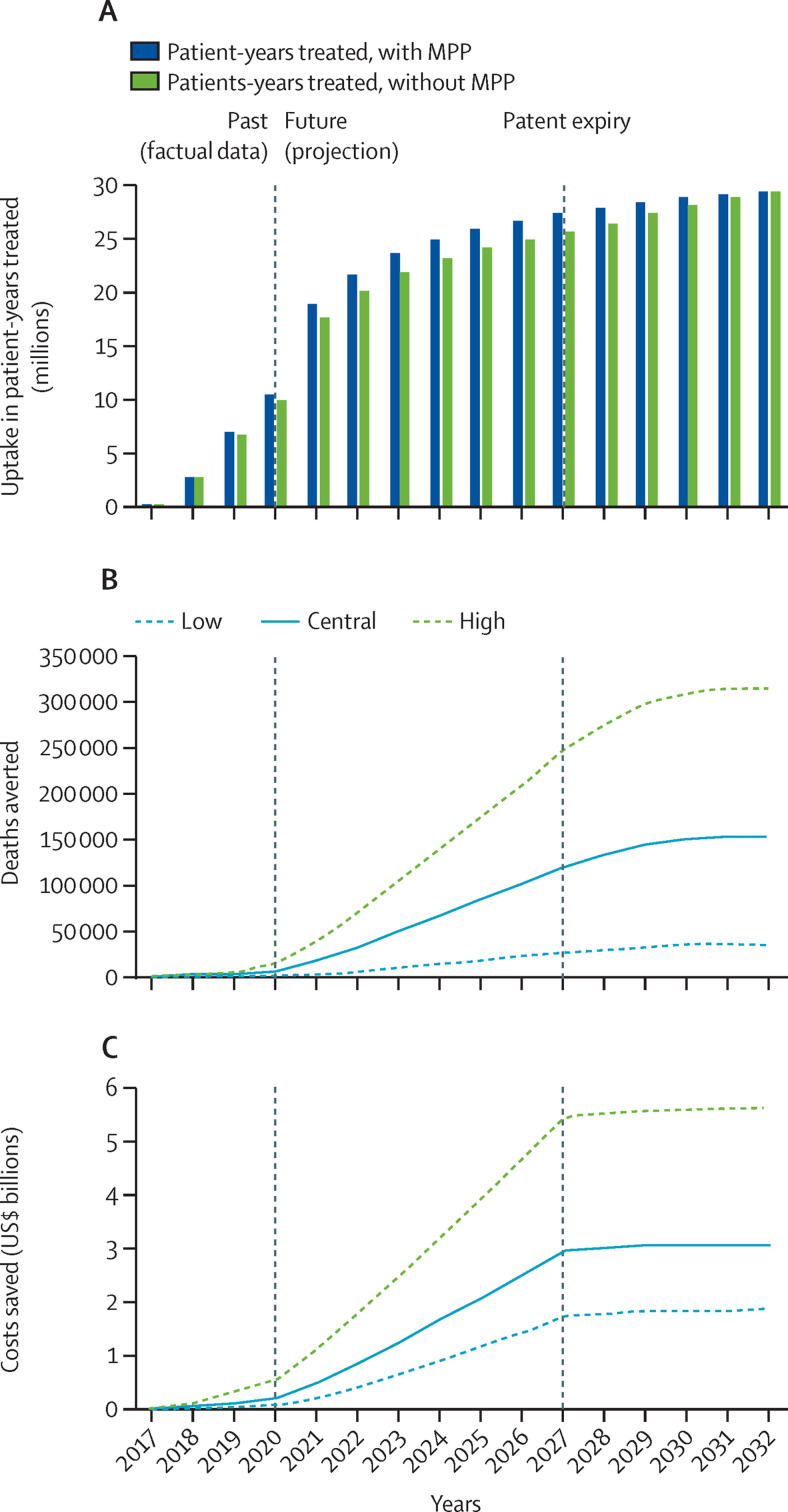
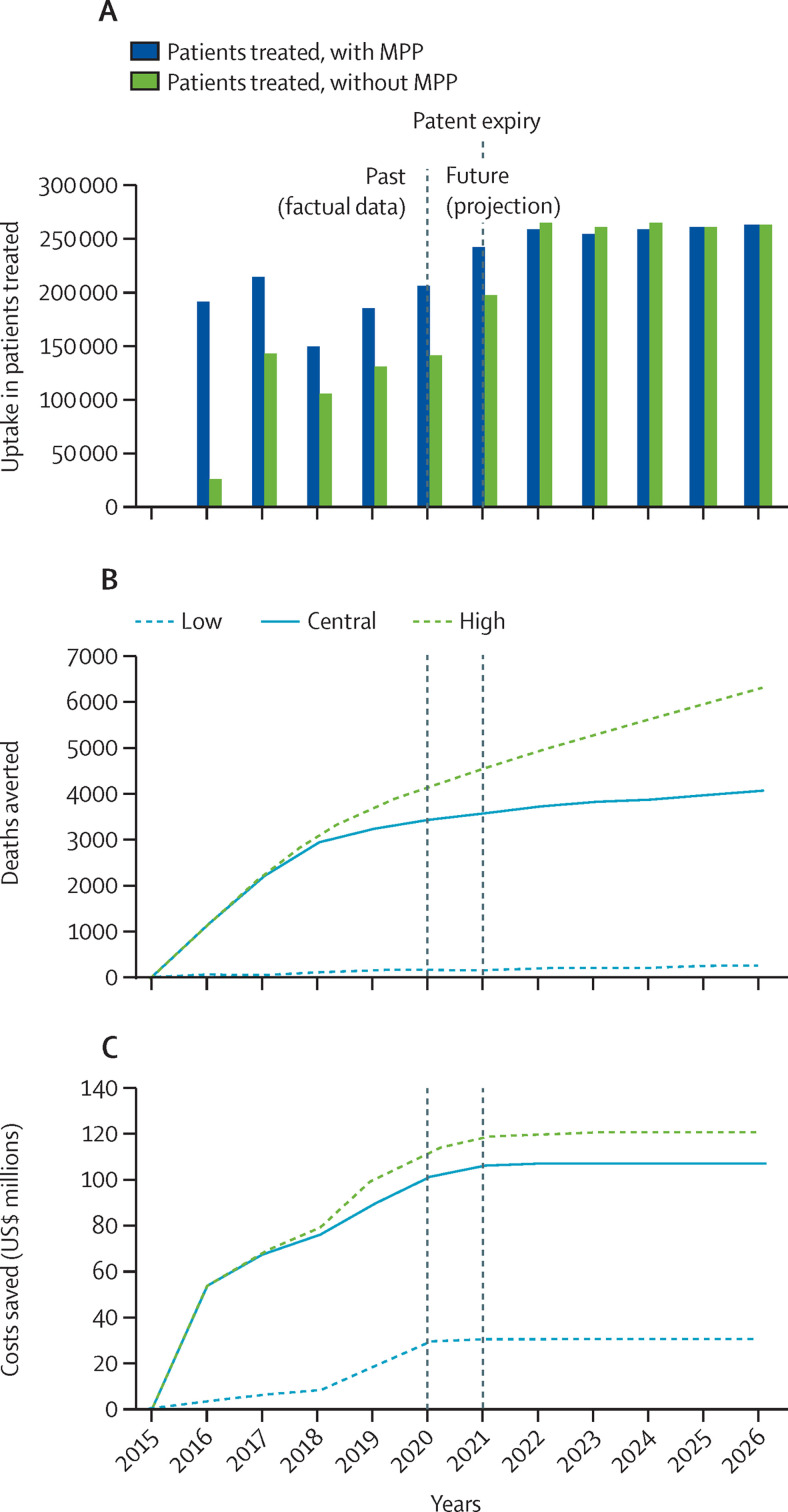
Findings: Cumulatively, between 2017 and 2032, the model's central assumptions predicted an additional uptake of 15·494 (range 14·406-15·494) million patient-years of dolutegravir-based HIV treatments, 151 839 (34 575-312 973) deaths averted, and US$3·074 (1·837-5·617) billion saved through the MPP licence compared with the counterfactual scenario. For daclatasvir-based HCV treatments, the cumulative effect from 2015 to 2026 was predicted to be an additional uptake of 428 244 (127 584-636 270) patients treated with daclatasvir, 4070 (225-6323) deaths averted, and $107·593 (30·377-121·284) million saved with the licence compared with the counterfactual scenario.
Interpretation: The chain of effects linking upstream licensing to downstream outcomes can be modelled. Accordingly, credible quantitative estimates of economic and health effects arising from access-oriented voluntary licensing were obtained based on assumptions that early generic competition leads to price reductions that influence procurement decisions and enable the faster and broader uptake of recommended medicines, with beneficial economic and health effects.
Funding: Unitaid.
Copyright © 2022 The Author(s). Published by Elsevier Ltd. This is an Open Access article under the CC BY-NC-ND 4.0 license. Published by Elsevier Ltd.. All rights reserved.
Conflict of interest statement
Declaration of interests SM is an employee of the MPP and reports grants from Unitaid. HBM is an employee of MPP and reports grants from Unitaid. EB is an employee of MPP and reports grants from Unitaid. OB-H has acted as a consultant for MPP for this work. CvD has acted as a consultant for MPP for this work. JVL has acted as a consultant for MPP for this work.
Figures
References
-
- WHO WHO Access to COVID-19 Tools (ACT) Accelerator. https://www.who.int/initiatives/act-accelerator
-
- WHO COVID-19 Technology Access Pool. https://www.who.int/emergencies/diseases/novel-coronavirus-2019/global-r... - PubMed
-
- WHO Roadmap for access to medicines, vaccines and health product 2019–2023: comprehensive support for access to medicines, vaccines and other health products. 2019. https://apps.who.int/iris/handle/10665/330145
Publication types
MeSH terms
Substances
LinkOut - more resources
Full Text Sources
Miscellaneous
