


Identification of RET fusions in a Chinese multicancer retrospective analysis by next-generation sequencing
- PMID: 34710947
- PMCID: PMC8748217
- DOI: 10.1111/cas.15181
Identification of RET fusions in a Chinese multicancer retrospective analysis by next-generation sequencing
Abstract
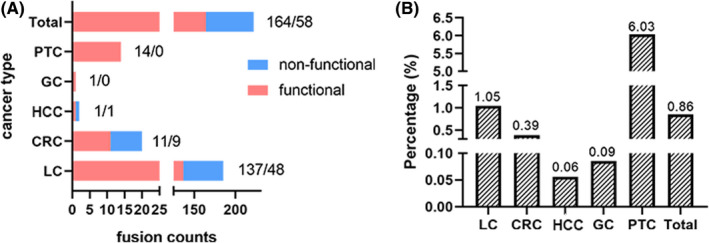
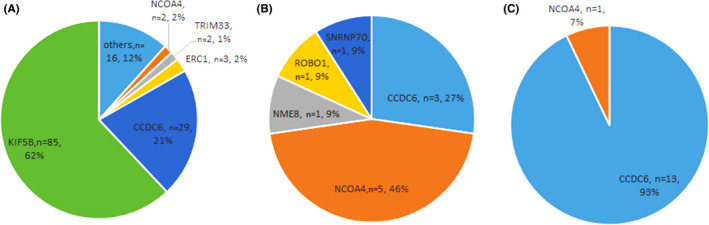
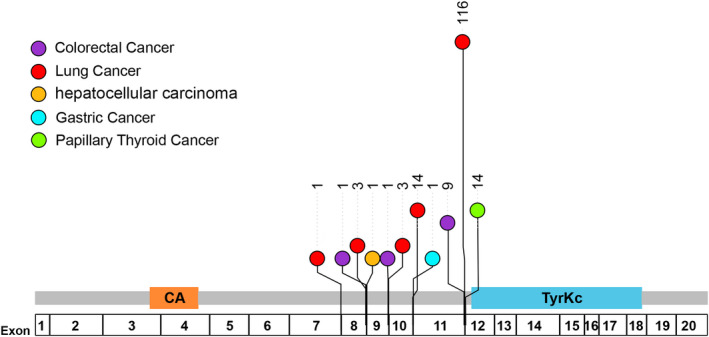
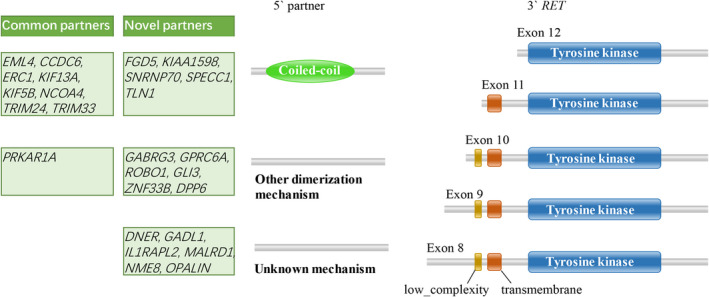
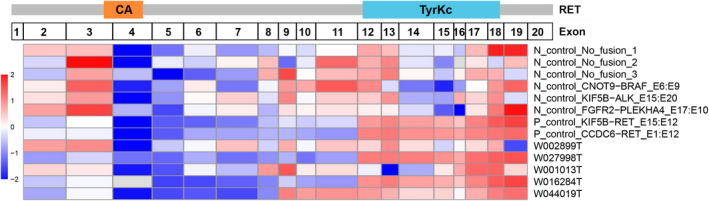
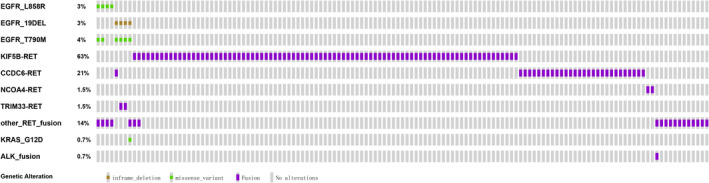
Fusion of RET with different partner genes has been detected in papillary thyroid, lung, colorectal, pancreatic, and breast cancer. Approval of selpercatinib for treatment of lung and thyroid cancer with RET gene mutations or fusions calls for studies to explore RET fusion partners and their eligibility for RET-based targeted therapy. In this study, RET fusion patterns in a large group of Chinese cancer patients covering several cancer types were identified using next-generation sequencing. A total of 44 fusion patterns were identified in the study cohort with KIF5B, CCDC6, and ERC1 being the most common RET fusion partners. Notably, 17 novel fusions were first reported in this study. Prevalence of functional RET fusions was 1.05% in lung cancer, 6.03% in thyroid cancer, 0.39% in colorectal cancer, and less than 0.1% in gastric cancer and hepatocellular carcinoma. Analysis showed a preference for fusion partners in different tumor types, with KIF5B being the common type in lung cancer, CCDC6 in thyroid cancer, and NCOA4 in colorectal cancer. Co-occurrence of EGFR mutations and RET fusions with rare partner genes (rather than KIF5B) in lung cancer patients was correlated with epidermal growth factor receptor-tyrosine kinase inhibitor resistance and could predict response to targeted therapies. Findings from this study provide a guide to clinicians in determining tumors with specific fusion patterns as candidates for RET targeted therapies.
Keywords: EGFR-TKI resistance; NGS; RET fusion; lung cancer; multicancer.
© 2021 The Authors. Cancer Science published by John Wiley & Sons Australia, Ltd on behalf of Japanese Cancer Association.
Figures
References
-
- Takahashi M, Ritz J, Cooper GM. Activation of a novel human transforming gene, ret, by DNA rearrangement. Cell. 1985;42:581‐588. - PubMed
-
- Alberti L, Carniti C, Miranda C, Roccato E, Pierotti MA. RET and NTRK1 proto‐oncogenes in human diseases. J Cell Physiol. 2003;195:168‐186. - PubMed
-
- McCarty MF. Targeting multiple signaling pathways as a strategy for managing prostate cancer: multifocal signal modulation therapy. Integr Cancer Ther. 2004;3:349‐380. - PubMed
Publication types
MeSH terms
Substances
Grants and funding
LinkOut - more resources
Full Text Sources
Medical
Research Materials
Miscellaneous
