Review
. 2021 Dec;44(12):936-945.
doi: 10.1016/j.tins.2021.09.005. Epub 2021 Oct 25.

Rethinking stress resilience

Affiliations
Review

Rethinking stress resilience

Seema Bhatnagar. Trends Neurosci. 2021 Dec.

Abstract

Resilience to stressful life events has received considerable attention in both clinical and preclinical studies. A number of neural substrates have been identified as putatively mediating resilience to stress. However, there remains considerable diversity in how resilience is defined and studied. This article aims to examine how resilience is defined and conceptualized in social psychology, public health, and related fields, to better inform the understanding of stress resilience in the neurobiological context, and to differentiate resilience from other patterns of response to stressful experiences. An understanding of resilience through the lens of clinical and applied sciences is likely to lead to the identification of more robust and reproducible neural substrates, though many challenges remain.

Keywords: PTSD; brain; inflammation; neural substrates; sex differences.


Conflict of interest statement

Declaration of Interests:

The author declares no competing interests in relation to this work.

Figures
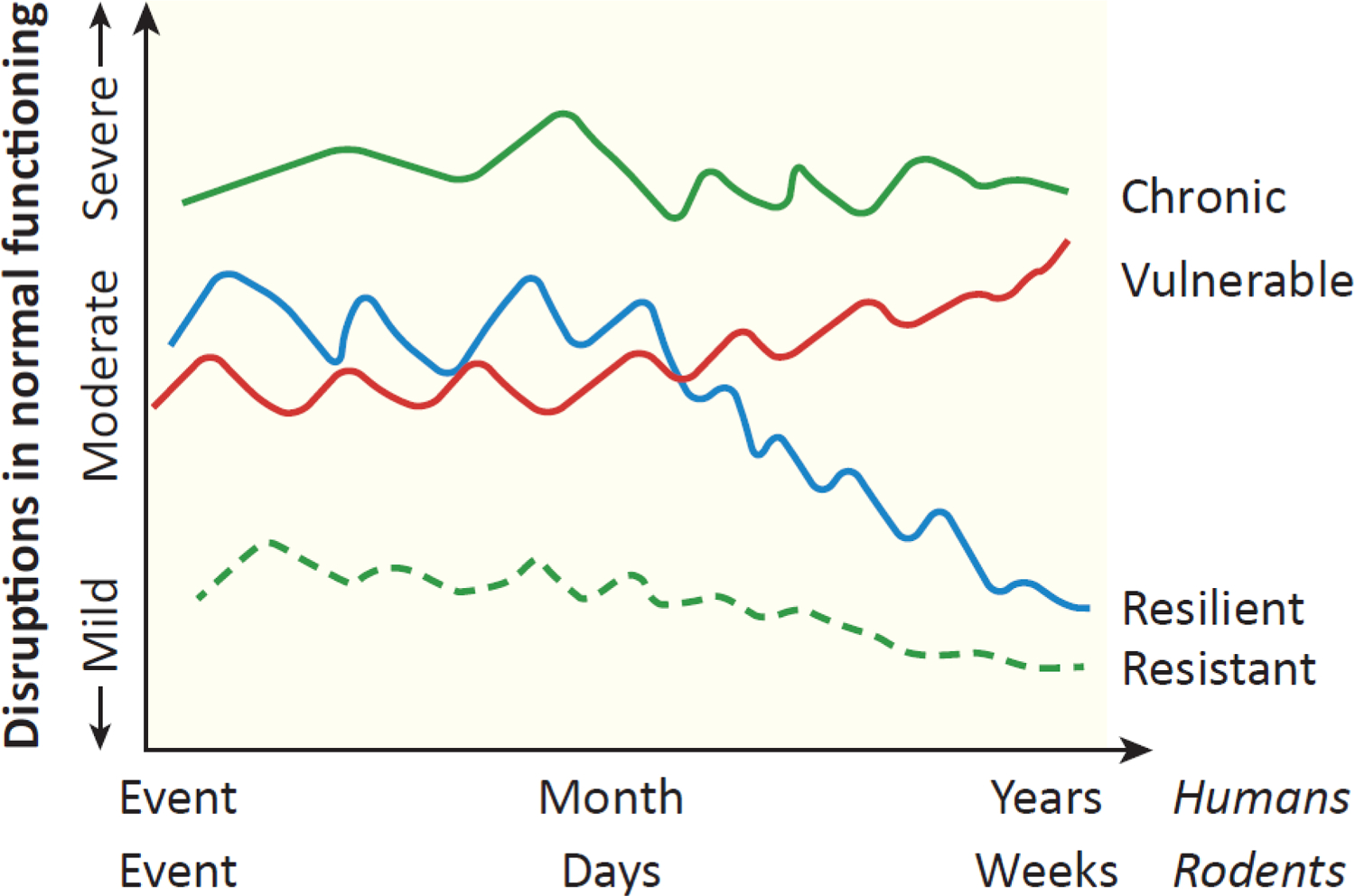
Figure 1.
Figure 1.. Hypothetical patterns of responses to an intense or traumatic stressful event.
Multiple possible patterns of responses to stressful and traumatic stimuli exist. The vulnerable trajectory is one in which moderate levels of stress or distress persist and may increase further over time. The chronic trajectory is characterized by elevated responses to the trauma and those symptoms remain highly elevated. Resistance is one in which few symptoms develop either initially or later on. The resilient category is one in which there is moderate disruption and symptoms initially, followed by a return towards baseline. Cross-sectional studies of the response in stressed individuals at periods of time after patterns have stabilized are unable to differentiate resilient from resistant individuals or chronically responsive from vulnerable individuals. As a result, neural substrates underlying resilience may not be reproducibly identified. An approach that examines the trajectory of individuals’ responses improves the ability to identify underlying discrete and stress-specific neural substrates. Adapted from [13] with permission.
Figure 2.
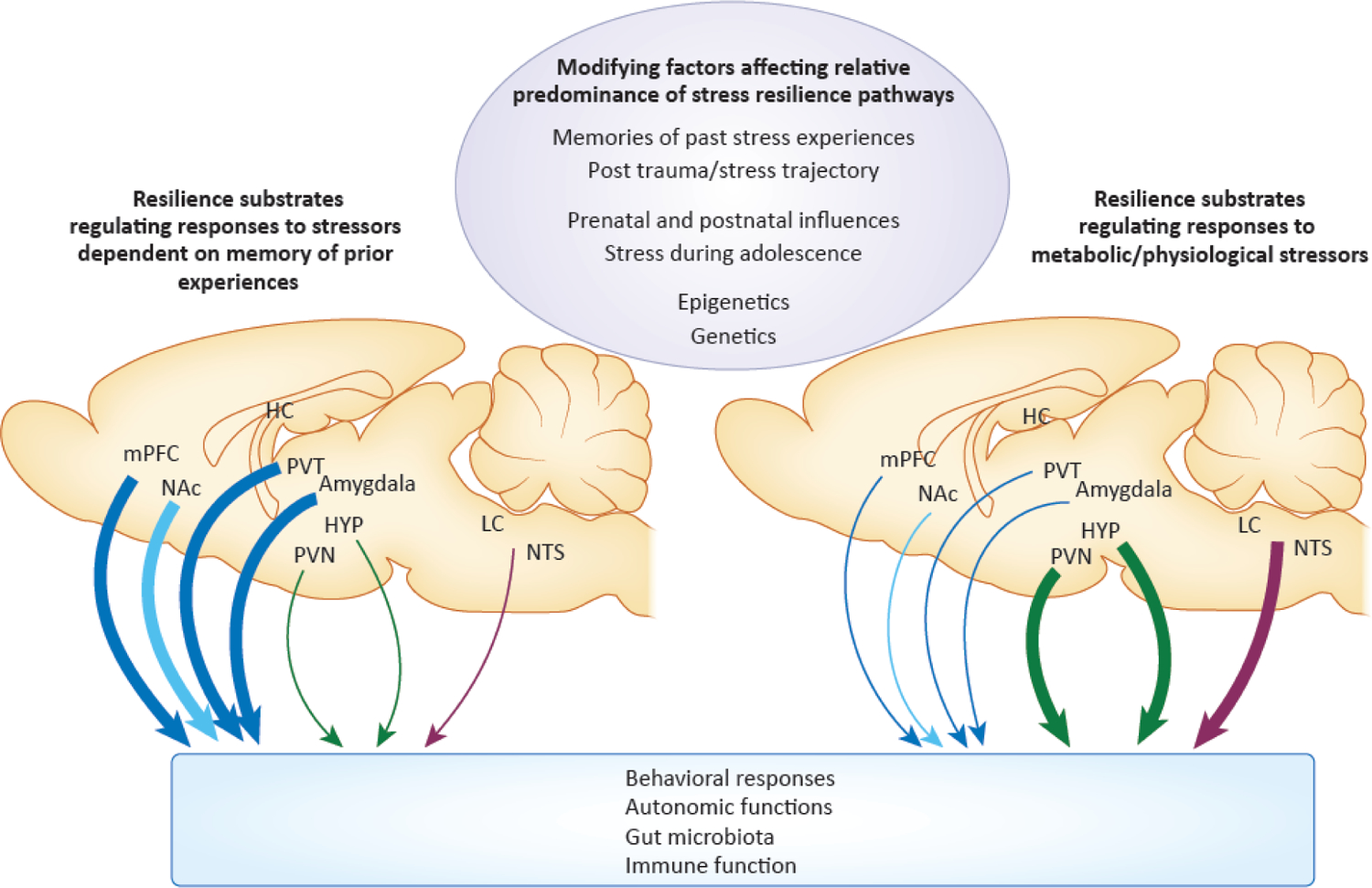
Figure 2.. Schematic illustration of some of the neural substrates involved in stress resilience in the rodent brain, and how their relative predominance may shift depending on modifying factors.
Multiple substrates and circuits exist in parallel that can promote resilience. Which substrates or circuits predominate may be determined by modifying factors. These include experiences in early life; prenatal or postnatal disruptions; stress during adolescence; epigenetic or genetic influences; prior experience with the ongoing, current stressors; and the time point being examined during the post-stress trajectory. These modifying factors can shift the weight of resilience circuits and substrates, so that some circuits/substrates predominate in promoting resilience. For example, resilience substrates in limbic structures may predominate to control responses to stress when memories for prior experiences are relevant, such as when familiar stressors are experienced or when the same stressors are experienced over time (heavier blue lines on the left). With more metabolic or physiological types of stressors, resilience substrates in hypothalamic structures may predominate (heavier green lines on the right). The structures, responses, and modifying factors depicted in the figure are not intended to be all inclusive. Abbreviations: mPFC: medial prefrontal cortex, NAc: nucleus accumbens, HC: hippocampus, HYP: hypothalamus, PVT: paraventricular nucleus of the thalamus, PVN: paraventricular nucleus of the hypothalamus, LC: locus coeruleus, NTS: nucleus tractus solitarius.

References

    1. Ehlert U, Gaab J, and Heinrichs M, Psychoneuroendocrinological contributions to the etiology of depression, posttraumatic stress disorder, and stress-related bodily disorders: the role of the hypothalamus-pituitary-adrenal axis. Biol Psychol, 2001. 57(1–3): p. 141–52. - PubMed
    1. Yehuda R, Biology of posttraumatic stress disorder. J Clin Psychiatry, 2001. 62 Suppl 17: p. 41–6. - PubMed
    1. Scott KM, McLaughlin KA, Smith DA, and Ellis PM, Childhood maltreatment and DSM-IV adult mental disorders: comparison of prospective and retrospective findings. Br J Psychiatry, 2012. 200(6): p. 469–75. - PMC - PubMed
    1. Benjet C, Borges G, and Medina-Mora ME, Chronic childhood adversity and onset of psychopathology during three life stages: childhood, adolescence and adulthood. J Psychiatr Res, 2010. 44(11): p. 732–40. - PubMed
    1. Kessler RC, McLaughlin KA, Green JG, Gruber MJ, Sampson NA, Zaslavsky AM, Aguilar-Gaxiola S, Alhamzawi AO, Alonso J, Angermeyer M, Benjet C, Bromet E, Chatterji S, de Girolamo G, Demyttenaere K, Fayyad J, Florescu S, Gal G, Gureje O, Haro JM, Hu CY, Karam EG, Kawakami N, Lee S, Lepine JP, Ormel J, Posada-Villa J, Sagar R, Tsang A, Ustun TB, Vassilev S, Viana MC, and Williams DR, Childhood adversities and adult psychopathology in the WHO World Mental Health Surveys. Br J Psychiatry, 2010. 197(5): p. 378–85. - PMC - PubMed

Publication types