. 2021 Oct 28;12(1):6223.
doi: 10.1038/s41467-021-26475-6.

The impact of the timely birth dose vaccine on the global elimination of hepatitis B

Affiliations

The impact of the timely birth dose vaccine on the global elimination of hepatitis B

Margaret J de Villiers et al. Nat Commun. .

Abstract

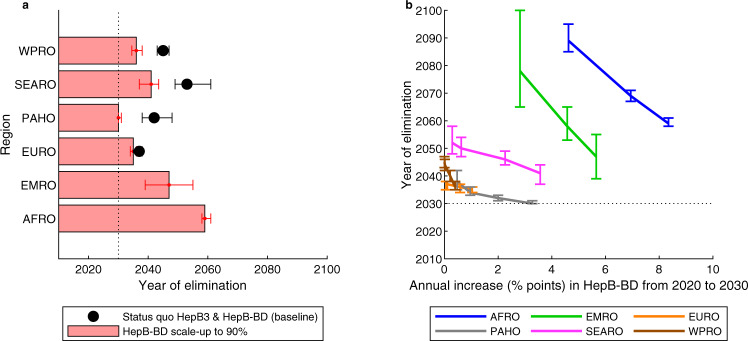
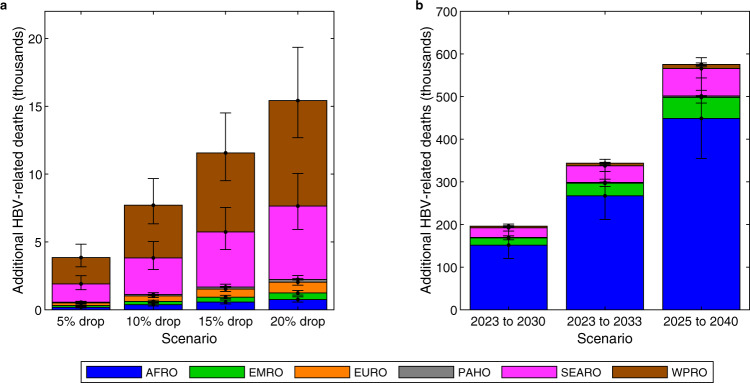
In 2016 the World Health Organization set the goal of eliminating hepatitis B globally by 2030. Horizontal transmission has been greatly reduced in most countries by scaling up coverage of the infant HBV vaccine series, and vertical transmission is therefore becoming increasingly dominant. Here we show that scaling up timely hepatitis B birth dose vaccination to 90% of new-borns in 110 low- and middle-income countries by 2030 could prevent 710,000 (580,000 to 890,000) deaths in the 2020 to 2030 birth cohorts compared to status quo, with the greatest benefits in Africa. Maintaining this could lead to elimination by 2030 in the Americas, but not before 2059 in Africa. Drops in coverage due to disruptions in 2020 may lead to 15,000 additional deaths, mostly in South-East Asia and the Western Pacific. Delays in planned scale-up could lead to an additional 580,000 deaths globally in the 2020 to 2030 birth cohorts.


Conflict of interest statement

The authors declare the following competing interests: This work was carried out as part of the Vaccine Impact Modelling Consortium (www.vaccineimpact.org), but the views expressed are those of the authors and not necessarily those of the Consortium or its funders. The funders were given the opportunity to review this paper prior to publication, but the final decision on the content of the publication was taken by the authors. SN and TBH have received personal fees for technical consultation work with the World Health Organization on Hepatitis elimination, surveillance and monitoring, and for the preparation of reports for guidelines committees on the prevention of mother-to-child transmission. The other authors declare no competing interests.

Figures

Fig. 1
Fig. 1. The model calibrations and the scenarios used.
a HBsAg prevalence in all ages, b HBeAg prevalence in HBsAg+ women of childbearing age, and HBV-related death rates (deaths per 100,000) from c cirrhosis and d hepatocellular carcinoma in the 110 countries modelled compared to data from the literature in the year the data were collected. Data are presented as mean values with 95% credibility intervals of n = 200 model outcomes resulting from 200 independent draws from the posterior distribution of each country. Countries modelled in the six WHO regions AFRO, EMRO, EURO, PAHO, SEARO and WPRO are given in Supplementary Fig. 1. e HepB3 and f timely HepB-BD vaccination coverage globally in selected scenarios (see Table 1). Note that all four lines co-incide in Fig. 1e. In Fig. 1f, the Status quo HepB3 & HepB-BD (baseline) line appears dashed where it co-incides with the HepB-BD disruptions 20% in 2020 line and the HepB-BD scale-up to 90% line appears dashed where it co-incides with the HepB-BD delayed & slow scale-up 2025 to 2040 line. HBeAg: hepatitis B e antigen; HBsAg: hepatitis B surface antigen; HBV: hepatitis B virus; HCC: hepatocellular carcinoma; HepB3: infant HBV vaccine series; timely HepB-BD: timely birth dose; WHO: World Health Organization.
Fig. 2
Fig. 2. The overall impact of timely HepB-BD scale-up on disease burden globally.
a Incidence of new chronic carriage of HBV, b Prevalence of chronic HBsAg among five-year-olds, c HBV-related deaths and d total DALYs incurred. Shown are the means (lines) and 95% credibility intervals (shaded areas), comparing the status quo HepB3 & HepB-BD scenario (black line; grey shading) with a scenario in which timely HepB-BD is given to ≥90% of new-borns (the HepB-BD scale-up scenario; red line and shading). Results are the sum from all modelled countries of n = 200 model outcomes resulting from 200 independent draws from the posterior distribution of each country. The horizontal dashed line in Fig. 2b represents the WHO elimination threshold of 0.1% HBsAg prevalence in five-year-olds. DALY: disability adjusted life years; HBsAg: hepatitis B surface antigen; HBV: hepatitis B virus; timely HepB-BD: timely birth dose; WHO: World Health Organization.
Fig. 3
Fig. 3. The impact of timely HepB-BD scale-up on HBV-related deaths.
a HBV-related deaths averted in each WHO region (mean and 95% credibility intervals) in the birth cohorts for years 2015 to 2050, in the scenario in which timely HepB-BD coverage is scaled up to ≥90% by 2030 in each country (the HepB-BD scale-up scenario) compared to the status quo HepB3 & HepB-BD scenario. Results are the sums within WHO regions from all modelled countries of n = 200 model outcomes resulting from 200 independent draws from the posterior distribution of each country. b Percentage of global total HBV-related deaths averted in the 2020 to 2030 birth cohorts that occurs in each country if timely HepB-BD coverage is scaled up to ≥90% by 2030 (the HepB-BD scale-up scenario) relative to the status quo HepB3 & HepB-BD scenario. The six WHO regions AFRO, EMRO, EURO, PAHO, SEARO, and WPRO are shown in Supplementary Fig. 1. HBV hepatitis B virus, HepB3 infant HBV vaccine series, timely HepB-BD timely birth dose, WHO World Health Organization.
Fig. 4
Fig. 4. The impact of timely HepB-BD scale-up on achieving WHO elimination targets.
a Median year by which the elimination target (0.1% HBsAg prevalence in five-year-olds) is reached in the WHO regions, with 95% credibility intervals, in the status quo HepB3 & HepB-BD scenario (black dots) and the scenario in which timely HepB-BD coverage is scaled up to ≥90% by 2030 (HepB-BD scale-up scenario; red bars). b Median year of elimination, with 95% credibility intervals, for different levels of annual scale-up of timely HepB-BD coverage (the HepB-BD scale-up scenarios) in the populations within each of the WHO regions. The dotted lines for the year 2030 are for reference purposes only. For each WHO region, number of HBsAg prevalent cases in five-year-olds and total number of five-year-olds were summed across countries. Number of HBsAg prevalent cases in five-year-olds was divided by total number of five-year-olds to give HBsAg prevalence in five-year-olds. The year of elimination was identified as the year in which HBsAg prevalence in five-year-olds falls below 0.1%. This was repeated n = 200 times using independent draws from the posterior distribution of each country. The six WHO regions AFRO, EMRO, EURO, PAHO, SEARO and WPRO are shown in Supplementary Fig. 1. HBsAg: hepatitis B surface antigen; HepB3: infant HBV vaccine series; timely HepB-BD: timely birth dose; WHO: World Health Organization.
Fig. 5
Fig. 5. The impact of disruptions to the scale-up of timely HepB-BD on HBV-related deaths.
a Mean additional HBV-related deaths in the birth cohorts in 2020-2030 due to a drop in the proportion of new-borns receiving timely HepB-BD in 2020 (the HepB-BD disruptions scenarios) relative to the status quo HepB3 & HepB-BD scenario, with 95% credibility intervals. b Mean additional HBV-related deaths in the birth cohorts in 2020-2030 due to delays in scaling up timely HepB-BD coverage to ≥90% (the delayed HepB-BD scale-up scenarios) relative to scaling up timely HepB-BD coverage to ≥90% between 2020 and 2030 (the HepB-BD scale-up scenario), with 95% credibility intervals. Results are the sums within WHO regions from all modelled countries of n = 200 model outcomes resulting from 200 independent draws from the posterior distribution of each country. The six WHO regions AFRO, EMRO, EURO, PAHO, SEARO, and WPRO are shown in Supplementary Fig. 1. HBV: hepatitis B virus; HepB3: infant HBV vaccine series; timely HepB-BD: timely birth dose; WHO: World Health Organization.

References

    1. Global hepatitis report 2017 (World Health Organization, Geneva, 2017).
    1. Combating hepatitis B and C to reach elimination by 2030: advocacy brief (World Health Organization, Geneva, 2016).
    1. Global health sector strategy on viral hepatitis 2016–2021. Towards ending viral hepatitis (World Health Organization, Geneva, 2016).
    1. Hepatitis B vaccines: WHO position paper. in Weekly epidemiological record, Vol. 84 405–420 (World Health Organization, 2009).
    1. Hepatitis B vaccines: WHO position paper--recommendations. Vaccine28, 589–590 (2010). - PubMed

Publication types

Substances