


An extremely rare case: Transorbital penetrating intracranial injury by wooden foreign body. Case report
- PMID: 34712477
- PMCID: PMC8528685
- DOI: 10.1016/j.amsu.2021.102937
An extremely rare case: Transorbital penetrating intracranial injury by wooden foreign body. Case report
Abstract
Introduction and importance: Transorbital Penetrating Intracranial Injury (TOPI) is a rare case, but those caused by Wooden Foreign Body are even challenging that may pose unusual diagnostic and surgical challenges.
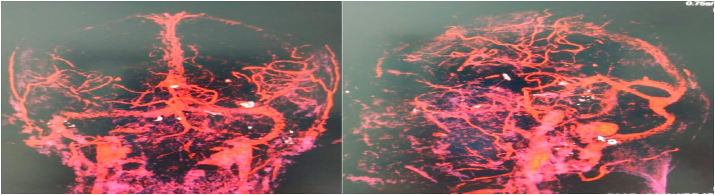
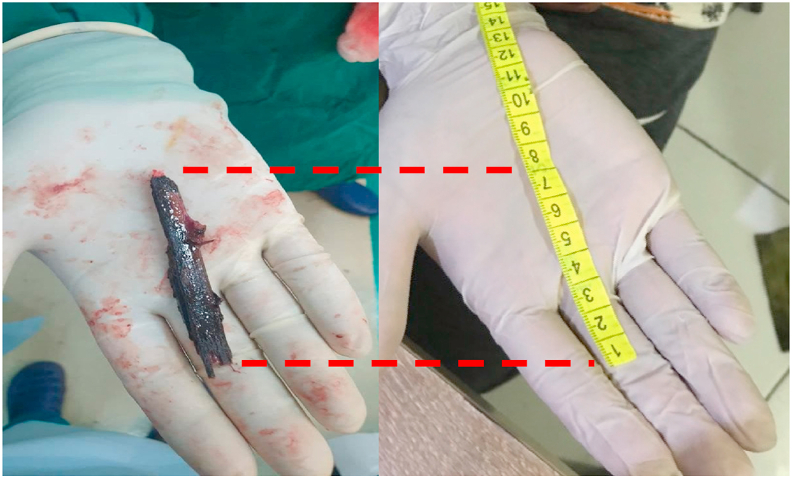
Case presentation: we presented a TOPI following a wood penetrated to the left temporal fossa region via orbital roof due to struck the tree branches while got a motor vehicle accident. The patient was fully conscious with decreased visual acuity in the left eye and left ophthalmoplegia. Non-contrast CT scan showed the linear-shaped foreign body, air mimicking that penetrated medial orbit plane to the left temporal fossa.
Clinical discussion: The surgery was performed with a temporobasal approach and revealed good results with only mild ophthalmologic complications without long-term fatal complications (1-year followed-up).
Conclusion: early removal of wooden foreign body that penetrates to the intracranial via transorbital is mandatory and should be involved multidisciplinary approach to get the optimal result and avoid the fatal complication both neurologically or ophthalmologically.
Keywords: Case report; Multidisciplinary approach; Orbitocranial injury; Penetrating injury; Wooden foreign body.
© 2021 The Authors.
Conflict of interest statement
None.
Figures




References
-
- Prasetyo E., Oley M.C., Islam A.A., Prihantono P. Management of transorbital penetrating intracranial injury by a homemade metal arrow: serials case report. Open Access Maced J Med Sci. 2020;8:30–35. doi: 10.3889/OAMJMS.2020.3361. C. - DOI
Publication types
LinkOut - more resources
Full Text Sources
Research Materials
