


Second-Generation Digital Health Platforms: Placing the Patient at the Center and Focusing on Clinical Outcomes
- PMID: 34713042
- PMCID: PMC8521820
- DOI: 10.3389/fdgth.2020.569178
Second-Generation Digital Health Platforms: Placing the Patient at the Center and Focusing on Clinical Outcomes
Abstract
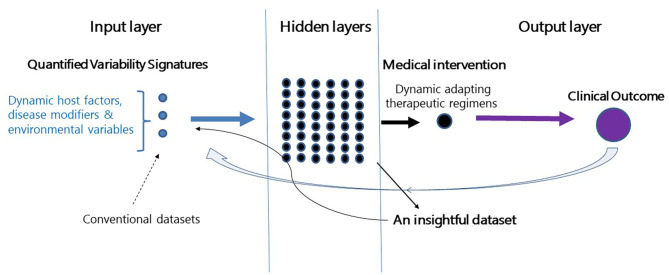
Artificial intelligence (AI) digital health systems have drawn much attention over the last decade. However, their implementation into medical practice occurs at a much slower pace than expected. This paper reviews some of the achievements of first-generation AI systems, and the barriers facing their implementation into medical practice. The development of second-generation AI systems is discussed with a focus on overcoming some of these obstacles. Second-generation systems are aimed at focusing on a single subject and on improving patients' clinical outcomes. A personalized closed-loop system designed to improve end-organ function and the patient's response to chronic therapies is presented. The system introduces a platform which implements a personalized therapeutic regimen and introduces quantifiable individualized-variability patterns into its algorithm. The platform is designed to achieve a clinically meaningful endpoint by ensuring that chronic therapies will have sustainable effect while overcoming compensatory mechanisms associated with disease progression and drug resistance. Second-generation systems are expected to assist patients and providers in adopting and implementing of these systems into everyday care.
Keywords: algorithms; artificial intelligence; complex systems; precision medicine; variability.
Copyright © 2020 Ilan.
Conflict of interest statement
YI is the founder of Oberon Sciences and is a consultant for Teva, ENZO, Protalix, Betalin Therapeutics, Immuron, SciM, Natural Shield, and Tiziana.
Figures
References
-
- Singh RP, Hom GL, Abramoff MD, Campbell JP, Chiang MF, on behalf of the AAO Task Force on Artificial Intelligence . Current challenges and barriers to real-world artificial intelligence adoption for the healthcare system, provider, the patient. Transl Vis Sci Technol. (2020) 9:45. 10.1167/tvst.9.2.45 - DOI - PMC - PubMed
LinkOut - more resources
Full Text Sources
