Randomized Controlled Trial
. 2021 Nov 2;10(21):e021570.
doi: 10.1161/JAHA.121.021570. Epub 2021 Oct 29.

Implications of Myocardial Infarction on Management and Outcome in Cardiogenic Shock

Affiliations
Randomized Controlled Trial

Implications of Myocardial Infarction on Management and Outcome in Cardiogenic Shock

Richard G Jung et al. J Am Heart Assoc. .

Abstract

Background The randomized DOREMI (Dobutamine Compared to Milrinone) clinical trial evaluated the efficacy and safety of milrinone and dobutamine in patients with cardiogenic shock. Whether the results remain consistent when stratified by acute myocardial infarction remains unknown. In this substudy, we sought to evaluate differences in clinical management and outcomes of acute myocardial infarction complicated by cardiogenic shock (AMICS) versus non-AMICS. Methods and Results Patients in cardiogenic shock (n=192) were randomized 1:1 to dobutamine or milrinone. The primary composite end point in this subgroup analysis was all-cause in-hospital mortality, cardiac arrest, non-fatal myocardial infarction, cerebrovascular accident, the need for mechanical circulatory support, or initiation of renal replacement therapy (RRT) at 30-days. Outcomes were evaluated in patients with (n=65) and without (n=127) AMICS. The primary composite end point was significantly higher in AMICS versus non-AMICS (hazard ratio [HR], 2.21; 95% CI, 1.47-3.30; P=0.0001). The primary end point was driven by increased rates of all-cause mortality, mechanical circulatory support, and RRT. No differences in other secondary outcomes including cardiac arrest or cerebrovascular accident were observed. AMICS remained associated with the primary composite outcome, 30-day mortality, and RRT after adjustment for age, sex, procedural contrast use, multivessel disease, and inotrope type. Conclusions AMI was associated with increased rates of adverse clinical outcomes in cardiogenic shock along with increased rates of mortality and initiation of mechanical circulatory support and RRT. Contrast administration during revascularization likely contributes to increased rates of RRT. Heterogeneity of outcomes in AMICS versus non-AMICS highlights the need to study interventions in specific subgroups of cardiogenic shock. Registration URL: https://www.clinicaltrials.gov; Unique identifier: NCT03207165.

Keywords: acute myocardial infarction; cardiogenic shock; inotrope; mechanical circulatory support; renal replacement therapy; revascularization.


Figures
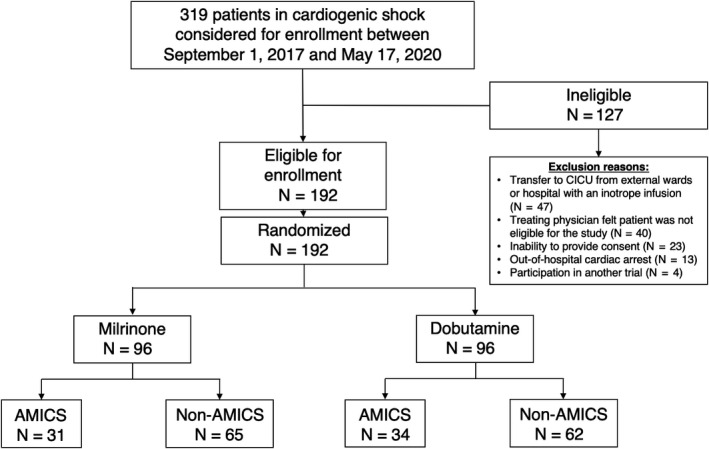
Figure 1
Figure 1. Study flow diagram.
Flow diagram of patient enrollment, showing ineligible patients at screening, randomization 1:1 to inotrope type, and divided by acute myocardial infarction status. AMICS indicates acute myocardial infarction complicated by cardiogenic shock; and CICU, critical intensive care unit.
Figure 2
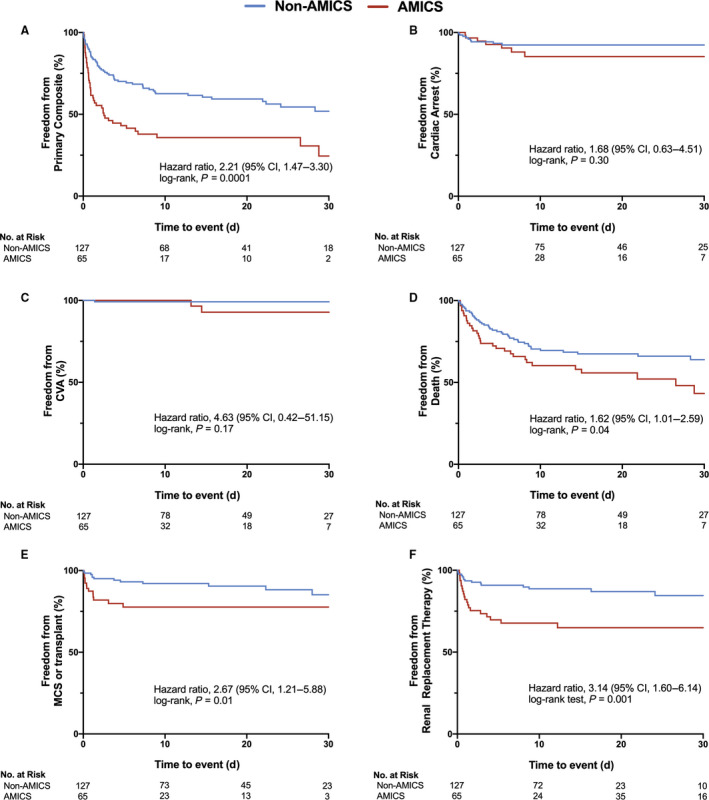
Figure 2. Kaplan‒Meier estimates in patients with acute myocardial infarction complicated by cardiogenic shock (AMICS) vs non‐AMICS by primary and secondary end points.
A, AMICS was associated with increased rates of primary composite end point (hazard ratio [HR], 2.21; 95% CI, 1.47–3.30; P=0.0001). B, No differences in rates of cardiac arrest was observed with AMICS vs non‐AMICS (HR, 1.68; 95% CI, 0.63–4.51; P=0.30). C, No differences in rates of CVA was observed with AMICS vs non‐AMICS (HR, 4.63; 95% CI, 0.42–51.15; P=0.21). D, AMICS was associated with increased rates of 30‐day all‐cause mortality (HR, 1.62; 95% CI, 1.01–2.59; P=0.04). E, AMICS was associated with increased rates of need for mechanical circulatory support or cardiac transplant (HR, 2.67; 95% CI, 1.21–5.88; P=0.01). F, AMICS was associated with increased initiation of renal replacement therapy (HR, 3.14; 95% CI, 1.60–6.14; P=0.001). Comparisons were made by log‐rank test and hazard ratios were evaluated using the Cox proportional hazards model. P<0.05 is considered statistically significant. AMICS indicates acute myocardial infarction complicated by cardiogenic shock; CVA, cerebrovascular accident; and MCS, mechanical circulatory support.
Figure 3
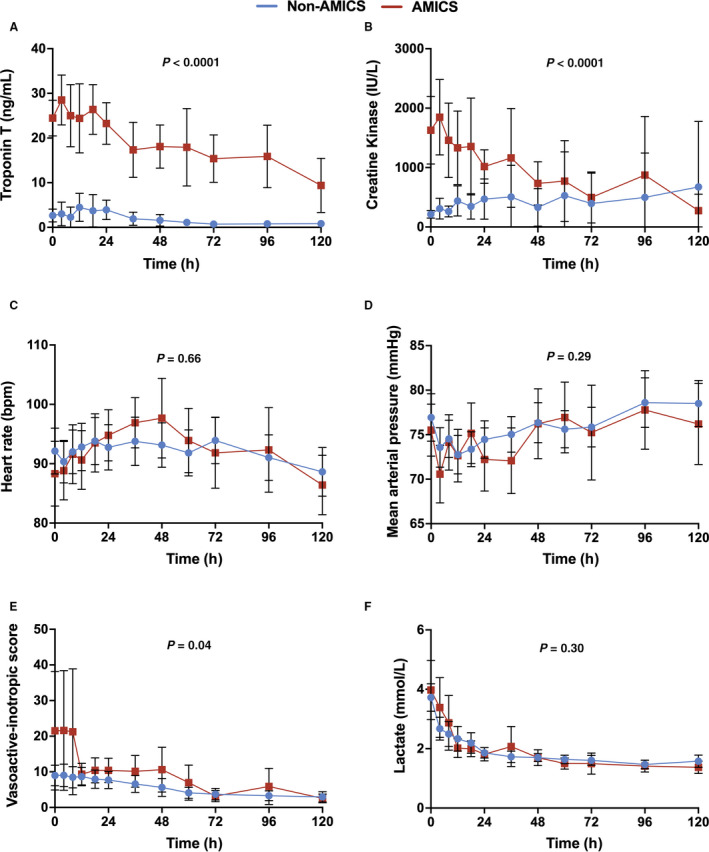
Figure 3. Changes in key hemodynamic and biochemical parameters from baseline to 120 hours.
A, Troponin T (ng/mL; P<0.0001). B, Creatine kinase (IU/L; P<0.0001). C, Heart rate (beats per minute [bpm]; P=0.66). D, Mean arterial pressure (mm Hg; P=0.29). E, Vasoactive‐inotropic score (P=0.04). F, Lactate (mmol/L; P=0.30). A repeated measure mixed model was utilized to evaluate differences in the continuous variables between the 2 groups. All panels reveal mean±95% CIs with blue representing non acute myocardial infarction complicated by cardiogenic shock and red representing acute myocardial infarction complicated by cardiogenic shock. AMICS indicates acute myocardial infarction complicated by cardiogenic shock
Figure 4
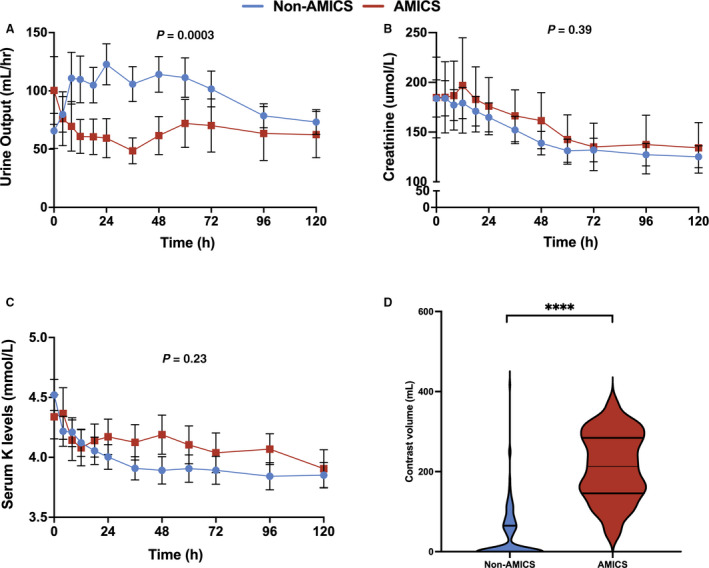
Figure 4. Renal outcomes.
A, Changes in urine output (mL/h) from baseline to 120 hours (P=0.0003). B, Changes in creatinine (µmol/L) from baseline to 120 hours (P=0.39). C, Changes in serum potassium levels (mmol/L) from baseline to 120 hours (P=0.23). D, Contrast volume was elevated in acute myocardial infarction complicated by cardiogenic shock (213.0 [147.0–279.0] mL vs 0.0 [0.0–65.0] mL; P<0.0001). A repeated measure mixed model was used to evaluate differences in the continuous variables between the 2 groups. All panels reveal mean±95% CIs with blue representing nonacute myocardial infarction complicated by cardiogenic shock and red representing patients with acute myocardial infarction complicated by cardiogenic shock. AMICS indicates acute myocardial infarction complicated by cardiogenic shock. **** represents P<0.0001.

References

    1. van Diepen S, Katz JN, Albert NM, Henry TD, Jacobs AK, Kapur NK, Kilic A, Menon V, Ohman EM, Sweitzer NK, et al. Contemporary management of cardiogenic shock: a scientific statement from the American Heart Association. Circulation. 2017;136:e232–e268. doi: 10.1161/CIR.0000000000000525 - DOI - PubMed
    1. Thiele H, Ohman EM, de Waha‐Thiele S, Zeymer U, Desch S. Management of cardiogenic shock complicating myocardial infarction: an update 2019. Eur Heart J. 2019;40:2671–2683. doi: 10.1093/eurheartj/ehz363 - DOI - PubMed
    1. Berg DD, Bohula EA, Van Diepen S, Katz JN, Alviar CL, Baird‐Zars VM, Barnett CF, Barsness GW, Burke JA, Cremer PC, et al. Epidemiology of shock in contemporary cardiac intensive care units. Circ Cardiovasc Qual Outcomes. 2019;12:e005618. doi: 10.1161/CIRCOUTCOMES.119.005618 - DOI - PMC - PubMed
    1. Hochman JS, Sleeper LA, Webb JG, Dzavik V, Buller CE, Aylward P, Col J, White HD; Investigators S . Early revascularization and long‐term survival in cardiogenic shock complicating acute myocardial infarction. JAMA. 2006;295:2511–2515. doi: 10.1001/jama.295.21.2511 - DOI - PMC - PubMed
    1. Hochman JS, Sleeper LA, Webb JG, Sanborn TA, White HD, Talley JD, Buller CE, Jacobs AK, Slater JN, Col J, et al. Early revascularization in acute myocardial infarction complicated by cardiogenic shock. N Engl J Med. 1999;341:625–634. doi: 10.1056/NEJM199908263410901 - DOI - PubMed

Publication types

Associated data

Grants and funding